
In short, an automatic control system in a concrete batch plant provides significant advantages in accuracy, consistency, and operational efficiency. It uses programmable logic controllers (PLCs) and precise weight systems to ensure every batch of concrete meets exact specifications, reducing material waste and accelerating production schedules.
The fundamental advantage of an automatic control system is its ability to transform concrete production from a variable, labor-intensive process into a highly reliable, data-driven manufacturing operation.
The Core Pillars: Accuracy and Consistency
The primary function of an automatic system is to remove the guesswork and human error inherent in manual operations. This creates a foundation of reliability for the entire plant.
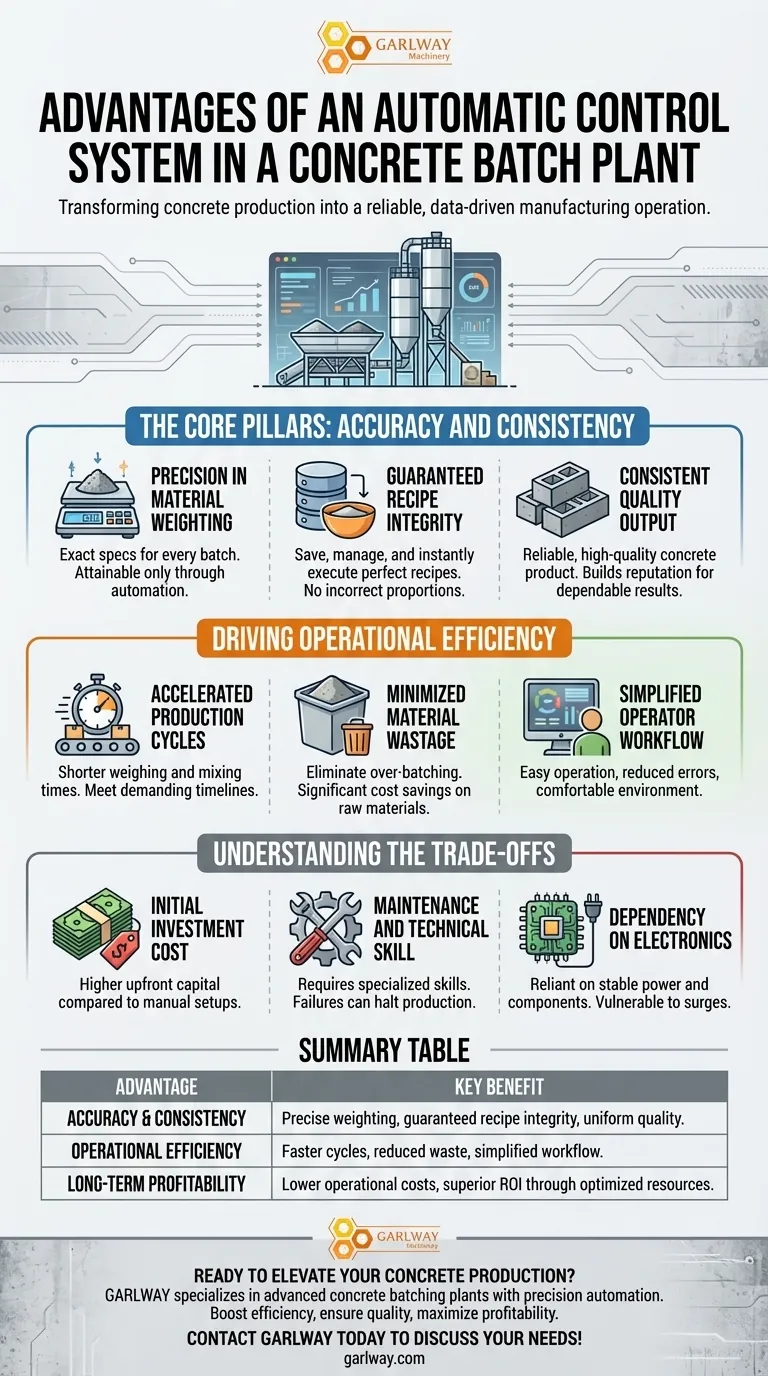
Precision in Material Weighting
An automated weight system provides a level of accuracy that is simply unattainable through manual methods.
This system ensures the precise amount of cement, aggregates, and water is used for every single batch, leading to a consistent mix.
Guaranteed Recipe Integrity
The control system allows for saving, managing, and instantly recalling specific mix design recipes.
Operators can select a stored recipe, and the PLC executes the batching process perfectly, eliminating the risk of incorrect proportions. This also allows for printing reports for quality control and client records.
Consistent Quality Output
By combining precise weighting with flawless recipe execution, the system guarantees a consistently high-quality concrete product.
This reliability is critical for meeting project specifications and building a reputation for dependable results.
Driving Operational Efficiency
Beyond quality, automation streamlines the entire production workflow, leading to tangible gains in speed and cost-effectiveness.
Accelerated Production Cycles
Automated systems feature significantly shorter weighting and mixing times compared to manual intervention.
This ability to produce high-quality concrete quickly allows plants to meet demanding project timelines and complete construction tasks ahead of schedule.
Minimized Material Wastage
The high accuracy of the system directly translates to reduced waste.
By eliminating over-batching and ensuring every gram of material is accounted for, the plant saves significant costs on raw materials over time.
Simplified Operator Workflow
Modern control panels are designed for easy operation, reducing the cognitive load on the operator.
This simplifies training, minimizes the chance of operational errors, and creates a more comfortable and efficient work environment.
Understanding the Trade-offs
While the benefits are substantial, it's important to view automation within a complete business context. A fully automatic system is not a universal solution without its own set of considerations.
Initial Investment Cost
The primary barrier to entry is the higher upfront capital investment required for an automated plant compared to a manual or semi-automatic setup.
Maintenance and Technical Skill
These sophisticated systems require specialized maintenance and troubleshooting skills. A system failure can halt all production if the necessary technical expertise is not available on-site.
Dependency on Electronics
The plant becomes reliant on the stability of its electronic components and a consistent power supply. Power surges or electronic failures can be a significant point of vulnerability.
Making the Right Choice for Your Operation
The decision to invest in an automatic control system should be aligned directly with your primary business goals.
- If your primary focus is high-volume production and strict quality assurance: An automatic system is non-negotiable for achieving the necessary consistency and throughput.
- If your primary focus is large-scale project delivery with tight deadlines: The speed and efficiency gains from automation are essential for meeting schedules and avoiding penalties.
- If your primary focus is maximizing long-term profitability: The reduction in material waste and optimized labor provided by an automatic system delivers a superior return on investment over the life of the plant.
Ultimately, adopting an automatic control system elevates your plant from a simple production site to a precise and highly predictable manufacturing asset.
Summary Table:
| Advantage | Key Benefit |
|---|---|
| Accuracy & Consistency | Precise material weighting and guaranteed recipe integrity for uniform concrete quality. |
| Operational Efficiency | Faster production cycles, reduced material waste, and simplified operator workflow. |
| Long-Term Profitability | Lower operational costs and superior ROI through optimized resource use and reduced errors. |
Ready to elevate your concrete production with a reliable automatic control system?
GARLWAY specializes in construction machinery, offering advanced concrete batching plants with precision automation for construction companies and contractors globally. Our systems are designed to boost your efficiency, ensure consistent quality, and maximize your profitability.
Contact GARLWAY today to discuss how our solutions can meet your specific project needs!
Visual Guide
Related Products
- HZS35 Small Cement Concrete Mixing Batch Plant
- HZS120 Ready Mix Concrete Batching Plant Commercial Mud Cement Mixer
- HZS75 Concrete Batching Plant Cement Mixer Price Concrete Mixer Bunnings Mixing Plant
- HZS180 Ready Mix Concrete Plant for Foundations with Sand and Cement
- Commercial Electric Concrete Mixer Machine HZS 50 Small Batch Plant for Sale
People Also Ask
- Why buy concrete batch plant parts only from the manufacturer? Protect Your Investment and Maximize Uptime
- Why is proper maintenance important for a concrete batch mix plant? Maximize Uptime & Profitability
- What is the advantage of a mobile concrete batching plant? Achieve On-Site Production & Total Control
- What are the advantages and disadvantages of concrete batching plants? Maximize Quality & Efficiency
- What are the two methods of material charging in a concrete mixing station? Single vs. Multiple Charging Explained





