In the defense sector, winches are mission-critical tools used for tactical vehicle recovery, aerial logistics and deployment, and supply chain management. They are integrated into everything from light off-road vehicles navigating difficult terrain to helicopters delivering heavy supplies to otherwise inaccessible locations.
A winch is far more than a simple pulling device; in a military context, it is a fundamental enabler of mobility, logistics, and operational readiness, ensuring that personnel and equipment can function effectively in the most demanding environments.
The Core Functions: Enabling Mobility and Logistics
At its heart, a winch multiplies force to pull or lift heavy loads. In defense, this simple capability is leveraged to solve complex operational challenges, primarily centered on keeping units mobile and well-supplied.
Tactical Vehicle Recovery
Military operations often occur in extreme terrain where vehicles can easily become mired in mud, sand, or snow.
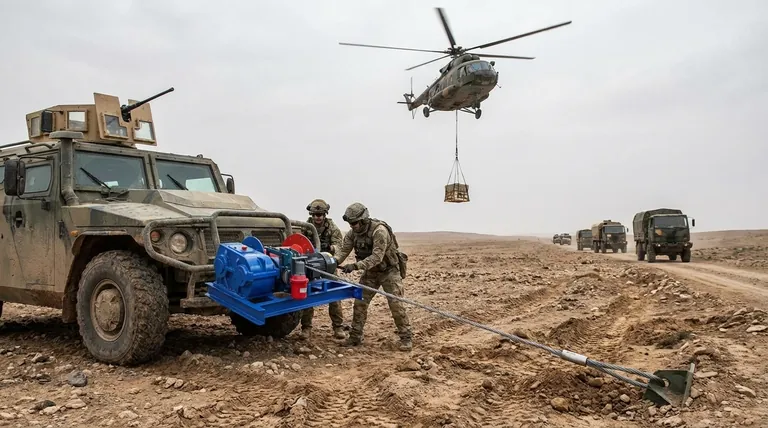
Small-to-medium-sized electric winches are standard equipment on many tactical off-road vehicles. They allow a vehicle to pull itself—or another vehicle—free from an obstacle without relying on a dedicated recovery truck.
This self-recovery capability is critical for maintaining patrol momentum and preventing soldiers from being stranded in vulnerable or hostile conditions.
Aerial Deployment and Resupply
Helicopters and other aircraft are essential for moving assets quickly, and winches extend their logistical reach significantly.
Heavy-duty winches, often called hoists, are mounted on aircraft to lower and lift heavy cargo. This includes supplies, ammunition, and even light vehicles that need to be delivered to locations without a viable landing zone.
This function is vital for resupplying forward operating bases, special operations teams, or conducting personnel recovery missions.
Base and Warehouse Operations
Behind the front lines, the defense supply chain relies on the efficient movement of massive quantities of materiel.
Within defense warehouses and logistical hubs, industrial winches are used to safely manage and position heavy pallets, engine components, and other critical supplies, streamlining the process of loading and unloading transport vehicles.
Specialized Winch Types in Defense Applications
The type of winch deployed is dictated by the specific mission requirements, from the power source to the internal gear mechanism.
Electric Winches for Field Mobility
Electric winches are the most common type found on tactical vehicles. They are valued for their relative simplicity and ability to run directly off the vehicle's electrical system.
Hydraulic and Air Winches for Heavy-Duty Tasks
For recovering heavy armored vehicles or for use in marine environments, hydraulic or air-powered winches are often employed. Hydraulic systems can generate immense pulling force, while air winches are intrinsically safe for use near flammable materials.
Worm Gear vs. Planetary Systems
The internal gearing determines how a winch operates. Worm gear winches offer exceptional load-holding capability and act as a natural brake, which is a critical safety feature. Planetary gear winches are more compact, lighter, and more efficient, making them ideal for vehicle applications where space and weight are concerns.
Understanding the Operational Trade-offs
While indispensable, relying on winches introduces specific dependencies and risks that must be managed.
Power Source Dependency
A winch is useless without a reliable power source. An electric winch can drain a vehicle's battery quickly, while a hydraulic winch requires the engine to be running, which may not always be possible or tactically wise.
Maintenance and Reliability
Winches are mechanical systems placed under extreme stress. Cables can fray and snap, and motors can fail. A lack of rigorous, preventative maintenance can lead to equipment failure at the most critical moment.
Weight and Size Constraints
There is a direct trade-off between a winch's power and its weight. Equipping a light vehicle with a winch powerful enough to be effective adds significant weight, which can impact fuel efficiency and overall maneuverability.
Making the Right Choice for the Mission
The selection of a winch system is a tactical decision based on the specific operational goal.
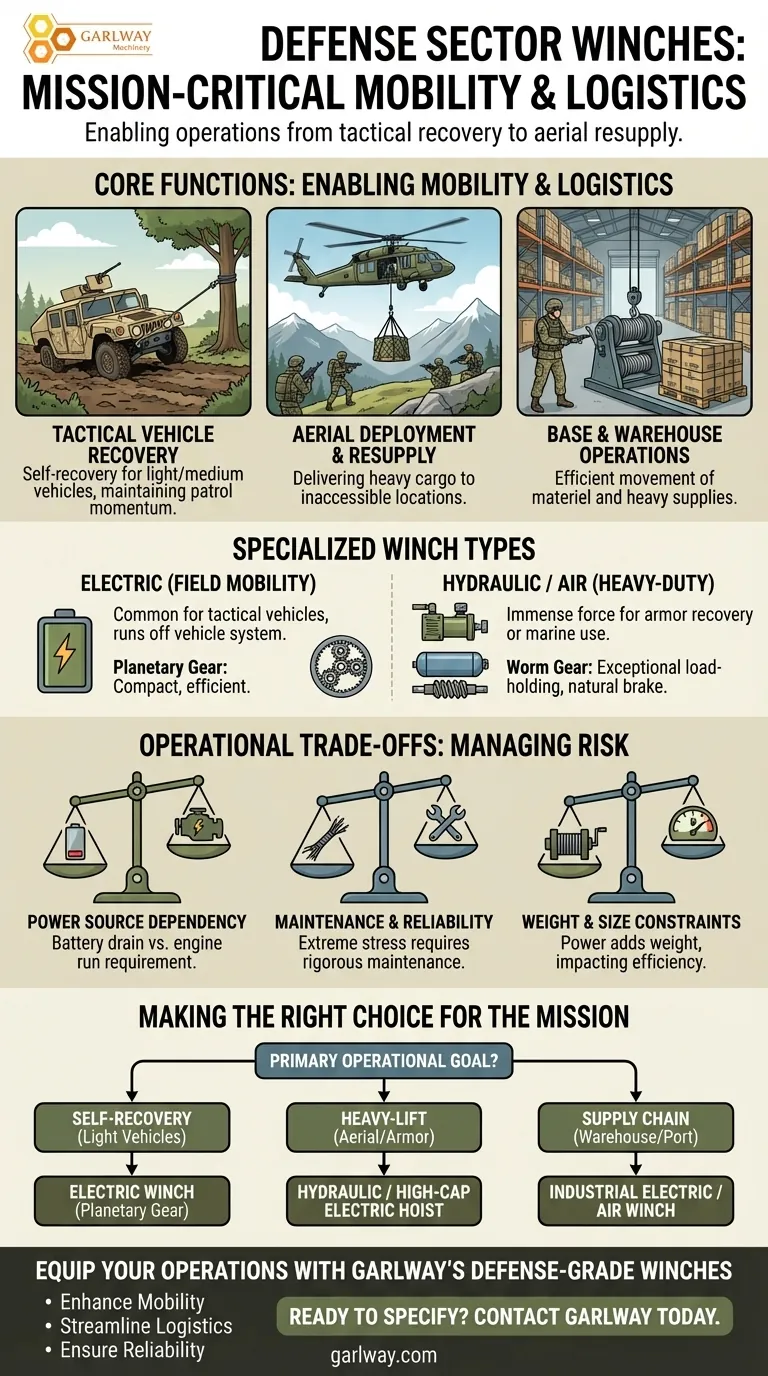
- If your primary focus is individual vehicle self-recovery: A correctly sized electric winch with a planetary gear system is the standard, offering the best balance of performance, weight, and simplicity.
- If your primary focus is heavy-lift logistics and aircraft operations: Specialized hydraulic or high-capacity electric hoists engineered for aviation standards are the only acceptable choice.
- If your primary focus is supply chain management in a controlled environment: Standard industrial electric or air winches provide the necessary power and reliability for warehouse and port operations.
Ultimately, this simple machine acts as a powerful force multiplier, directly contributing to mission success.
Summary Table:
| Application | Key Function | Common Winch Type |
|---|---|---|
| Tactical Vehicle Recovery | Self-recovery from mud, sand, or obstacles | Electric Winch (Planetary Gear) |
| Aerial Deployment & Resupply | Lowering/lifting cargo from helicopters | Heavy-Duty Hydraulic/Electric Hoist |
| Base & Warehouse Operations | Moving heavy pallets and supplies | Industrial Electric/Air Winch |
| Heavy Armor Recovery | Recovering large armored vehicles | High-Capacity Hydraulic Winch |
Equip Your Operations with GARLWAY's Defense-Grade Winches
From rugged electric winches for tactical vehicles to powerful hydraulic systems for heavy-lift logistics, GARLWAY provides the reliable, mission-critical equipment that defense contractors and construction companies doing defense work depend on.
We help you:
- Enhance Mobility: Keep your vehicles operational in the most demanding terrain.
- Streamline Logistics: Ensure efficient and safe aerial and ground resupply.
- Ensure Reliability: Benefit from durable winches built for extreme conditions.
Ready to specify the right winch for your mission's unique requirements?
Contact GARLWAY today to discuss your specific needs for construction machinery, including winches, concrete mixers, and batching plants, and let our experts provide a solution that ensures your operational success.
Visual Guide
Related Products
- Warn Winch Windlass Boat Trailer Winch
- Electric and Hydraulic Winch for Heavy Duty Applications
- Small Electric Winch 120V and 240V for Compact Applications
- Quick Windlass Portable Winch for Truck and Boat Best Boat Winch
- Hydraulic Winding Engine Harbor Freight Winch
People Also Ask
- What are the main components of a boat trailer winch? A Guide to Safe & Efficient Boat Loading
- What factors should be considered when choosing a boat trailer winch? Ensure Safe and Effortless Boat Loading
- What is the purpose of boat trailer winches? Safely and Efficiently Load Your Boat
- What are the two main types of boat trailer winches? Manual vs. Electric Explained
- How often should a boat trailer winch be replaced? Your Guide to Safety and Longevity