
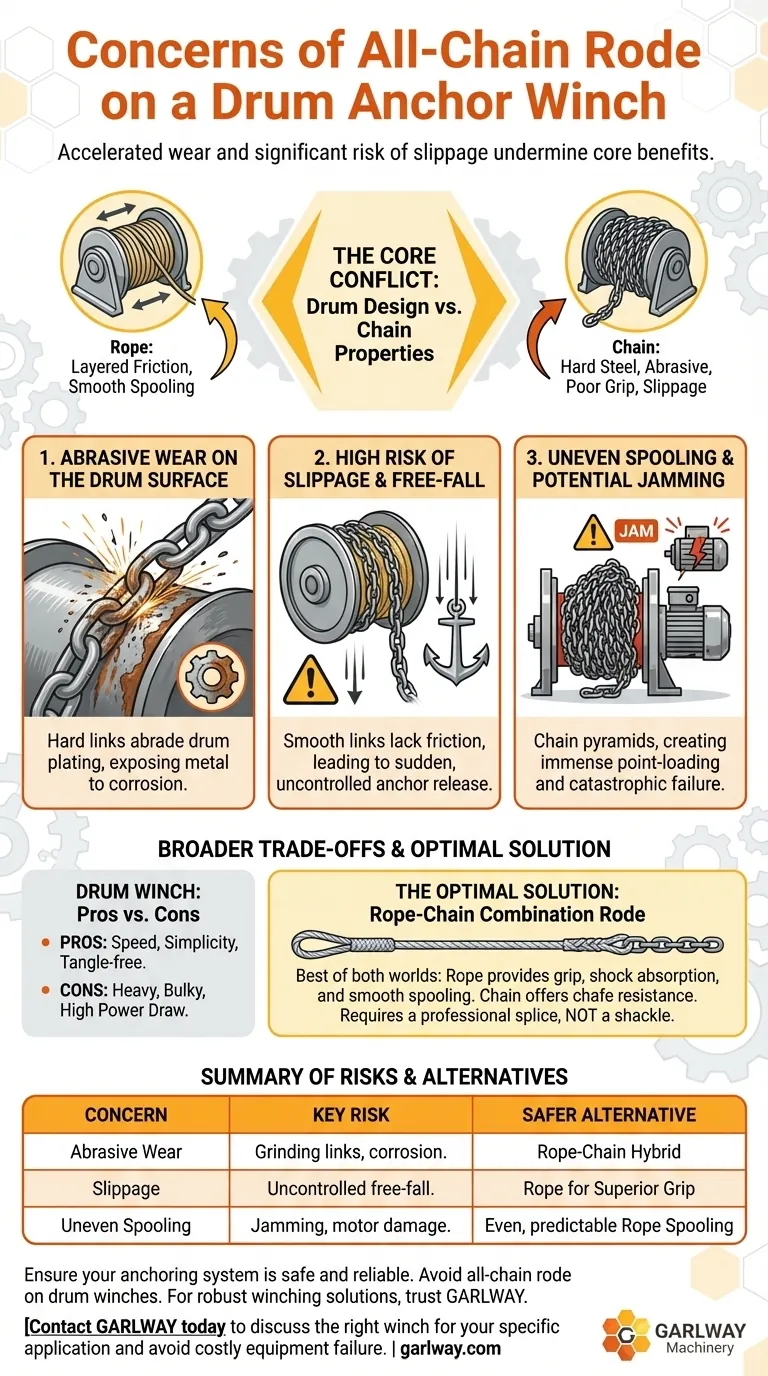
The primary concerns with using an all-chain rode on a drum anchor winch are accelerated wear of the winch drum and the significant risk of the chain slipping. The hard steel links abrade the drum's surface, often removing protective plating, while the chain's inability to grip itself can lead to a loss of friction and potential anchor free-fall.
While drum winches offer exceptional speed and tangle-free operation, their design is fundamentally optimized for rope. Using an all-chain rode introduces risks of equipment damage and anchoring failure that undermine the system's core benefits.

The Core Conflict: Drum Design vs. Chain Properties
Understanding why chain is problematic requires looking at the mechanics of how a drum winch operates. It relies on the layered friction of the rode coiling upon itself, a principle that works far better with rope than with chain.
Abrasive Wear on the Drum Surface
A drum winch is designed for the smooth, forgiving nature of nylon or synthetic rope. Chain, by contrast, is a series of hardened, articulating steel links.
As the chain is retrieved under load, these links grind against the drum's surface. This abrasive action can quickly wear through paint, galvanizing, or chrome plating, exposing the underlying metal to corrosion.
The High Risk of Slippage
A drum winch maintains its grip because the layers of rope press into and bind against each other. Rope has a high coefficient of friction and slightly compresses under load, creating a solid, non-slip spool.
Chain does not have this property. The smooth, hard surfaces of the links can easily slide or roll against each other, especially when there are only a few wraps left on the drum. This can cause a sudden, uncontrolled release of the anchor.
Uneven Spooling and Potential Jamming
Rope naturally coils evenly across the drum face. Chain is less predictable and can "pyramid" or bunch up in one area.
This uneven stack can create immense point-loading on the drum and, in a worst-case scenario, can jam against the winch housing, causing catastrophic failure of the motor or gearbox.
Understanding the Broader Trade-offs
The choice to use a drum winch involves more than just the anchor rode. It's a system with distinct advantages and disadvantages compared to a traditional vertical windlass.
The Advantage: Speed and Simplicity
The main appeal of a drum winch is its rapid, "free-fall" deployment and powered retrieval. There is no need to handle the rode, and it spools neatly without creating the "chain pyramid" common in a traditional anchor locker.
The Downside: Weight, Space, and Power
Drum winches are significantly heavier and bulkier than their windlass counterparts. A unit for a 35-foot boat might weigh 100 lbs, compared to 40 lbs for a vertical windlass.
They also have a very high power draw, often necessitating the installation of a dedicated, heavy-gauge wiring circuit and potentially an additional battery to handle the load. Installation requires considerable space and a reinforced mounting surface.
The Optimal Solution: The Rope-Chain Combination
For nearly all drum winch applications, the industry-standard solution is not all-rope or all-chain, but a hybrid rode.
How a Combination Rode Works
This setup consists of a long length of nylon anchor rope that makes up the bulk of the rode, which is then professionally spliced to a short length of chain (e.g., 10-20 feet) at the anchor end.
The Best of Both Worlds
This hybrid approach gives you the critical benefits of both materials. The chain provides excellent chafe and abrasion resistance against the seabed, while the long length of rope spools perfectly and safely on the drum, providing shock absorption in rough conditions.
The Critical Role of the Splice
The connection between the rope and chain must be a smooth, tapered, professional-grade splice. A bulky knot or shackle will not feed evenly onto the drum and will almost certainly cause a dangerous jam during retrieval.
Making the Right Choice for Your Anchoring Style
Ultimately, your choice of anchoring system should be dictated by your specific needs and type of boating.
- If your primary focus is offshore cruising or anchoring in severe conditions: A traditional windlass with an all-chain rode offers the most robust and proven solution for maximum holding power.
- If your primary focus is convenience and speed for coastal fishing or day trips: A drum winch with a professionally spliced rope-and-chain combination rode is the superior choice for its ease of use.
- If you are considering an all-chain rode for your drum winch: You should avoid this configuration unless the winch manufacturer explicitly states it is designed for it, as the risk of damage and failure is too high.
Matching your anchoring system to your vessel's intended use is the most effective way to ensure safety and reliability on the water.
Summary Table:
| Concern | Key Risk | Safer Alternative |
|---|---|---|
| Abrasive Wear | Chain links grind and remove drum plating, causing corrosion. | Use a rope-chain hybrid rode. |
| Slippage | Smooth chain links can slide, risking uncontrolled anchor free-fall. | Rope provides superior grip and friction on the drum. |
| Uneven Spooling/Jamming | Chain can pyramid and jam, potentially damaging the winch motor. | Rope spools evenly and predictably, preventing jams. |
Ensure your anchoring system is safe and reliable. The risks of using an all-chain rode on a drum winch are significant. For construction and marine projects requiring robust and dependable winching solutions, trust GARLWAY. We specialize in heavy-duty winches and machinery designed for performance and durability.
Contact GARLWAY today to discuss the right winch for your specific application and avoid costly equipment failure.
Visual Guide
Related Products
- Best 18000 Pound Drum Anchor Trailer Winch
- Heavy Duty Electric Boat Winch Windlass Anchor
- Electric Hoist Winch Boat Anchor Windlass for Marine Applications
- 12000 lb Electric Boat Trailer Winch with Windlass Anchor Warn
- Portable Small Trailer Winch
People Also Ask
- In what scenarios is a winch particularly useful for trailers? Load Heavy Items Safely & Efficiently
- How do you install a trailer winch? A Step-by-Step Guide for a Safe & Secure Setup
- What should be considered when mounting a winch on a trailer? Ensure a Safe, Aligned Installation
- What are the considerations for equipping a trailer with a winch for hauling a car? A Guide to Safe and Efficient Vehicle Loading
- What are the main types of trailer winches? Choose the Right Power Source for Your Load


