Choosing the right electric winch for a subsea project is a critical engineering decision that hinges on a systematic evaluation of the operational environment and performance requirements. The core considerations are the winch's ability to withstand harsh marine conditions, the precision of its control system, its long-term installation and maintenance needs, and most importantly, a rigorously calculated load capacity that includes a significant safety margin.
Selecting a subsea electric winch is not simply about matching a lift weight. It is about engineering a system for precision, durability, and safety in an environment where equipment failure carries severe consequences.
Deconstructing the Core Requirements
A successful deployment depends on a winch that is specified correctly from the outset. Each of the following areas must be carefully analyzed to prevent costly downtime and ensure operational safety.
Load Capacity and Safety Factor
The most critical specification is the winch's Safe Working Load (SWL). This is the maximum load the equipment can handle safely.
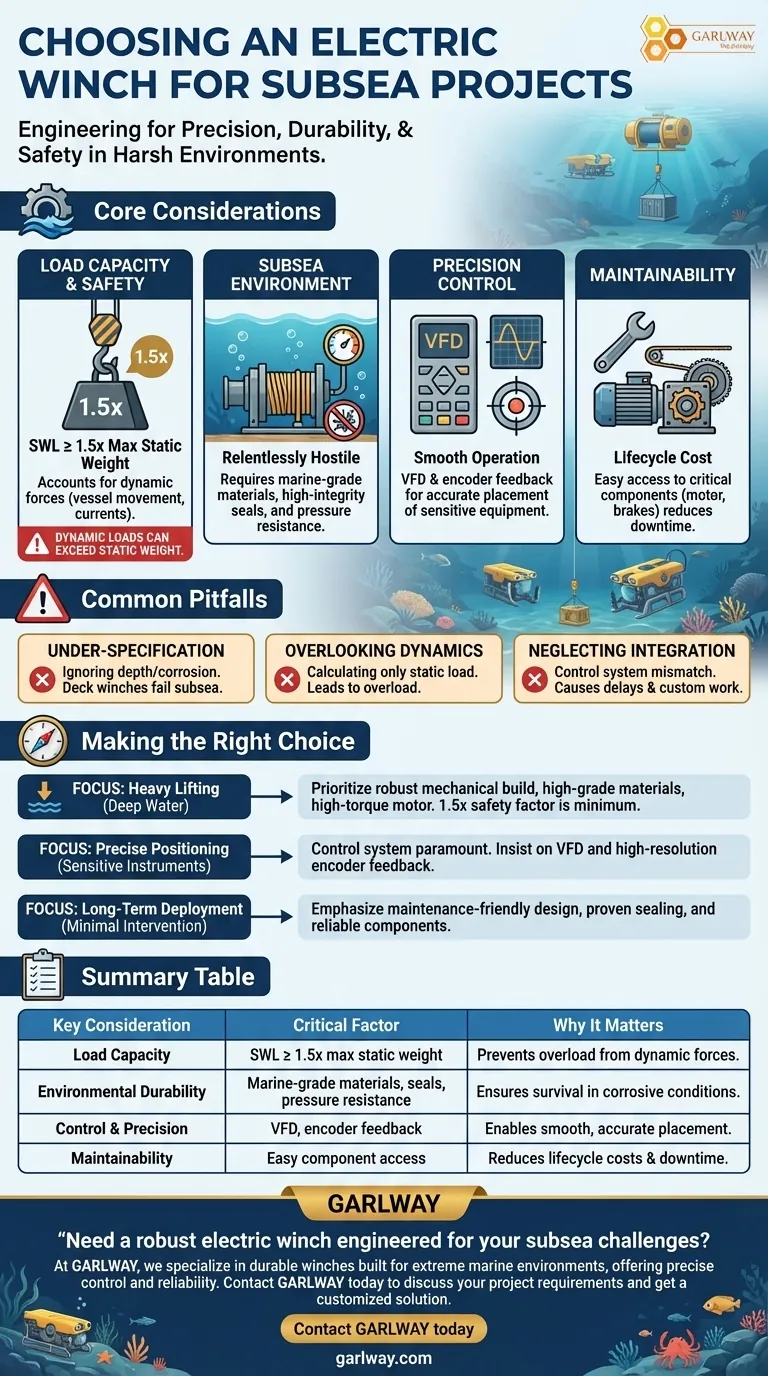
A fundamental rule is to select a winch with a capacity of at least 1.5 times the maximum static weight of the equipment being deployed. This safety factor is non-negotiable, as it accounts for dynamic forces, such as vessel movement, currents, and acceleration during lifting.
Surviving the Subsea Environment
The subsea environment is relentlessly hostile to mechanical and electrical systems. The winch's design and materials must be chosen to ensure its survival and long-term reliability.
Key considerations include material selection (e.g., marine-grade stainless steel or specialized coatings), the integrity of its seals to prevent water ingress, and its ability to function under immense hydrostatic pressure at depth.
Precision Control and Feedback
Modern subsea operations often require the precise placement of sensitive equipment. This demands a sophisticated control system.
The system should allow for variable speed control, often achieved with a Variable Frequency Drive (VFD), to ensure smooth starts and stops. For positioning tasks, feedback mechanisms like encoders are essential to provide the operator with real-time data on cable payout and position.
Installation and Long-Term Maintainability
The winch's entire lifecycle cost, not just its purchase price, must be considered. This includes the complexity of its installation on a vessel or platform.
Furthermore, a design that allows for straightforward inspection and maintenance is crucial. Ease of access to critical components like the motor, gearbox, and brake system can dramatically reduce downtime over the project's duration.
Understanding the Common Pitfalls
Choosing a winch solely based on its lift capacity or initial cost is a common mistake. A holistic view that acknowledges the inherent trade-offs is essential for a successful outcome.
Under-specification on Environmental Protection
Failing to properly specify the winch for the correct depth and corrosive environment is a primary cause of premature failure. A winch designed for a deck application will not survive long-term submersion.
Overlooking Dynamic Loads
Calculating load capacity based only on the static weight of the payload is a critical error. The dynamic forces exerted by vessel heave, pitch, and roll can easily exceed the static weight, leading to overload if the 1.5x safety factor is ignored.
Neglecting System Integration
The winch is part of a larger system. Its control interface must integrate seamlessly with the vessel's or ROV's primary control station. A failure to plan for this integration can lead to significant delays and costly custom development work.
Making the Right Choice for Your Project
Your final decision should be guided by the primary objective of your specific subsea operation.
- If your primary focus is heavy lifting in deep water: Prioritize a robust mechanical build with high-grade, corrosion-resistant materials and a high-torque motor, ensuring the 1.5x safety factor is treated as an absolute minimum.
- If your primary focus is the precise positioning of sensitive instruments: The control system is paramount. Insist on a winch with a VFD and high-resolution encoder feedback for superior accuracy and control.
- If your primary focus is long-term deployment with minimal intervention: Emphasize a maintenance-friendly design, proven sealing technology, and components with a documented history of reliability in extended subsea missions.
A successful subsea operation begins with a winch that is meticulously matched to its environment, its load, and its mission.
Summary Table:
| Key Consideration | Critical Factor | Why It Matters |
|---|---|---|
| Load Capacity | Safe Working Load (SWL) ≥ 1.5x max static weight | Accounts for dynamic forces like vessel movement and currents to prevent overload. |
| Environmental Durability | Marine-grade materials, high-integrity seals, pressure resistance | Ensures survival and reliability in harsh, corrosive subsea conditions. |
| Control & Precision | Variable Frequency Drive (VFD), encoder feedback | Enables smooth operation and accurate placement of sensitive equipment. |
| Maintainability | Easy access to motor, gearbox, and brakes | Reduces lifecycle costs and downtime over long-term deployments. |
Need a robust electric winch engineered for your subsea challenges?
At GARLWAY, we specialize in designing and manufacturing durable construction machinery, including high-performance winches, concrete mixers, and batching plants. Our winches are built to withstand extreme marine environments, offering precise control and reliable operation for construction companies and contractors worldwide.
Contact GARLWAY today to discuss your project requirements and get a customized solution that ensures safety and efficiency on your next subsea mission.
Visual Guide
Related Products
- Electric Hoist Winch Boat Anchor Windlass for Marine Applications
- Heavy Duty Electric Boat Winch Windlass Anchor
- Electric and Hydraulic Winch for Heavy Duty Applications
- Electric 120V Boat Winch by Badlands
- 12000 lb Electric Boat Trailer Winch with Windlass Anchor Warn
People Also Ask
- How does an electric anchor winch work? Power, Safety, and Reliable Operation Explained
- What are the advantages of installing an electric anchor winch on a boat? Boost Safety & Ease for Boaters
- What are the operational differences between electric hoists and winches? A Guide to Safe Lifting vs. Pulling
- What are the main benefits of a boat anchor winch? Boost Safety & Efficiency for Your Vessel
- How does a boat anchor winch work? A Guide to Reliable Anchor Handling