The Illusion of Brute Force
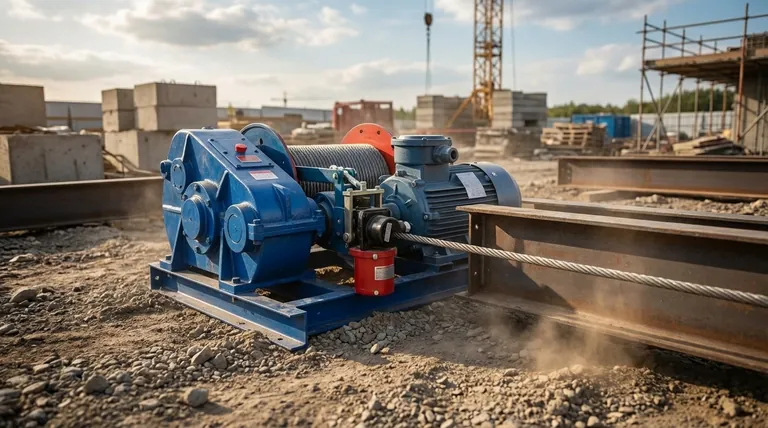
Picture a construction site. A massive steel I-beam, weighing several tons, hangs suspended, needing to be guided into place with millimeter precision. No amount of human muscle can perform this task. It’s a challenge not of strength, but of physics and control.
This is where our intuition about power often fails us. We see a heavy object move and assume the machine responsible is simply a more powerful version of ourselves. But the genius of a winch isn't brute force; it's the elegant conversion of one type of energy into another. It takes speed and masterfully trades it for strength.
The Anatomy of Controlled Power
To trust a machine with a task that is beyond human capability, you must first understand the principles that govern it. A winch is a beautiful system where each component has a singular, vital purpose in this energy conversion.
The Spark: The Power Source
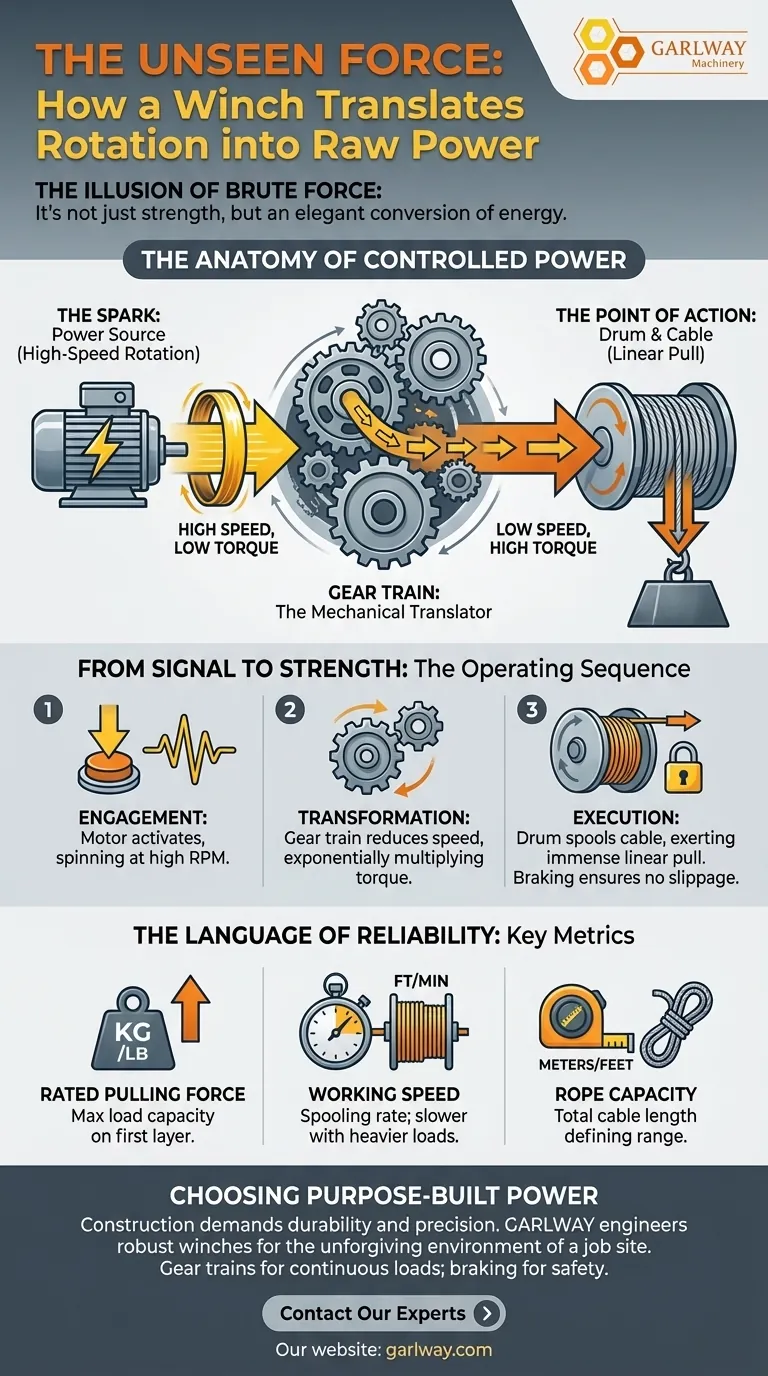
Every action begins with an initial impulse. In an electric winch, this is the motor—a device designed for high-speed rotation. Powered by a vehicle's battery or a dedicated AC source, its job is not to pull, but to spin. It provides the raw, untamed rotational energy that fuels the entire operation.
The Soul of the Machine: The Gear Train
This is the heart of the winch's power and the source of its mechanical magic. The motor spins incredibly fast, but with very little torque—the rotational equivalent of strength. The gear train, a precise series of interlocking gears, acts as a mechanical translator.
It takes the high-speed, low-torque input from the motor and transforms it into low-speed, high-torque output. This is the fundamental trade-off: sacrificing speed to multiply force. It's an act of pure mechanical leverage, a testament to engineering that allows a small motor to perform the work of giants.
The Point of Action: The Drum and Cable
The powerful, slow rotation from the gear train is transferred to the drum. This simple cylinder does the final work, winding the steel cable or synthetic rope. As the cable spools onto the drum, it becomes the tangible application of all the force generated within the machine—a direct, unwavering line of pull between the winch and its load.
From Signal to Strength: The Operating Sequence
When an operator presses a button, a precise and reliable sequence unfolds. Understanding this flow is key to appreciating the winch as a system of trust.
- Engagement: An electrical signal awakens the motor, which begins spinning at thousands of revolutions per minute.
- Transformation: This high-speed rotation immediately engages the gear train. Here, the speed is systematically reduced, and with each reduction, the torque is multiplied exponentially.
- Execution: The final gear transfers this slow, powerful rotation to the drum. The drum turns, spooling the cable and exerting a steady, immense linear pull on the load. A braking system often engages automatically, holding the load securely the moment the motor stops, ensuring there is no slippage.
This isn't a chaotic jolt of power; it's a controlled, predictable application of force.
The Language of Reliability: Key Metrics
The capabilities of a winch are not abstract; they are defined by a clear set of metrics. For a project manager or contractor, these numbers are not just specifications—they are promises of performance and safety.
- Rated Pulling Force: The maximum load the winch can pull on the first layer of cable on the drum. This is the single most important measure of its capability.
- Working Speed: How fast the cable is spooled, usually measured in feet per minute. This speed is inversely related to the load; as the weight increases, the speed decreases.
- Rope Capacity: The total length of cable the drum can hold, defining the winch's maximum operational distance.
| Component | Function |
|---|---|
| Power Source | Provides initial high-speed rotational energy |
| Gear Train | Multiplies torque, converting speed into power |
| Drum | Spools the cable to execute the linear pull |
| Cable/Rope | The direct link to the object being moved |
Choosing Purpose-Built Power
Understanding these mechanics reveals a crucial insight: not all winches are created equal. The demands of a construction site—lifting pre-cast concrete panels, positioning structural steel, or moving heavy materials across uneven ground—require more than just a high pulling rating. They demand durability, precision, and unwavering reliability.
This is where specialized machinery becomes essential. Companies like GARLWAY, which focus on robust construction equipment, engineer their winches, mixers, and batching plants for the unforgiving environment of a job site. The gear trains are designed for continuous, heavy loads, and the braking systems are built for absolute safety.
Understanding this intricate dance of physics is the first step; equipping your team with a machine built for this reality is the next. For machinery designed to meet the rigorous demands of modern construction, Contact Our Experts.
Visual Guide
Related Products
- Warn Winch Windlass Boat Trailer Winch
- Electric and Hydraulic Winch for Heavy Duty Applications
- Small Electric Winch 120V and 240V for Compact Applications
- 12000 lb Electric Boat Trailer Winch with Windlass Anchor Warn
- Quick Windlass Portable Winch for Truck and Boat Best Boat Winch
Related Articles
- Beyond the Bumper: The Critical System Choice in Powering Your Trailer Winch
- Force vs. Mass: The Critical Difference in Sizing a Boat Winch
- Lines of Force: The Unseen Geometry of a Boat Winch
- More Than a Number: The Engineering Psychology of Choosing a Boat Winch
- How to Choose and Optimize Winch Speed for Maximum Efficiency