A Moment of Tension
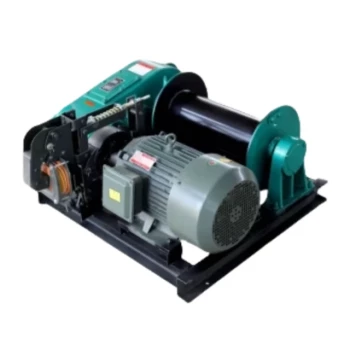
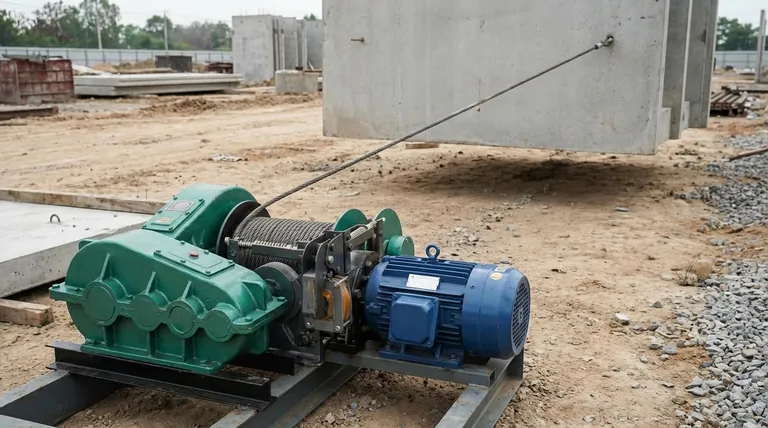
Imagine a precast concrete panel, weighing several tons, suspended a few feet off the ground. A construction crew is positioning it into place. The electric winch groans, pulling the immense weight inch by inch. Then, the operator stops.
In that moment of silence, all that stands between control and catastrophe is an unseen, uncelebrated component inside the winch drum.
This component is the brake. And the most dangerous thing about it is the profound misunderstanding of how it works. We assume it functions like the brake in our car—a tool for controlled deceleration. This assumption is intuitive, logical, and dangerously wrong.
The Elegant Fail-Safe
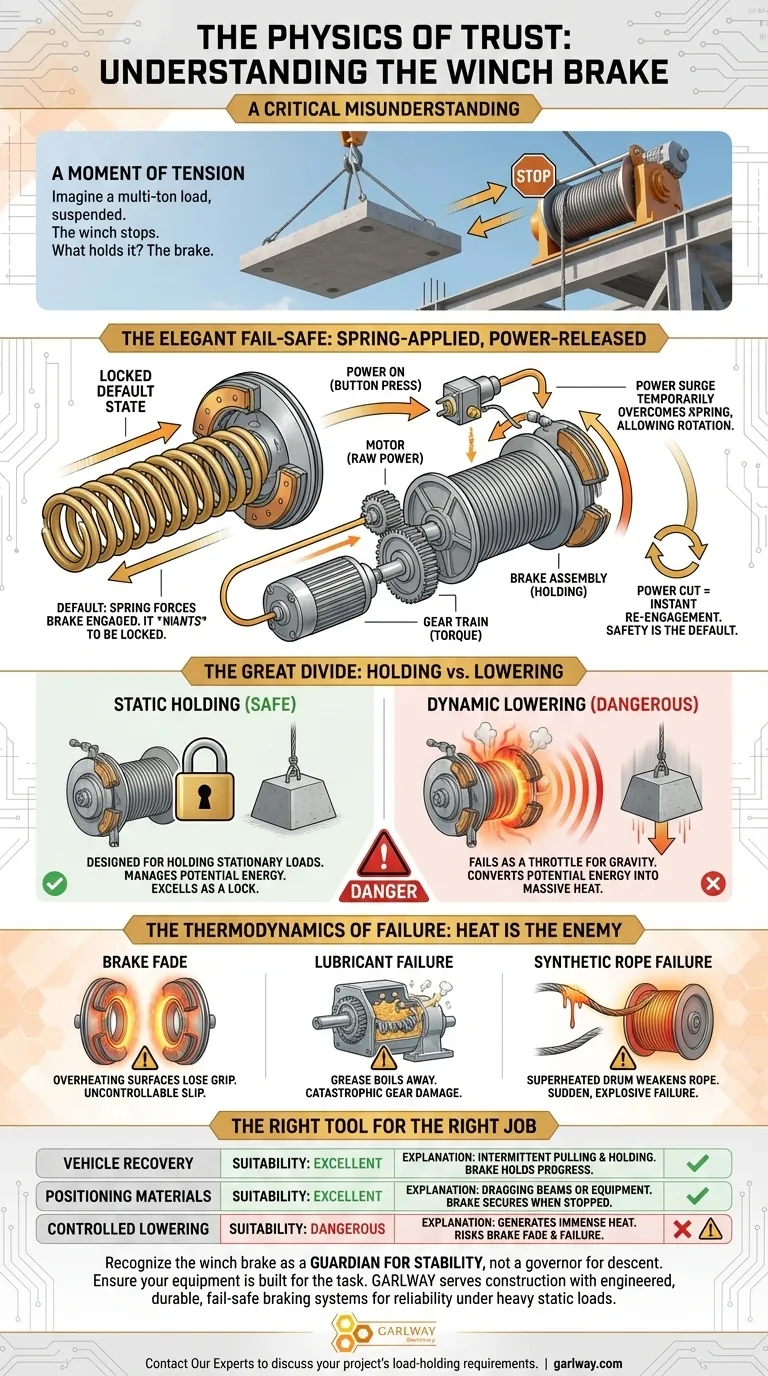
The genius of a standard electric winch brake lies in its default state. It is not a system you apply; it is a system you must actively override.
Engineers call this a spring-applied, power-released system.
Think of it this way: a powerful mechanical spring is constantly forcing the brake to be engaged, locking the winch drum solid. It wants to be locked. It is its natural, resting state. Only when you press the button on the controller, sending a surge of power to the motor, does that force temporarily overcome the spring, allowing the drum to turn.
The moment you lift your finger, power is cut, and the spring instantly, automatically, re-engages the brake. There is no delay, no decision. Safety is the default.
This simple, robust design is a small piece of engineering poetry. It works in concert with the system's other core components:
- The Motor: Provides the raw power.
- The Gear Train: Converts the motor's speed into immense pulling torque.
- The Drum: Houses the cable and, critically, the internal brake assembly.
Together, they form a system designed for one primary purpose: pulling and holding.
The Great Divide: Holding vs. Lowering
Here is the critical insight that separates safe operators from reckless ones: a winch brake is designed for static holding, not dynamic lowering.
It excels at being a lock, but it fails at being a throttle for gravity.
The Physics of Holding
When a winch brake is engaged, it's a simple matter of mechanical friction holding a stationary load. The force is immense, but the energy being managed is potential, not kinetic. It is designed to withstand the winch's full rated load in this state.
The Thermodynamics of Failure
The problem arises when an operator tries to "power out" a heavy load—like lowering that concrete panel or a heavy vehicle down a steep hill.
Doing this forces the brake to slip under immense resistance. This process doesn't just manage the load; it converts gravitational potential energy into a massive amount of heat directly inside the winch drum.
This heat is the enemy. It can cause:
- Brake Fade: The braking surfaces overheat and lose their ability to grip, just like worn-out brakes on a truck descending a mountain pass. The load can begin to slip uncontrollably.
- Lubricant Failure: The grease inside the gearbox can boil away, leading to catastrophic gear damage.
- Synthetic Rope Failure: This is the most insidious danger. Synthetic winch ropes, prized for their strength and low weight, have a relatively low melting point. A drum superheated by the brake can weaken the rope from the inside out, leading to a sudden, explosive failure with no visible warning.
You aren't lowering a load; you are cooking your safety system from the inside out.
The Right Tool for the Right Job
Understanding this limitation is not about seeing the winch as flawed; it's about seeing it as a specialized tool and respecting its design. Your operational goal should determine your choice of equipment.
| Task Scenario | Winch Brake Suitability | Explanation |
|---|---|---|
| Vehicle Recovery | Excellent | Involves intermittent pulling and holding. The brake is used as intended: to hold progress between pulls. |
| Positioning Materials | Excellent | Dragging beams or equipment across a job site. The brake securely holds the item when the motor stops. |
| Controlled Lowering | Dangerous | Using the winch to lower a heavy load or as a hoist generates immense heat, risking brake fade and rope failure. |
For tasks involving intermittent, heavy pulling on a construction site—positioning steel, securing materials, or light vehicle recovery—a robust winch with a reliable automatic holding brake is essential. The integrity of that brake is a non-negotiable part of the safety chain.
That is why equipment from specialists like GARLWAY, which serves construction companies and contractors, is engineered with durable, fail-safe braking systems. Their winches, concrete mixers, and batching plants are built for environments where reliability under heavy static loads is the primary concern.
Recognizing the winch brake not as a governor for descent but as a guardian for stability is the foundation of safe operation. It's the difference between leveraging a powerful tool and creating a liability. For projects that depend on this unwavering holding power, ensure your equipment is built for the task.
Contact Our Experts to discuss the specific load-holding requirements of your next project.
Visual Guide
Related Products
- Portable Small Trailer Winch
- Quick Windlass Portable Winch for Truck and Boat Best Boat Winch
- Small Electric Winch 120V and 240V for Compact Applications
- Electric and Hydraulic Winch for Heavy Duty Applications
- Electric 120V Boat Winch by Badlands
Related Articles
- Beyond the Bumper: The Critical System Choice in Powering Your Trailer Winch
- The Calculated Pull: A Systems Approach to Winch Selection
- How Quick Winch Rope Speed Transforms Industrial Efficiency
- How to Match Winch Specifications to Your Operational Needs
- The Gravity of the Situation: Why Vehicle Weight is the Least of Your Winch's Worries