The Silence on the Job Site
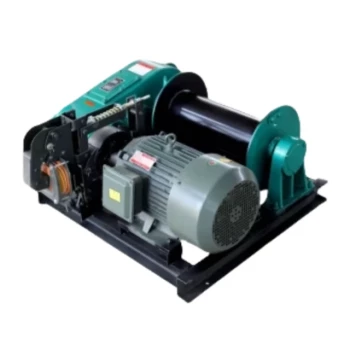
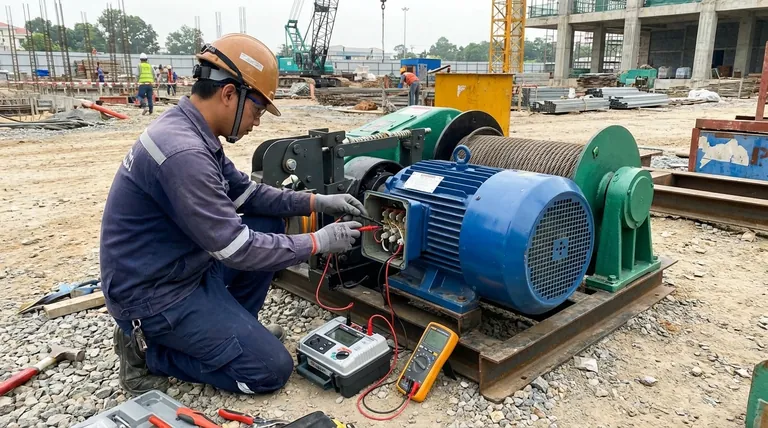
A construction winch, tasked with lifting a critical load, suddenly goes silent. The motor hums, then trips its breaker. The entire workflow on a multi-story project grinds to a halt.
In this moment, a dozen assumptions are born. Is it the power supply? The variable frequency drive (VFD)? Did the load jam? Or is it the motor itself—the very heart of the machine?
The cost of downtime is measured in minutes and dollars. But the cost of a wrong diagnosis—needlessly replacing a perfectly healthy motor or, worse, putting a faulty one back into service—is far greater. The challenge isn't just technical; it's psychological. It's a battle against uncertainty.
Overcoming Diagnostic Bias
Our minds seek simple answers. The easiest target is often the most visible or complex component: the motor. We are biased toward action, and swapping the motor feels like progress.
But a systematic approach replaces assumption with certainty. A healthy motor has a distinct electrical "heartbeat" defined by two fundamental properties: perfect electrical isolation from its casing and perfectly balanced pathways for current to flow within.
By testing these two properties, we can move from guessing to knowing.
The Two Pillars of Motor Health
We can get a complete picture of a motor's electrical condition with two straightforward, yet powerful, tests.
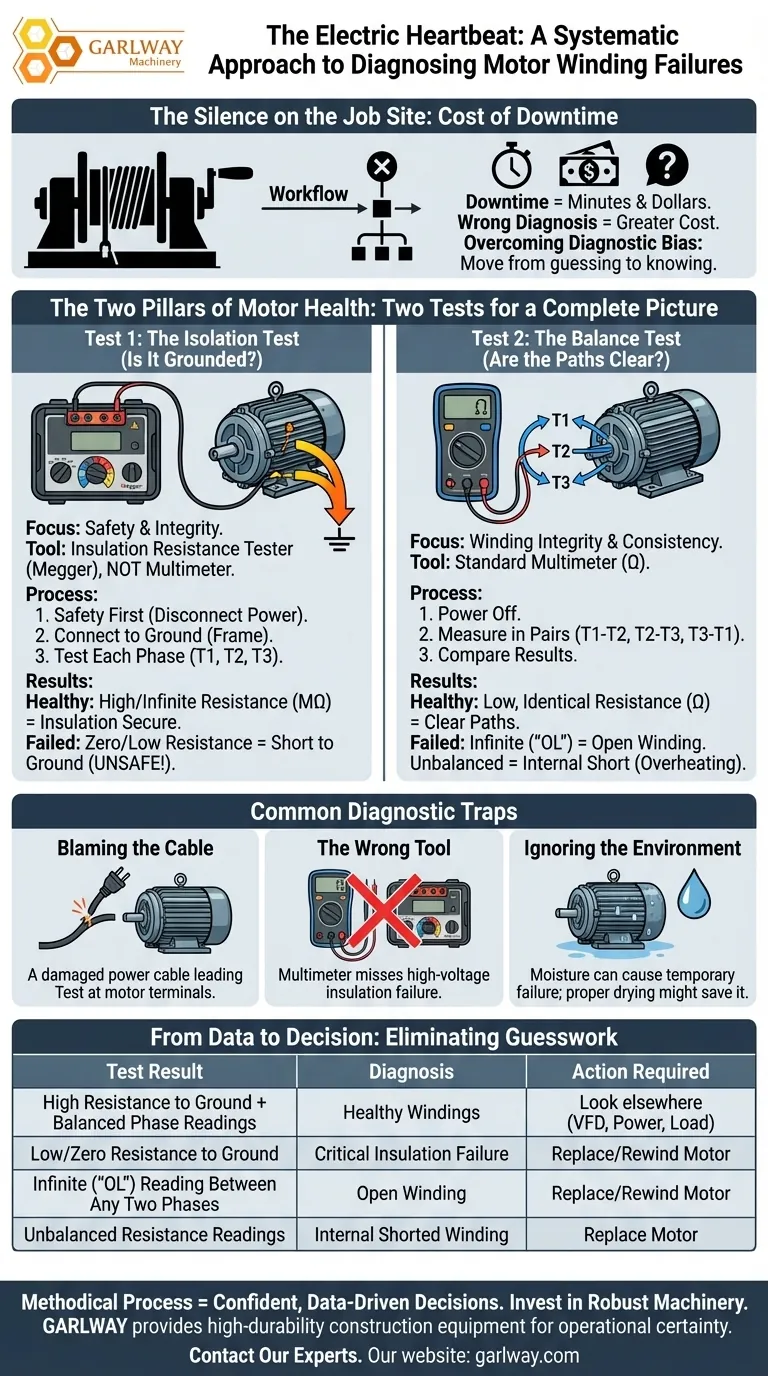
Test 1: The Isolation Test (Is It Grounded?)
This is the single most important test for safety and integrity. It answers one question: Has the insulation protecting the copper windings broken down, allowing electricity to leak to the motor's metal frame?
This is called a short to ground, and it's a critical failure.
Your tool for this job should be an insulation resistance tester (often called a Megger), not a standard multimeter. A multimeter uses a low voltage that can be fooled by weakened insulation. A Megger uses a higher voltage to truly stress the system and reveal its flaws.
The Process:
- Safety First: Completely disconnect all power to the motor.
- Connect to Ground: Attach one lead of the tester to an unpainted part of the motor's frame.
- Test Each Phase: Connect the other lead sequentially to each motor wire (T1, T2, T3), running the test for each one.
- A Healthy Motor: Shows an extremely high, or near-infinite, resistance reading (measured in megohms, MΩ). This means the insulation is doing its job, keeping the electricity contained.
- A Failed Motor: Shows a zero or very low resistance reading. This is a clear signal that current has a direct path to the ground. The motor is unsafe and unusable.
Test 2: The Balance Test (Are the Paths Clear?)
This test looks inside the windings themselves. It checks for the integrity of the copper wires, ensuring there are no breaks or internal shorts. For a three-phase motor to run smoothly, all three windings must be electrically identical.
A standard multimeter set to measure resistance (Ω) is the perfect tool here.
The Process:
- Power Off: Ensure the motor remains completely disconnected.
- Measure in Pairs: Check the resistance between T1-to-T2, T2-to-T3, and T3-to-T1.
- Compare the Results: The absolute number is less important than the consistency between the three readings.
- A Healthy Motor: The three resistance values will be very low (often under 1 Ω) and, crucially, almost identical to each other.
- A Failed Motor: An infinite reading ("OL") indicates a broken or open winding. A reading that is significantly different from the other two points to an internal short, which will cause overheating and eventual failure.
Common Diagnostic Traps
Confidence in a diagnosis comes from avoiding common pitfalls.
Blaming the Motor for the Cable's Sins
A failed test at the control cabinet doesn't automatically condemn the motor. The power cable itself can fail. Always perform these tests directly at the motor terminals to isolate the problem. This simple step prevents the costly mistake of replacing a good motor due to a bad cable.
The Overconfidence in a Simple Tool
Using a multimeter for the ground test is a common error. It might detect a dead short, but it will miss compromised insulation that only fails under the higher voltage of a proper insulation tester. Using the right tool isn't about preference; it's about asking the right question.
Ignoring the Environment
Moisture is the arch-enemy of insulation. A motor that fails a ground test after sitting in a damp environment may not be permanently damaged. In some cases, a proper drying procedure in a controlled oven can restore the insulation and save the motor from the scrap heap.
From Data to Decision
Your test results create a clear path forward, eliminating guesswork.
| Test Result | Diagnosis | Action Required |
|---|---|---|
| High Resistance to Ground + Balanced Phase Readings | Motor windings are healthy. | Look elsewhere: VFD, power supply, or mechanical load. |
| Low or Zero Resistance to Ground | Critical insulation failure (short to ground). | Replace or professionally rewind the motor. |
| Infinite ("OL") Reading Between Any Two Phases | Open winding. | Replace or rewind the motor. |
| Unbalanced Resistance Readings Between Phases | Internal shorted winding. | Replace the motor to prevent further damage. |
This methodical process transforms a moment of high-stress uncertainty into a confident, data-driven decision. It ensures that when a critical piece of equipment like a winch, concrete mixer, or batching plant goes down, the right repair is made the first time.
Ultimately, the best strategy is to minimize these failures from the start by investing in robust, reliable machinery built for demanding environments. GARLWAY provides high-durability construction equipment designed to offer the operational certainty that contractors depend on worldwide.
If frequent equipment failures are compromising your project timelines, it may be time to upgrade your foundation. Contact Our Experts
Visual Guide
Related Products
- Hydraulic Winding Engine Harbor Freight Winch
- Electric Hoist Winch Boat Anchor Windlass for Marine Applications
- Quick Windlass Portable Winch for Truck and Boat Best Boat Winch
- 12000 lb Electric Boat Trailer Winch with Windlass Anchor Warn
- Portable Small Trailer Winch
Related Articles
- How to Extend Hydraulic Winch Lifespan with Preventive Maintenance and OEM Parts
- Hydraulic Winches: When Heavy-Duty Power Justifies the Investment
- How to Choose the Right Winch for Your Industry’s Demands
- The Physics of Trust: Why a Winch Is Never 'Just a Winch'
- How to Match Winch Specifications to Your Operational Needs