The Heartbeat of the Plant Goes Silent
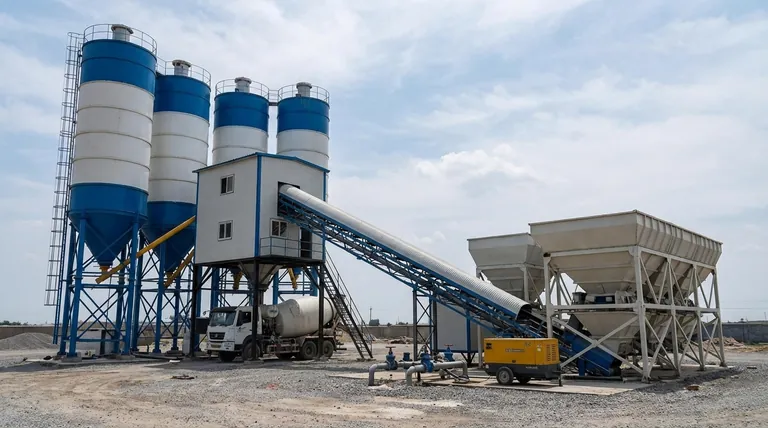
A concrete truck is waiting, its drum slowly turning. The weigh hoppers are full. The control room is staffed. But the entire batching plant is eerily silent.
The cause isn't a catastrophic failure of the main mixer or a silo running empty. It's a small, overworked, and often ignored component: the air compressor.
In the complex ecosystem of a concrete plant, we have a psychological bias toward the big machinery. We focus on the massive mixers and towering silos. Yet, the humble air compressor acts as the plant's central nervous system. When it fails, the entire operation is paralyzed. Understanding its common failure points is not just about mechanical knowledge; it's about shifting your entire operational mindset from reactive panic to proactive control.
The Unseen Engine of Production
The air compressor doesn't move a single piece of aggregate. It doesn’t mix a pound of cement. Instead, it provides the pneumatic force that makes everything else happen. It is the invisible hand that orchestrates the entire production flow.
The Automation Powerhouse
Compressed air is what actuates the critical moving parts of your plant:
- Feeder Gates: It opens and closes the gates that release sand and gravel from the bins.
- Butterfly Valves: It controls the precise discharge of cement and water from the weigh hoppers.
- Discharge Gate: It operates the main gate on the mixer, releasing the finished concrete.
Without reliable air pressure, these components become sluggish, inconsistent, or cease to function entirely.
A Single Point of Failure
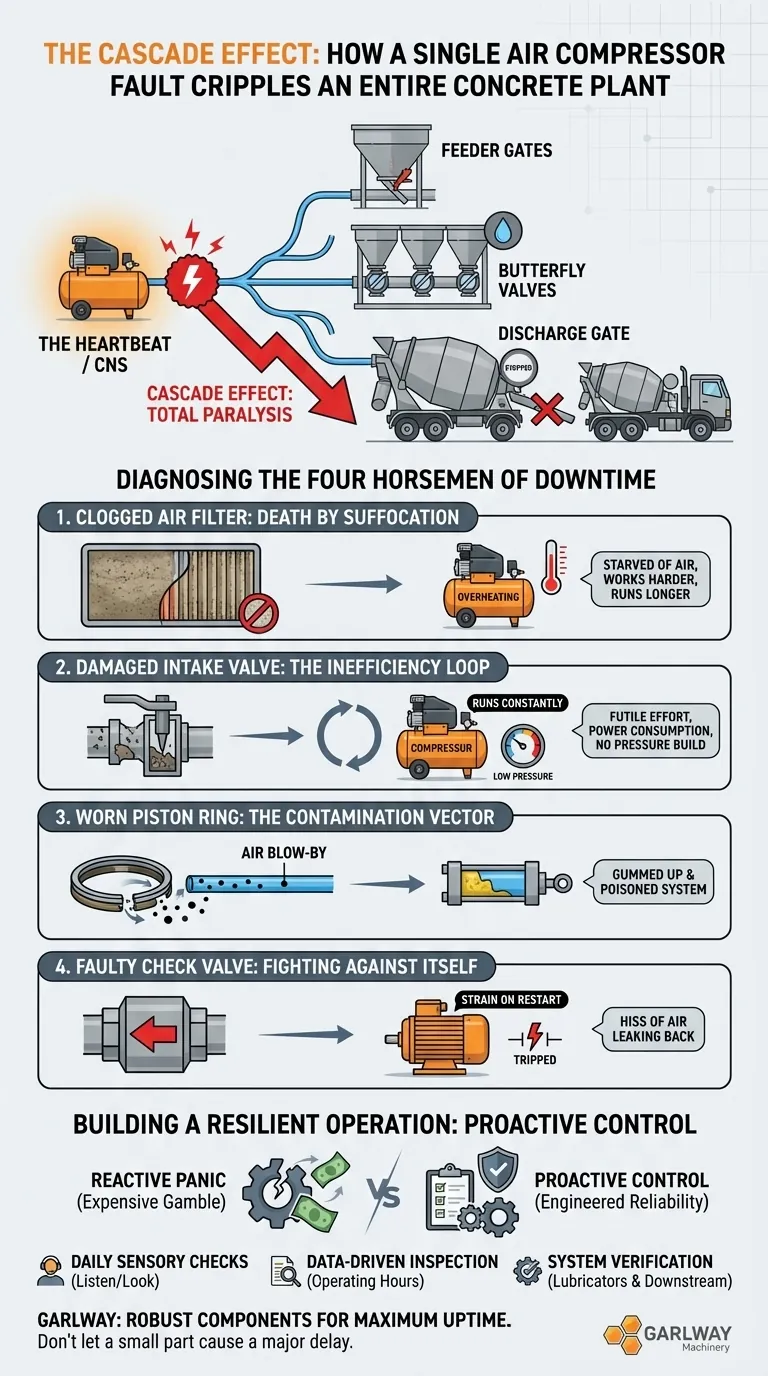
Because the compressor powers these disparate systems, its failure creates a cascade effect. A drop in pressure doesn't just slow one thing down; it brings the entire synchronized process to a dead stop. This transforms a minor mechanical issue into a major operational and financial crisis.
Diagnosing the Four Horsemen of Downtime
Most compressor failures are not mysterious. They can be traced to four high-wear components whose symptoms are a clear language, if you know how to listen.
1. The Clogged Air Filter: Death by Suffocation
This is the most common and preventable failure. A concrete plant is, by its nature, a dusty environment. This dust is the compressor's primary enemy.
A blocked filter literally starves the compressor of air. The unit is forced to work harder and run longer to generate the required pressure, leading to overheating and accelerated wear on every other internal part. It’s the first domino to fall.
2. The Damaged Intake Valve: The Inefficiency Loop
The intake valve is the gateway for air entering the compression cylinder. If debris gets past a clogged filter or metal fatigue sets in, the valve won't seal properly.
This creates a massive inefficiency. The compressor runs constantly, consuming power, but struggles to build pressure. It's like trying to inflate a tire with a leaky valve stem—a futile and ultimately destructive effort.
3. The Worn Piston Ring: The Contamination Vector
Piston rings are essential for sealing the compression chamber. As they wear, compressed air "blows by" the piston. The immediate symptom is a loss of performance. The far more dangerous symptom is oil in your air lines.
This oil is not just a sign of wear; it becomes a contaminant. It travels downstream, gumming up the sensitive pneumatic valves and cylinders that control your gates. The compressor begins to actively poison the very system it's meant to power.
4. The Faulty Check Valve: Fighting Against Itself
The check valve is a simple one-way gate. It stops the high-pressure air in the tank from flowing back into the compressor when it shuts off.
If this valve fails, the motor must try to restart against the tank's full pressure. This immense strain can trip thermal overloads or cause serious mechanical damage. You'll often hear a distinct hiss of air leaking back through the compressor after it stops—a clear warning sign.
The System is the Strategy
Fixating on the compressor unit alone is a classic cognitive trap. True reliability comes from managing the entire compressed air system.
Beyond the Compressor Unit
Many plants use an oil mist lubricator to protect downstream pneumatic components. This device itself can be a point of failure. A blocked nozzle or an air leak can stop it from atomizing oil, starving your gates and valves of lubrication. The compressor can be perfect, but if the system it supplies is seizing up, the result is the same: operational failure.
The Economics of Failure: Reactive vs. Proactive
Waiting for a component to break is the most expensive maintenance strategy possible.
The cost of a new air filter or valve plate is measured in tens or hundreds of dollars. The cost of a stalled concrete pour, with trucks waiting and a project schedule slipping, is measured in thousands. Reactive maintenance isn't a strategy; it's a gamble with terrible odds.
Building a Resilient Operation
Reliability is not an accident; it is engineered through process and quality components. Your maintenance approach should directly reflect your business goals.
- For Maximum Uptime: Implement daily sensory checks. Listen for air leaks. Look at the air filter.
- For Long-Term Cost Reduction: Follow a strict, data-driven inspection schedule for internal components based on operating hours.
- For Consistent Batch Quality: Regularly verify the entire system, including lubricators, to prevent the sluggish performance that ruins consistency.
Choosing robust machinery and components is the foundation of this strategy. At GARLWAY, we specialize in providing the high-performance winches, mixers, and batching plant components that construction leaders rely on to prevent these very failures. Don't let a ten-dollar filter cause a ten-thousand-dollar delay. Contact Our Experts
Visual Guide
Related Products
- Small Electric Winch 120V and 240V for Compact Applications
- Auto Concrete Cement Mixer Machine New
- HZS25 Best Cement Mixer for Quick Mix Concrete at Bunnings
- Construction Products Concrete Plant Machine Mixing Concrete Mixer
- HZS35 Small Cement Concrete Mixing Batch Plant
Related Articles
- How to Maximize Electrical Winch Performance in Challenging Environments
- How Electric Winch Safety Features Prevent Catastrophic Industrial Accidents
- How to Choose Between Manual and Electric Winches for Your Project
- How Electric Winches Solve Industrial Safety and Cost Challenges
- How Electric Winches’ Engineering Enhances Efficiency and Safety in Heavy-Duty Applications