The Psychology of Being Stuck
There's a unique feeling of helplessness when a multi-ton vehicle is completely immobilized. Wheels spin, mud flies, and the engine's roar only deepens the hole you're in. This moment is a battle not just against physics, but against a primal sense of losing control.
It is in this moment that the winch transforms from a piece of hardware into an instrument of order. It's a device that doesn't fight the chaos with more chaos; it imposes a calm, calculated, and overwhelming force.
The Elegant Physics of Force Multiplication
At its heart, a winch is a testament to the power of simple mechanics. It’s not about magic; it’s about converting one form of energy into another with astonishing efficiency.
From Rotation to Linear Power
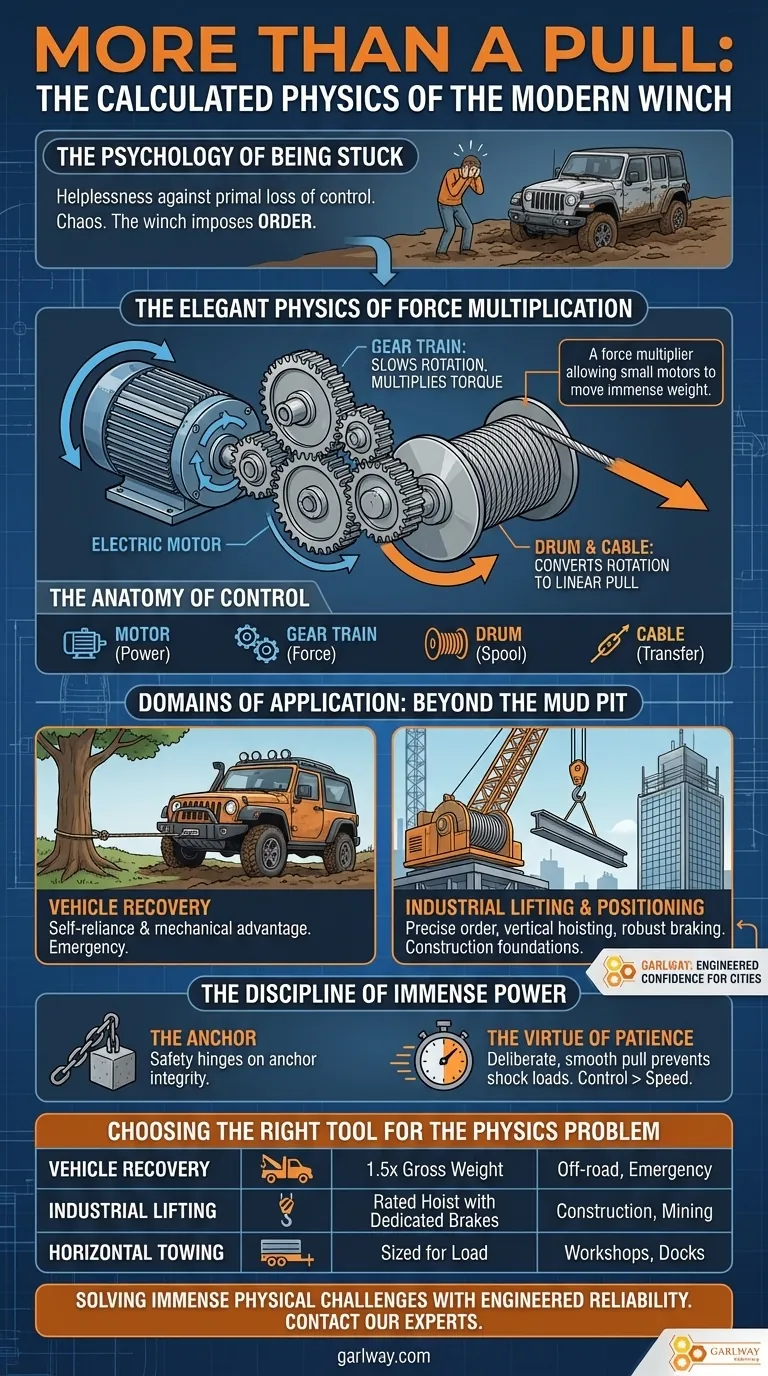
The core principle is simple: a motor's rotational energy is channeled through a gear train. This gearing slows the rotation down dramatically but, in doing so, multiplies its torque. This immense torque is then used to turn a drum.
As the drum spins, it spools a cable, converting the rotational force into a powerful, straight-line pull. This is the essence of the winch: a force multiplier that allows a small electric motor to move objects thousands of times its own weight.
The Anatomy of Control
This entire process is managed by a few key components working in concert:
- The Motor: Provides the initial electrical or hydraulic power.
- The Gear Train: The heart of force multiplication.
- The Drum: The spool that converts rotation into a pull.
- The Cable: The medium through which force is transferred, made of either steel wire or lighter, stronger synthetic rope.
This isn't a system of brute force. It's a system designed for precision.
Domains of Application: Beyond the Mud Pit
While its fame was born in the muddy trenches of off-roading, the winch's true impact is felt across industries where moving the immovable is a daily requirement.
The Classic Scenario: Vehicle Recovery
This is the winch's most famous role. A 4x4, anchored to a tree, pulling itself out of a seemingly impossible situation. It is a powerful demonstration of self-reliance and mechanical advantage.
The Industrial Backbone: Lifting and Positioning
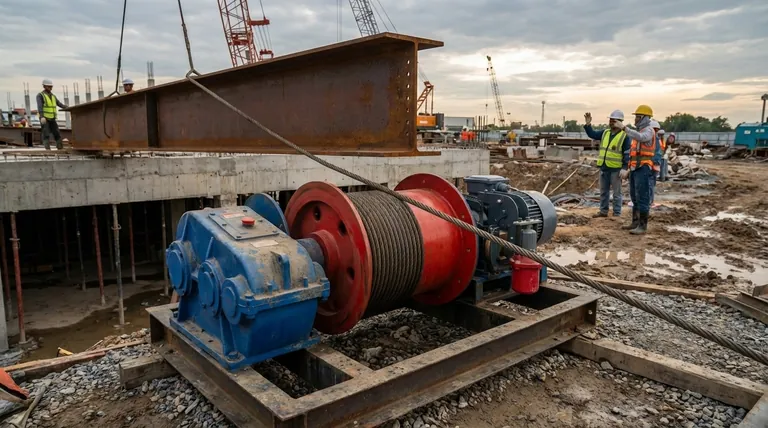
On a construction site, the challenges are different. The task isn't recovery from chaos, but the precise construction of order. Here, winches are the unsung heroes integrated into larger systems.
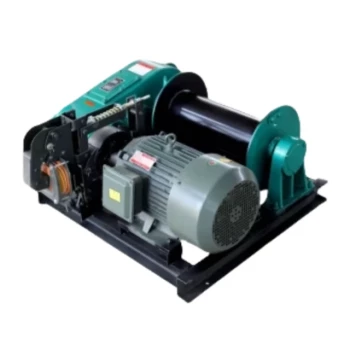
Imagine lifting a multi-ton steel I-beam to the tenth floor of a skyscraper or perfectly positioning a prefabricated concrete module. This isn't just "pulling." This is vertical hoisting, an application that demands different engineering, specifically robust braking systems that prevent catastrophic failure if power is lost. These are not just winches; they are industrial-grade hoists, the kind of heavy-duty machinery that forms the foundation of modern construction.
For contractors and global construction firms, this level of reliability isn't a luxury; it's a prerequisite for safety and efficiency. This is the domain where GARLWAY's robust construction winches and hoists operate, providing the engineered confidence needed to build our cities.
The Discipline of Immense Power
A winch grants its operator the ability to manipulate incredible forces. This power, however, demands an almost psychological discipline. It's a partnership between human judgment and mechanical potential.
The Anchor: The Single Point of Truth
A winch can pull with over 10,000 pounds of force. But that force is meaningless without an anchor point that can withstand it. The entire operation's safety hinges on the operator's ability to assess an anchor's integrity. A weak anchor turns the entire setup into a dangerous projectile. The winch's power forces you to see the world in terms of structural integrity.
The Virtue of Patience: Deliberate and Slow
The instinct when stuck is to hurry. The winch teaches the opposite lesson. Its power is most effective when applied slowly and steadily. A smooth, controlled pull allows the force to be distributed properly, preventing shock loads that can snap cables or dislodge anchors. It’s a deliberate process that prizes control over speed.
Choosing the Right Tool for the Physics Problem
Selecting a winch is about matching the engineering to the specific physical challenge you intend to overcome.
| Application | Key Consideration | Best For |
|---|---|---|
| Vehicle Recovery | Rated to pull at least 1.5x the vehicle's gross weight. | Off-road enthusiasts, emergency services. |
| Industrial Lifting | Must be a rated hoist with a dedicated braking system for vertical loads. | Construction sites, mining operations, forestry. |
| Horizontal Towing | Sized for the load; often used for positioning heavy equipment or workshop tasks. | Docks, manufacturing facilities, workshops, trailer loading. |
Solving these immense physical challenges requires more than just power; it requires engineered reliability. For industrial-grade winch and hoisting solutions designed for the rigors of modern construction, you need a partner who understands the physics of the job. Contact Our Experts
Visual Guide
Related Products
- Warn Winch Windlass Boat Trailer Winch
- Electric and Hydraulic Winch for Heavy Duty Applications
- Small Electric Winch 120V and 240V for Compact Applications
- 12000 lb Electric Boat Trailer Winch with Windlass Anchor Warn
- Quick Windlass Portable Winch for Truck and Boat Best Boat Winch
Related Articles
- Beyond the Bumper: The Critical System Choice in Powering Your Trailer Winch
- Force vs. Mass: The Critical Difference in Sizing a Boat Winch
- Lines of Force: The Unseen Geometry of a Boat Winch
- More Than a Number: The Engineering Psychology of Choosing a Boat Winch
- How to Choose and Optimize Winch Speed for Maximum Efficiency