Introduction
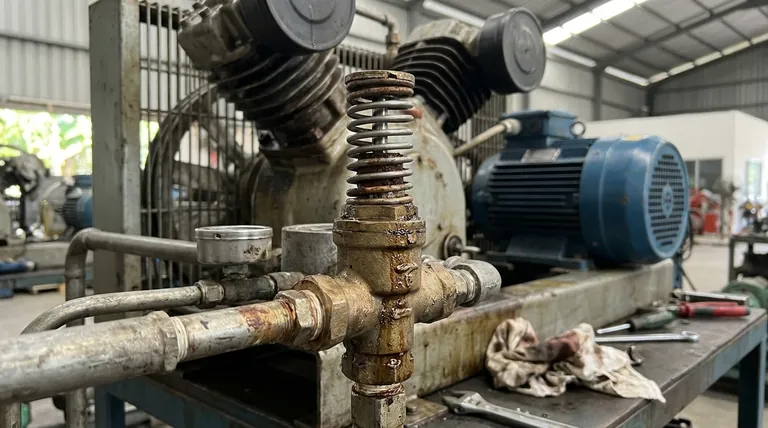
Check valves are the unsung heroes of air compressor systems, silently preventing costly reverse airflow damage. Yet when they fail, the consequences cascade through your entire operation—from motor burnout to compressed air contamination. This guide equips technicians and facility managers with:
- Clear diagnostic methods to catch early failure signs
- Data-backed maintenance routines that extend valve lifespan
- Real-world cost comparisons between reactive repairs and proactive care
Air Compressor Check Valve Essentials
How Check Valves Protect Your System
Think of check valves as one-way traffic signs for compressed air. They allow airflow toward the tank while blocking reverse flow that could:
- Force the compressor to restart against backpressure (wasting energy)
- Contaminate the system with debris from downstream
- Damage motor components through cyclic stress
Key Design Features:
- Spring-loaded discs or balls for rapid closure
- Metal-to-metal or elastomeric seals for airtight shutoff
- Corrosion-resistant materials (brass, stainless steel) for harsh environments
Key Failure Symptoms Before Complete Breakdown
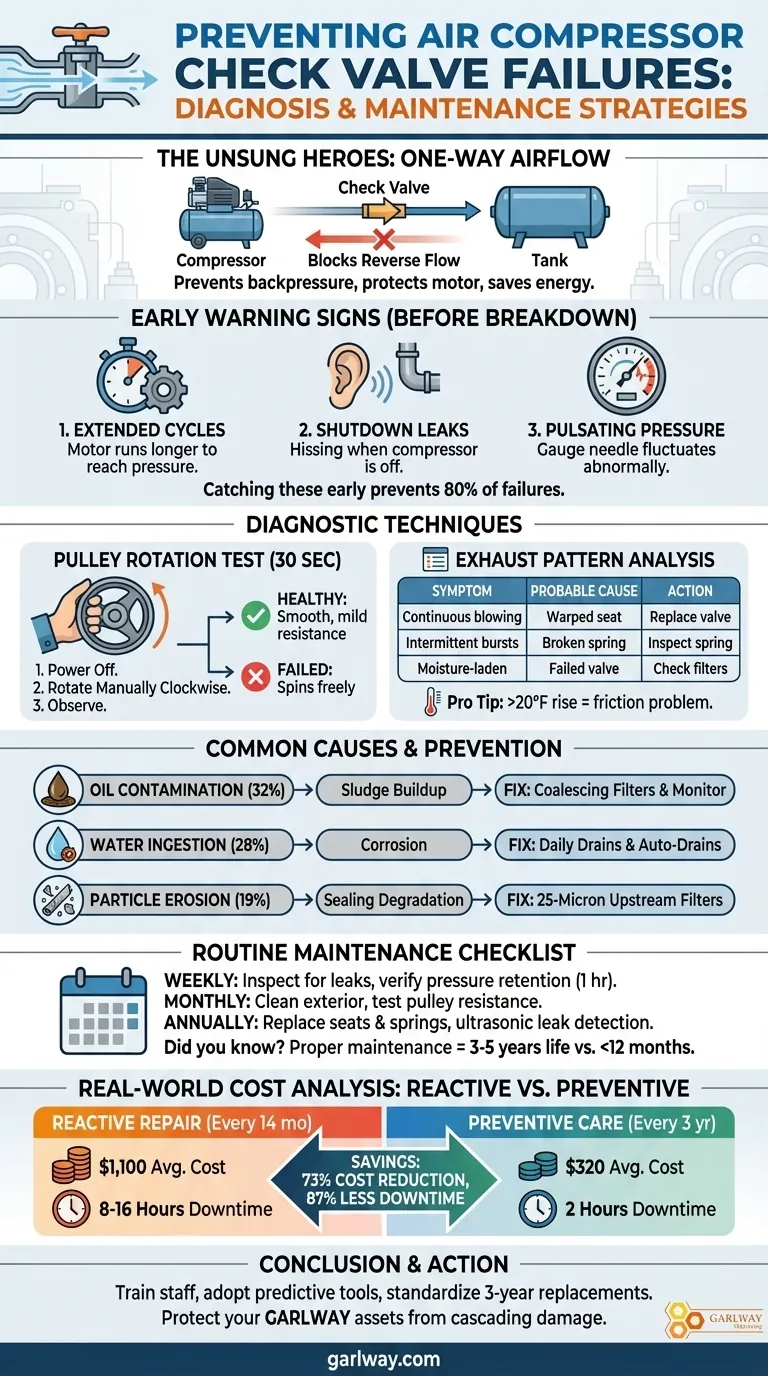
Catching these warning signs early prevents 80% of catastrophic failures:
-
Extended Compressor Cycle Times
- Motor runs longer to reach cutoff pressure
- Cause: Weak valve spring or fouled sealing surface
-
Air Leaks During Shutdown
- Hissing from the unloader valve or tank drain
- Test: Shut off compressor and listen for escaping air
-
Pulsating Discharge Pressure
- Gauge needle fluctuates abnormally
- Red Flag: Sticking valve disc unable to maintain steady flow
Ever noticed your compressor struggling to maintain pressure? That subtle change in sound could be the first whisper of valve failure.
Diagnostic Techniques in Depth
The Pulley Rotation Test Demystified
This 30-second check identifies severe valve leakage:
- Power down the compressor completely
- Rotate the drive pulley manually clockwise (direction of normal operation)
-
Observe resistance:
- Healthy Valve: Smooth rotation with mild resistance
- Failed Valve: Spins freely (air bypassing the valve)
Interpreting Exhaust Patterns Correctly
Abnormal exhaust port behavior reveals specific failure modes:
| Symptom | Probable Cause | Immediate Action |
|---|---|---|
| Continuous exhaust blowing | Warped valve seat | Replace valve assembly |
| Intermittent exhaust bursts | Broken valve spring | Inspect for metal fatigue |
| Moisture-laden exhaust | Failed valve allowing backflow | Check downstream filters |
Pro Tip: Use an infrared thermometer to detect temperature spikes near the valve—a 20°F+ rise over ambient indicates friction from misalignment.
Prevention and Maintenance Strategies
Common Causes of Premature Failure
Data from industrial maintenance logs shows these top culprits:
-
Oil Contamination (32% of failures)
- Sludge buildup prevents proper disc seating
- Fix: Install coalescing filters and monitor oil carryover
-
Water Ingestion (28% of failures)
- Accelerates corrosion in steel valve components
- Solution: Drain tanks daily and use auto-drains in humid climates
-
Particle Erosion (19% of failures)
- Metal shavings or pipe scale degrade sealing surfaces
- Defense: Add 25-micron particulate filters upstream
Routine Maintenance Checklist
Weekly:
- Inspect for audible leaks during shutdown
- Verify tank pressure retention over 1 hour
Monthly:
- Clean valve exterior with non-flammable solvent
- Test pulley rotation resistance
Annually:
- Replace valve seats and springs (even if functional)
- Conduct ultrasonic leak detection
Did you know? Properly maintained check valves last 3-5 years in industrial settings versus <12 months with neglect.
Real-World Scenarios
Case Study: Overlooked Symptoms Leading to Motor Burnout
A manufacturing plant ignored these progression signs:
- Month 1: 10% longer cycle times
- Month 3: Intermittent exhaust pulses
- Month 5: Motor thermal cutoff tripping
Result: $8,200 in motor rewinding costs vs. a $180 valve replacement.
Cost Analysis: Repair vs Preventive Maintenance
| Approach | Frequency | Avg. Cost | Downtime |
|---|---|---|---|
| Reactive Repair | Every 14 months | $1,100 | 8-16 hours |
| Preventive Replacement | Every 3 years | $320 | 2 hours |
| Savings: | 73% cost reduction | 87% less downtime |
Conclusion & Actionable Steps
Check valves demand attention precisely because they work silently in the background. Implement these practices today:
- Train staff to recognize early failure symptoms
- Adopt predictive maintenance with vibration analysis tools
- Standardize valve replacements at 3-year intervals
For operations relying on heavy machinery like winches or construction equipment, integrating these protocols protects your Garlway assets from cascading damage. The few minutes spent checking valves today prevent days of unplanned downtime tomorrow.
Final Thought: In compressed air systems, the components you never notice are often the ones that cost the most when neglected. What’s your first sign that a check valve needs attention?
Visual Guide
Related Products
- Small Electric Winch 120V and 240V for Compact Applications
- Auto Concrete Cement Mixer Machine New
- Hydraulic Winding Engine Harbor Freight Winch
- HZS25 Best Cement Mixer for Quick Mix Concrete at Bunnings
- Commercial Electric Concrete Mixer Machine HZS 50 Small Batch Plant for Sale
Related Articles
- How to Maximize Electrical Winch Performance in Challenging Environments
- How Electric Winch Safety Features Prevent Catastrophic Industrial Accidents
- How to Choose Between Manual and Electric Winches for Your Project
- How Electric Winches Solve Industrial Safety and Cost Challenges
- How Electric Winches’ Engineering Enhances Efficiency and Safety in Heavy-Duty Applications