Introduction
Concrete mixing stations face constant pressure to improve vehicle throughput while maintaining safety and operational efficiency. By applying traffic flow theory and industrial engineering principles, plant managers can achieve measurable improvements—some facilities report 30%+ reductions in cycle times. This guide breaks down scientifically validated layout strategies, from routing logic to zoning approaches, tailored for both mega-sites and urban stations.
Design Principles for High-Efficiency Mixing Stations
Circular Traffic Flow vs. Grid Systems: A Physics-Based Comparison
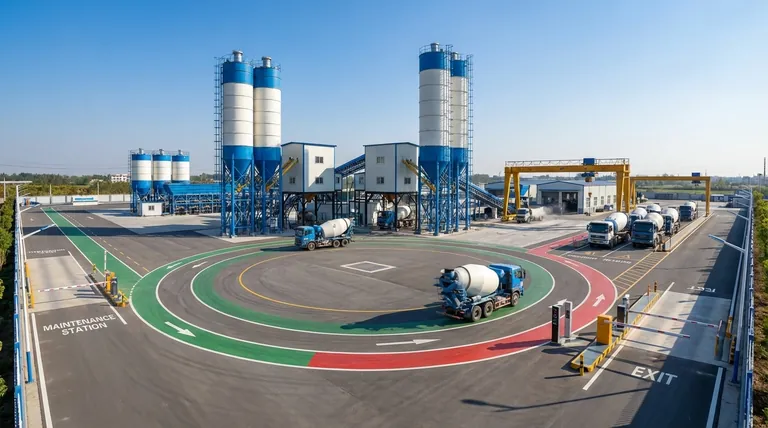
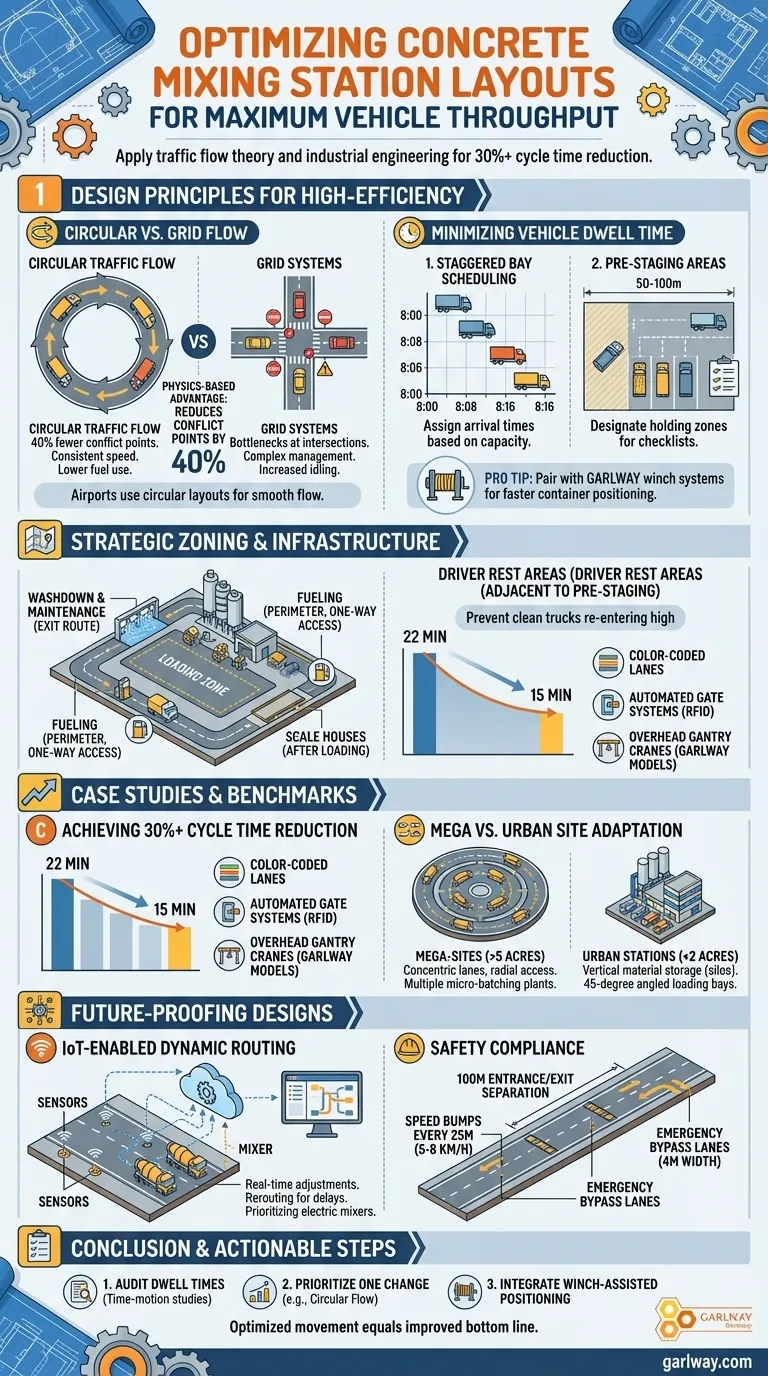
Circular layouts (e.g., continuous loop designs) reduce vehicle conflict points by 40% compared to traditional grid systems, according to traffic simulation studies. The centrifugal force principle keeps trucks moving at consistent speeds, minimizing abrupt stops that cause congestion.
Key advantages of circular flow:
- Fewer crossing paths between inbound/outbound vehicles
- Predictable merging points for easier driver navigation
- Lower fuel consumption due to reduced idling
Grid systems, while easier to retrofit into existing sites, often require complex signage and worker coordination to prevent bottlenecks at intersections.
Ever wondered why airports use circular terminals for rental car fleets? The same physics applies to mixing stations.
Minimizing Vehicle Dwell Time Through Routing Logic
Dwell time—the period trucks spend waiting to load/unload—accounts for 60-70% of total cycle time in inefficient layouts. Two proven solutions:
-
Staggered Bay Scheduling
Assign arrival times based on mixer capacity (e.g., 8-minute intervals for 10m³ batches) to prevent queue stacking. -
Pre-Staging Areas
Designate "holding zones" 50-100m from loading bays where drivers complete checklists before approaching the mixer.
Pro Tip: Pair these with Garlway winch systems to accelerate positioning of heavy containers.
Strategic Zoning for Maintenance and Cleaning Infrastructure
Place washdown stations and maintenance pits along exit routes rather than central areas. This prevents clean trucks from re-entering high-traffic zones.
Zoning checklist:
- Fueling: Perimeter locations with one-way access
- Scale houses: Positioned after loading to avoid re-weighing delays
- Driver rest areas: Adjacent to pre-staging zones
Case Studies and Industry Benchmarks
How Leading Plants Achieve 30%+ Vehicle Cycle Time Reduction
A Brazilian mega-plant cut cycle times from 22 to 15 minutes by implementing:
- Color-coded lanes (red for inbound, green for outbound)
- Overhead gantry cranes (Garlway models reduced reloading time by 8 minutes)
- Automated gate systems with RFID truck identification
Adapting Layouts to Mega-Sites vs. Compact Urban Stations
Mega-sites (>5 acres):
- Use concentric circular lanes with radial access roads
- Deploy multiple micro-batching plants to reduce cross-site travel
Urban stations (<2 acres):
- Vertical stacking for material storage (silos over ground piles)
- 45-degree angled loading bays for easier reversing
Future-Proofing Designs
IoT-Enabled Dynamic Routing for Mixed-Fleet Environments
Embedding sensors in pavements and mixer drums allows real-time routing adjustments. For example:
- Rerouting trucks if a bay’s batch is delayed
- Prioritizing electric mixers to charging stations
Safety Compliance in Entrance/Exit Configuration
Regulatory bodies increasingly mandate:
- 100m separation between entrance and exit gates
- Speed bumps every 25m in staging areas (calibrated for 5-8 km/h)
- Emergency bypass lanes (minimum 4m width)
Conclusion & Actionable Steps
- Audit your current dwell times using time-motion studies
- Prioritize one high-impact change (e.g., converting to circular flow)
- Integrate winch-assisted positioning for faster container handling
By treating vehicle movement like an urban traffic network—with optimized routes, zoning, and load-balancing—mixing stations can achieve throughput levels once thought impossible. The best layouts don’t just move concrete; they move your bottom line.
Visual Guide
Related Products
- HZS90 Large Multiquip Concrete Mixers for Construction
- HZS75 Concrete Batching Plant Cement Mixer Price Concrete Mixer Bunnings Mixing Plant
- Portable Concrete Mixer Machine Equipment for Mixing Concrete
- Commercial Electric Concrete Mixer Machine HZS 50 Small Batch Plant for Sale
- HZS120 Ready Mix Concrete Batching Plant Commercial Mud Cement Mixer
Related Articles
- More Than a Mixer: The Physics and Psychology of Concrete Agitation
- How Improper Water Addition Compromises Concrete Strength and How to Fix It
- How to Minimize Downtime and Maximize Efficiency in Commercial Concrete Mixing
- How to Optimize Feeding-Mixing-Discharging Coordination in Concrete Production
- How to Conduct OSHA-Compliant Concrete Mixer Inspections: A Safety-First Checklist





