The Cracks in the System
Imagine a brand-new concrete pavement, flawless on day one, developing a web of cracks months later. Or a building's foundation showing signs of weakness years before its time. The cause is often invisible, not a flaw in the raw materials, but a failure in a process we take for granted: mixing.
The problem isn't a lack of standards. We have precise specifications for mixing Portland Cement Concrete (PCC). The issue is psychological. We tend to focus on the numbers—the revolutions per minute, the total count—and forget the physical goal they are meant to achieve.
The Seduction of Simple Metrics
Engineers and contractors love clear targets. "Mix at 12-15 rpm for 70 revolutions." It's specific, measurable, and feels like a guarantee of quality.
But this number is an input, not an outcome.
The true, non-negotiable goal of mixing is homogeneity. It's the state where every grain of sand and piece of aggregate is perfectly coated in cement paste, and the entire batch has a uniform consistency. Without it, you create microscopic pockets of weakness that doom the structure from the start.
Focusing on the revolution count alone is like judging a chef by the time a dish spent in the oven, not by how it tastes. The number is a guide, but the result is what matters.
The Physics of Uniformity
High-speed mixing, defined as 12 to 15 revolutions per minute (rpm), is about energy.
This specific speed range imparts the intense shearing force needed to break down clumps of cement, overcome the surface tension of water, and force the cement paste into every void. It's a violent, controlled process designed to create a stable, homogenous mixture.
The question isn't if you need this energy, but where and when you apply it. This choice splits the path to quality concrete into two distinct strategies.
Two Paths to Homogeneity: A Critical Decision
The location of the final, high-speed mix dictates the entire logistical and quality control chain.
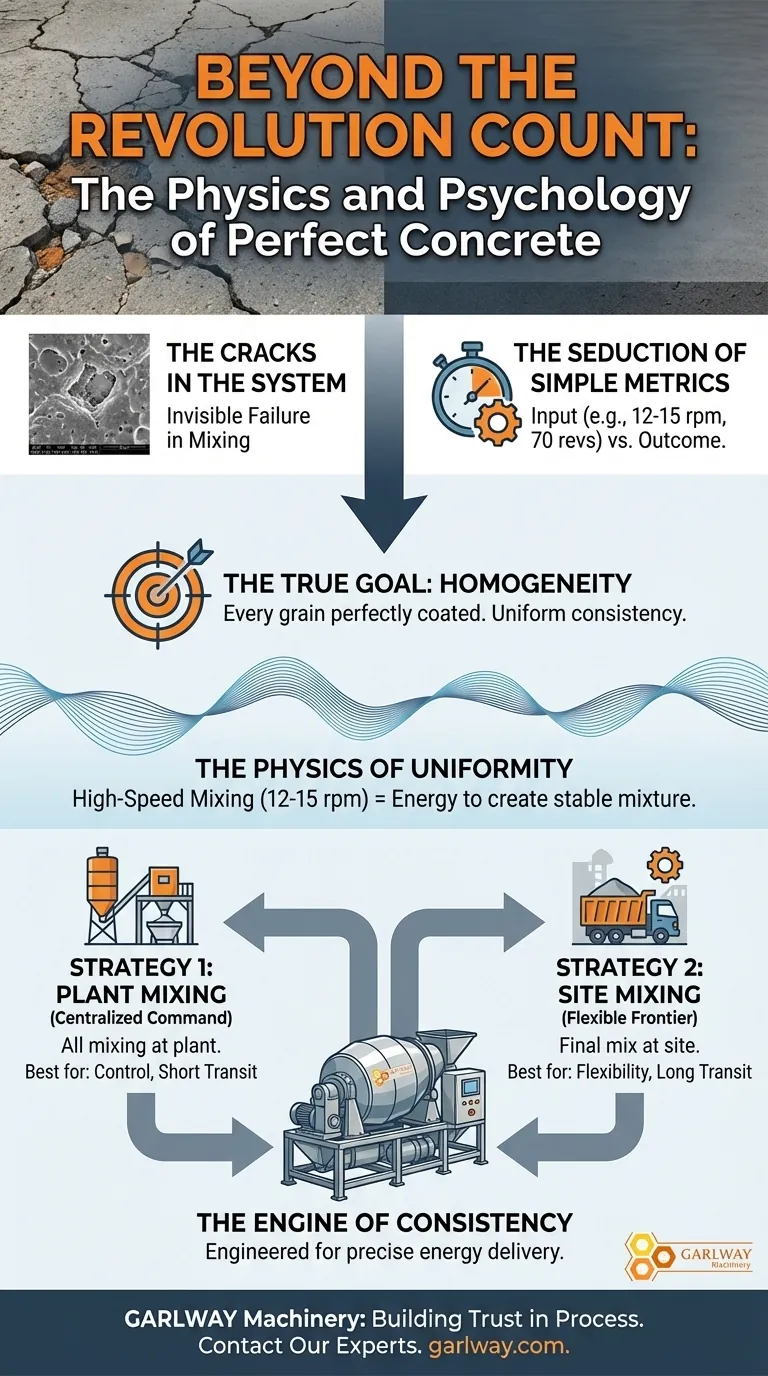
Strategy 1: The Centralized Command (Plant Mixing)
In this method, all mixing is completed in the controlled environment of a batching plant before the truck leaves.
- The Specification: 50 revolutions at a high speed of 12-15 rpm.
- The Psychology: This is for the perfectionist. It prioritizes absolute control over the mixing process, removing variables like transit time and on-site operator skill from the quality equation.
- The Trade-off: The clock is ticking. This method is ideal for projects close to the plant, as the concrete can begin to set during long transit times.
Strategy 2: The Flexible Frontier (Site Mixing)
Here, the concrete is blended during transport and receives its final, high-energy mix just before being poured at the job site.
- The Specification: 70 to 100 revolutions at 12-15 rpm upon arrival.
- The Psychology: This is for the pragmatist. It provides the operational flexibility needed for long hauls or unpredictable site conditions.
- The Trade-off: Responsibility shifts from the plant manager to the truck operator. This introduces a greater potential for human error and variability, making the quality of the machinery and the skill of the operator paramount.
| Mixing Method | Where High-Speed Mix Occurs | High-Speed RPM | Total Revolutions | Best For |
|---|---|---|---|---|
| Plant-Mixed | At the Batching Plant | 12-15 | 50 | Maximum quality control, short transit |
| Truck-Mixed | At the Paving Site | 12-15 | 70-100 | Logistical flexibility, long transit |
The Engine of Consistency
Achieving these precise specifications, batch after batch, is not an accident. It is a function of engineering. The specifications are meaningless without equipment capable of executing them flawlessly.
This is where the machinery itself becomes part of the quality control system. A high-performance concrete mixer or a fully integrated concrete batching plant isn't just a container that spins. It is a calibrated instrument designed to deliver a specific amount of energy to a mix, consistently and reliably.
At GARLWAY, we build equipment for construction companies who understand this principle. Our mixers and batching plants are engineered to be the dependable link between the specification on paper and the homogenous, durable concrete on the ground. They provide the control for plant mixing and the robust reliability needed for site mixing.
Ultimately, the trust you place in a structure begins with the trust you have in your process. That process, in turn, rests on the precision of your tools.
To ensure your projects are built on a foundation of perfect homogeneity, Contact Our Experts.
Visual Guide
Related Products
- Portable Concrete Mixer Machine Equipment for Mixing Concrete
- Construction Products Concrete Plant Machine Mixing Concrete Mixer
- Portable Electric Concrete Mixer Machine for Cement Mixing
- JZC400 Mobile Small Concrete Mixer Cement Mixer Machine
- Hydraulic Concrete Mixer Machine Cement Mixing Equipment for Mixture Concrete
Related Articles
- How to Diagnose and Prevent Sensor Resistance Failures in Concrete Mixing Equipment
- How to Build an OSHA-Compliant Safety System for Concrete Mixer Workspaces
- The Downtime Equation: How a Manufacturer's Support System Defines Your Concrete Mixer's True Cost
- How to Choose Concrete Mixers for Long-Term Reliability and Cost Savings
- How Concrete Composition Works: The Science Behind Stronger Structures