The Ticking Clock
The moment a batch of concrete is produced, a clock starts ticking. It's a perishable product, a precise chemical recipe with a finite window of usability. Its journey from the batch plant to the job site is its most vulnerable period, a race against physics and chemistry.
The rotating drum of a truck mixer is the primary guardian during this journey. But there's a common psychological trap: we see a spinning drum and our minds think "mixing." This misunderstanding can be the difference between a successful pour and a rejected load. The drum’s most critical job in transit is not to mix, but to preserve.
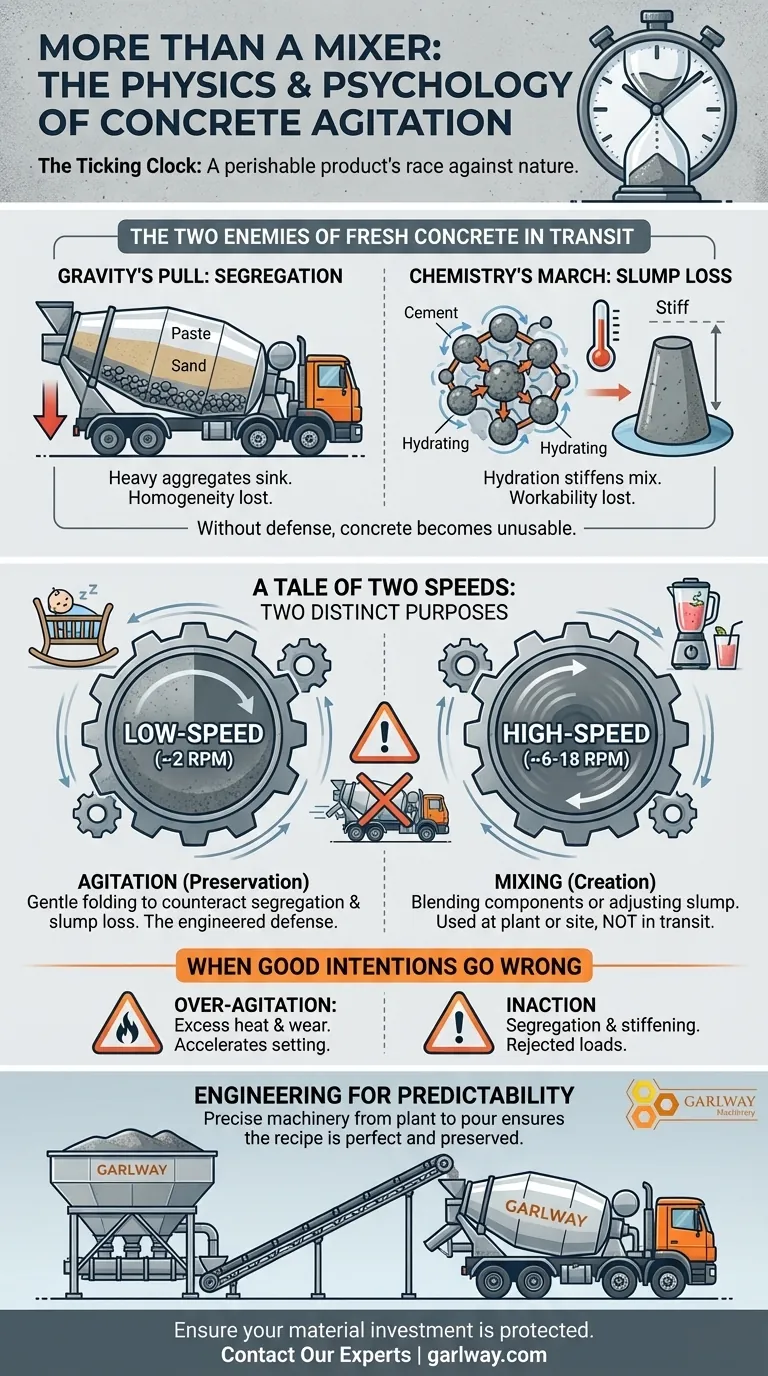
The Two Enemies of Fresh Concrete
In transit, concrete faces a silent, two-front battle against the laws of nature. The gentle, low-speed turn of the mixer drum is the engineered defense against them.
Gravity's Inevitable Pull: Segregation
Concrete is a suspension, not a solution. It's a carefully balanced mixture of heavy aggregates, sand, lighter cement paste, and water. Left undisturbed, gravity will do its work. The heavier coarse aggregates will settle to the bottom, and the lighter paste will rise.
This separation, known as segregation, is catastrophic for structural integrity. A slow, continuous rotation of about 2 RPM is a gentle, constant rebellion against gravity. It folds the material over itself, ensuring every part of the mix remains homogenous, delivering uniform strength from the first cubic meter to the last.
Chemistry's Unstoppable March: Slump Loss
From the instant water meets cement, a chemical reaction called hydration begins. This is what gives concrete its strength, but it also causes it to stiffen over time—a process measured as "slump loss."
Without agitation, this stiffening accelerates, making the concrete difficult to work with upon arrival. The slow turn keeps the mixture pliable and maintains its specified workability, buying the construction crew precious time to place, consolidate, and finish the pour correctly.
A Tale of Two Speeds
The core of the misunderstanding lies in the fact that the mixer drum has two distinct modes, for two profoundly different purposes. Confusing them is like using a scalpel as a hammer.
| Speed | Typical RPM | Primary Purpose | Analogy |
|---|---|---|---|
| Low-Speed | ~2 RPM | Agitation (Preservation) | Gently rocking a cradle |
| High-Speed | ~6-18 RPM | Mixing (Creation) | Blending a smoothie |
Agitation: The Art of Preservation (~2 RPM)
This is the transit speed. Its goal is maintenance. The energy input is minimal, just enough to counteract segregation and slump loss without generating excess heat or breaking down aggregates. It’s a delicate, custodial action.
Mixing: The Act of Creation (~6-18 RPM)
This is the manufacturing speed. It's used at the plant or on-site to blend dry components with water or to make authorized slump adjustments. Using this speed during transit is a form of over-mixing that damages the concrete, accelerating hydration and potentially altering the mix design.
When Good Intentions Go Wrong
Even with the best equipment, a failure to understand this principle leads to costly errors.
- The Risk of Over-Agitation: Every rotation adds energy. Excessive revolutions, even at low speed, generate heat that accelerates setting. It can also grind down the aggregates, subtly weakening the final product. This is why specifications often limit the total number of drum revolutions.
- The Danger of Inaction: Allowing the concrete to sit static is not an option. It guarantees a segregated, stiff, and unusable product upon arrival. This leads to rejected loads, project delays, and wasted resources.
Engineering for Predictability
The entire process, from batching to pouring, is a system designed to deliver a predictable material. The quality of that final product depends on the precision of the machinery used to create and transport it.
This is where the engineering of the equipment becomes paramount. A high-quality concrete batching plant from a manufacturer like GARLWAY ensures the recipe is perfect from the start. Their truck mixers are then entrusted to preserve that perfection. They are designed for precise and reliable agitation control, giving contractors confidence that the concrete arriving on-site has the exact properties that were specified. It’s not just about spinning a drum; it’s about mastering the forces of physics and chemistry to ensure project success.
Ultimately, that simple, slow rotation is a fundamental process that bridges the gap between the concrete's designed potential and its real-world performance. To ensure your material investment is protected from the plant to the pour, Contact Our Experts
Visual Guide
Related Products
- Portable Concrete Mixer Machine Equipment for Mixing Concrete
- Construction Products Concrete Plant Machine Mixing Concrete Mixer
- Portable Electric Concrete Mixer Machine for Cement Mixing
- Concrete Cement Mixer Machine Drum Mixer for Construction
- HZS90 Large Multiquip Concrete Mixers for Construction
Related Articles
- How to Diagnose and Prevent Sensor Resistance Failures in Concrete Mixing Equipment
- How to Build an OSHA-Compliant Safety System for Concrete Mixer Workspaces
- The Downtime Equation: How a Manufacturer's Support System Defines Your Concrete Mixer's True Cost
- How to Choose Concrete Mixers for Long-Term Reliability and Cost Savings
- How Concrete Composition Works: The Science Behind Stronger Structures