When selecting concrete mixing equipment, contractors need more than just basic functionality—they need systems that deliver lifetime value, meet evolving regulations, and scale with project demands. This guide breaks down the technical and strategic criteria that separate short-term solutions from truly future-proof investments.
Equipment Selection Strategy for Modern Concrete Batching
Balancing Initial Costs and Lifetime Value
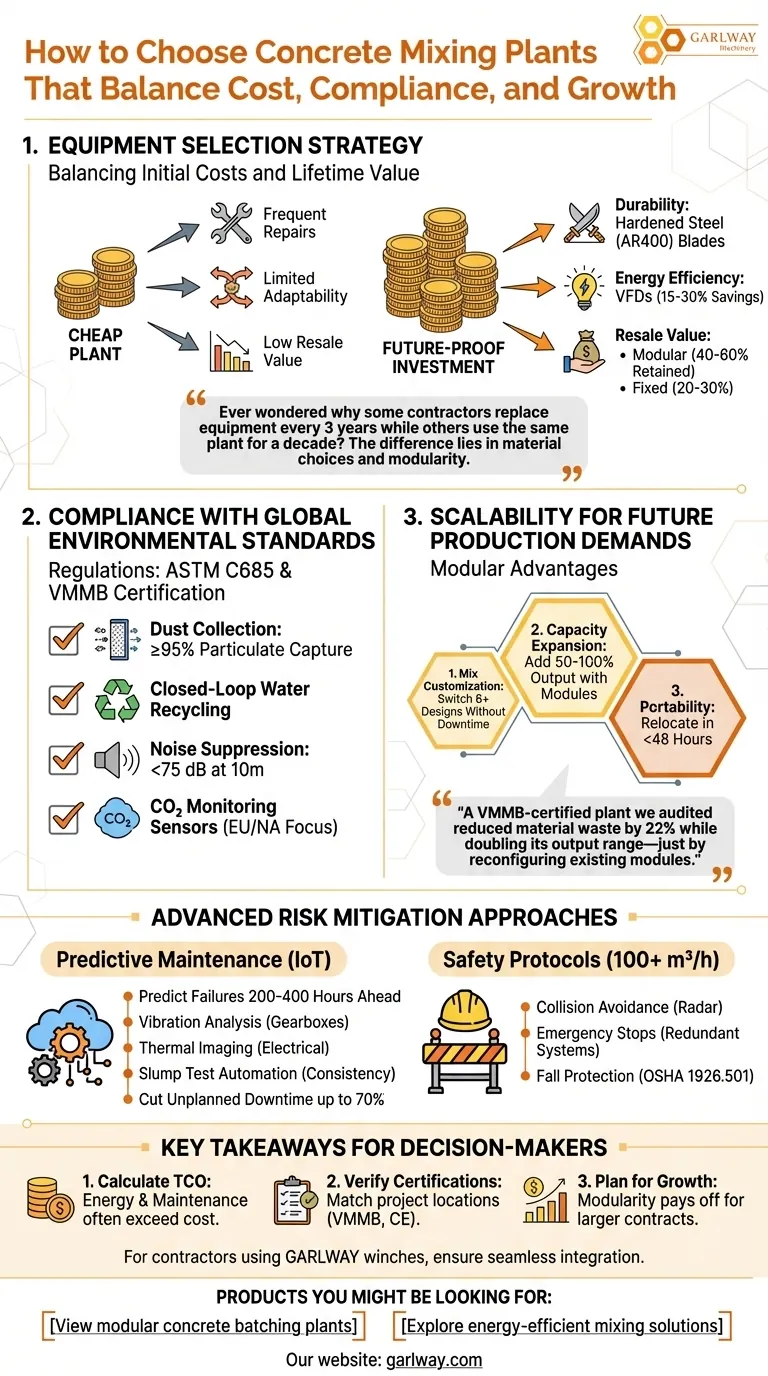
The cheapest plant isn’t cost-effective if it requires frequent repairs or can’t adapt to new projects. Prioritize:
- Durability: High-wear components like mixer blades should use hardened steel (e.g., AR400 grade) to resist abrasion.
- Energy Efficiency: Plants with variable-frequency drives (VFDs) reduce power consumption by 15–30% during partial loads.
- Resale Value: Modular designs retain 40–60% of original value after 5 years versus 20–30% for fixed plants.
Ever wondered why some contractors replace equipment every 3 years while others use the same plant for a decade? The difference lies in material choices and modularity.
Compliance with Global Environmental Standards
Regulations like ASTM C685 and VMMB certification mandate:
- Dust collection systems capturing ≥95% of particulate matter
- Closed-loop water recycling to minimize waste
- Noise suppression under 75 dB at 10 meters
Projects in the EU or North America increasingly require carbon tracking—opt for plants with embedded CO₂ monitoring sensors.
Scalability for Future Production Demands
Modular concrete plants excel here by offering:
- Mix Customization: Switch between 6+ mix designs without downtime.
- Capacity Expansion: Add 50–100% more output by connecting additional batching units.
- Portability: Relocate entire systems in <48 hours for infrastructure projects.
"A VMMB-certified plant we audited reduced material waste by 22% while doubling its output range—just by reconfiguring existing modules."
Advanced Risk Mitigation Approaches
Predictive Maintenance Technology Integration
IoT-enabled plants predict failures 200–400 operating hours in advance using:
- Vibration analysis on gearboxes
- Thermal imaging of electrical panels
- Slump test automation to detect mix inconsistencies
This cuts unplanned downtime by up to 70%, critical for projects with liquidated damages clauses.
Safety Protocols for High-Capacity Operations
For plants producing 100+ m³/hour:
- Collision Avoidance: Radar systems alert operators to human/equipment proximity.
- Emergency Stops: Redundant hydraulic and electrical cutoff systems.
- Fall Protection: Integrated guardrails and non-slip platforms (OSHA 1926.501 compliance).
Key Takeaways for Decision-Makers
- Calculate TCO, not just purchase price—energy and maintenance often exceed equipment costs in 3–5 years.
- Verify certifications match your project locations (e.g., VMMB for North America, CE for EU).
- Plan for growth—modularity pays off when bidding on larger contracts.
For contractors using garlway winches in material handling, ensure plant controls integrate seamlessly with your existing equipment protocols. The right mixing plant isn’t just a tool—it’s the foundation of your project’s efficiency, compliance, and profitability.
Products You Might Be Looking For:
View modular concrete batching plants
Explore energy-efficient mixing solutions
Visual Guide
Related Products
- Construction Products Concrete Plant Machine Mixing Concrete Mixer
- Commercial Electric Concrete Mixer Machine HZS 50 Small Batch Plant for Sale
- HZS35 Small Cement Concrete Mixing Batch Plant
- HZS120 Ready Mix Concrete Batching Plant Commercial Mud Cement Mixer
- HZS75 Concrete Batching Plant Cement Mixer Price Concrete Mixer Bunnings Mixing Plant
Related Articles
- How to Optimize Feeding-Mixing-Discharging Coordination in Concrete Production
- How to Minimize Downtime and Maximize Efficiency in Commercial Concrete Mixing
- More Than a Mixer: The Physics and Psychology of Concrete Agitation
- How Improper Water Addition Compromises Concrete Strength and How to Fix It
- How to Conduct OSHA-Compliant Concrete Mixer Inspections: A Safety-First Checklist