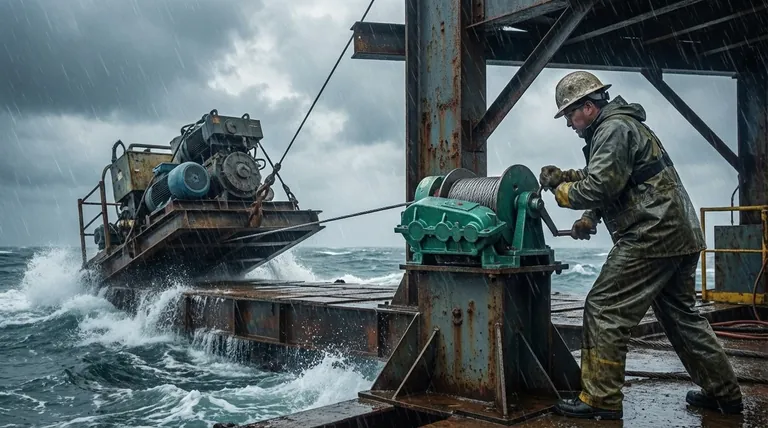
When operating in harsh environments—from marine construction sites to industrial facilities—equipment failure isn’t just an inconvenience; it’s a critical safety hazard. Manual winches stand out as indispensable tools in these scenarios, combining robust engineering with fail-safe mechanisms to protect both operators and cargo. This article breaks down the key design features that ensure their performance under pressure, backed by real-world applications and engineering insights.
Core Safety Mechanisms in Manual Winches
Load Brake Technology and Accident Prevention
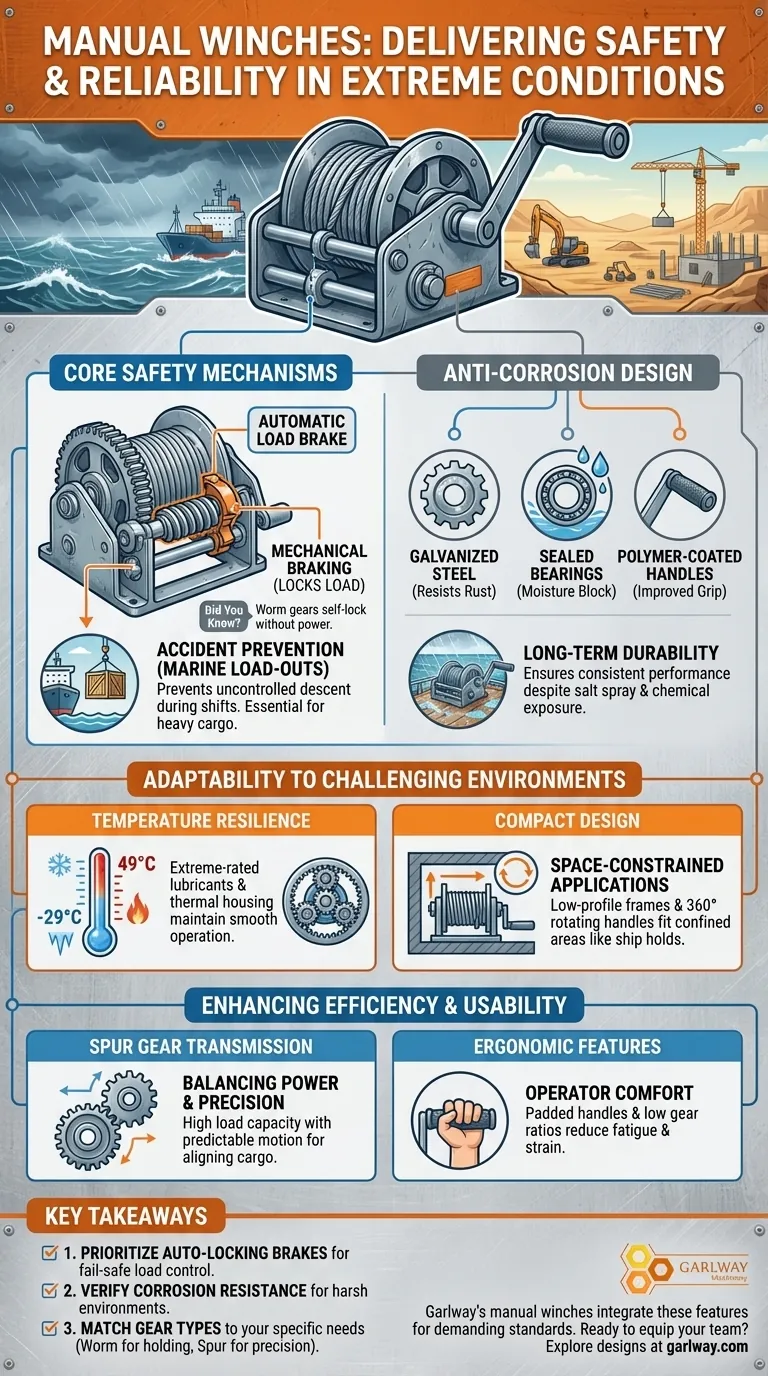
A manual winch’s primary safety feature is its load brake system, which automatically engages to prevent uncontrolled descent. Unlike powered winches that rely on continuous energy input, manual models use mechanical braking (often via worm gears or disc systems) to lock loads in place even if the operator releases the handle.
Why this matters: In marine load-outs—where cargo is transferred onto ships via skids or trailers—sudden shifts in weight or weather conditions can destabilize operations. A winch with an auto-locking brake ensures cargo won’t slip mid-transit, a critical safeguard when moving heavy machinery or fragile structures.
Did you know? Worm gear winches are particularly valued in these settings for their self-locking capability, which requires no additional power to hold loads.
Anti-Corrosion Design for Long-Term Durability
Saltwater, humidity, and chemical exposure accelerate wear in industrial equipment. High-quality manual winches combat this with:
- Galvanized steel components: Zinc coatings resist rust, even in marine environments.
- Sealed bearings: Prevent moisture ingress that could degrade internal gears.
- Polymer-coated handles: Improve grip while resisting corrosion.
Real-world proof: In skidded load-outs, where winches pull cargo along ship decks, corrosion-resistant materials ensure consistent performance despite constant salt spray.
Adaptability to Challenging Environments
Temperature Resilience in Industrial and Outdoor Settings
From freezing Arctic sites to scorching desert construction zones, manual winches must operate flawlessly. Key adaptations include:
- Lubricants rated for extreme temperatures: Maintain smooth gear operation from -20°F to 120°F (-29°C to 49°C).
- Thermal-resistant housing: Shields internal mechanisms from direct heat or cold.
Case in point: Planetary gear winches excel here, distributing load stress across multiple contact points to reduce friction-induced heat buildup.
Compact Design for Space-Constrained Applications
Unlike bulky powered winches, manual models often feature:
- Low-profile frames: Fit confined areas like ship holds or underground mines.
- 360° rotating handles: Allow operation in tight quarters without repositioning the winch.
Ever struggled with equipment that won’t fit your workspace? Compact capstan winches solve this by offering vertical or horizontal mounting options.
Enhancing Efficiency and Usability
Spur Gear Transmission: Balancing Power and Precision
Spur gears (straight-toothed gears) provide a sweet spot between torque and control:
- High load capacity: Suitable for pulling trailers or industrial skids.
- Predictable motion: Unlike worm gears, spur systems offer consistent speed, critical for precision tasks like aligning cargo on ramps.
Ergonomic Features for Operator Comfort
Long shifts demand winches designed for human use:
- Padded handles: Reduce hand fatigue during repetitive cranking.
- Low gear ratios: Enable heavy loads to be moved with less physical strain.
Human impact: On construction sites, ergonomic winches reduce worker injuries and boost productivity—proof that safety isn’t just about machinery, but also operator well-being.
Key Takeaways for Choosing a Reliable Winch
- Prioritize auto-locking brakes for fail-safe load control.
- Verify corrosion resistance if used near water or chemicals.
- Match gear types to your needs: Worm gears for holding, spur gears for precision.
For industries where safety and durability are non-negotiable, Garlway’s manual winches integrate these features to meet demanding operational standards—without compromising on usability.
Ready to equip your team with winches built for extremes? Explore designs that align with your environment’s unique challenges.
Visual Guide
Related Products
- Quick Windlass Portable Winch for Truck and Boat Best Boat Winch
- Portable Small Trailer Winch
- Electric and Hydraulic Winch for Heavy Duty Applications
- Small Electric Winch 120V and 240V for Compact Applications
- Hydraulic Winding Engine Harbor Freight Winch
Related Articles
- How the JK Quick Winch’s Portability Transforms Work in Tight Spaces
- How JK Quick Winches Solve 3 Critical Industrial Automation Challenges
- How to Choose a Quick Winch with the Right Traction Force for Your Job
- More Than a Number: The Engineering Psychology of Choosing a Boat Winch
- Force vs. Mass: The Critical Difference in Sizing a Boat Winch





