A Machine on the Edge of Failure
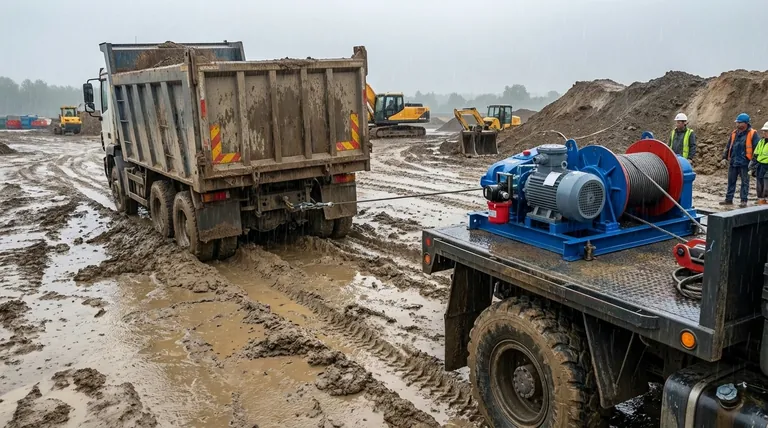
Imagine a loaded dump truck, its wheels sunk deep in the rain-softened soil of a construction site. Every minute it sits idle, a project timeline slips, and costs accumulate. The air is thick with the smell of diesel and the quiet pressure of a deadline.
In this moment, the winch on the front of the recovery vehicle isn't just a tool. It's a critical system, the one component standing between a minor delay and a catastrophic one.
Choosing that winch was a decision made months ago in a quiet office, but its consequences are felt right here, in the mud. The choice wasn't just about pulling power; it was a bet on a specific philosophy of energy, reliability, and preparedness.
The Core Dilemma: A Question of Energy
At its heart, a winch is a device for converting energy—electrical, hydraulic, or human—into immense pulling force. The source of that energy is the single most important factor determining its behavior under stress. It defines the machine's limits, its stamina, and its soul.
The Electric Winch: The Pragmatist's Tool
The most common winch is the electric one. It's a marvel of direct-current engineering, connecting straight to the vehicle's battery.
Its appeal is rooted in simplicity and accessibility. For the vast majority of situations—a 4x4 stuck on a trail, a light-duty vehicle needing a quick pull—it provides a powerful, immediate solution. It represents a pragmatic choice: immense capability for intermittent use, with a straightforward installation.
But its limitation is psychological as much as it is physical. An electric winch is in a constant race against its own heat and the battery's capacity. A long, heavy pull creates a sense of anxiety. Is the battery draining too fast? Is the motor overheating? It demands a cool-down period, a pause for recovery that you might not be able to afford.
The Hydraulic Winch: The Professional’s Promise
A hydraulic winch operates on a different principle entirely. It taps into the vehicle’s power steering pump, becoming an extension of the engine itself.
This design offers one profound advantage: a 100% duty cycle.
As long as the engine is running, the hydraulic winch can pull. It will not fade, overheat, or falter. It is a promise of relentless, continuous work. This is why it is the unwavering choice for industrial applications—tow trucks, commercial recovery rigs, and heavy construction vehicles.
The trade-off is complexity. Installation is more involved, and the line speed is often slower. But for a professional, this is an acceptable price for certainty. The hydraulic winch represents an investment in uptime and the elimination of a critical point of failure.
The Manual Winch: The Stoic's Failsafe
The manual winch, or come-along, stands apart. It requires no external power source, relying solely on gears and human effort.
Its value is philosophical. It is the ultimate failsafe, a tool of pure self-reliance. It will work when the battery is dead and the engine is flooded. It is a declaration that, no matter what, you will not be stranded.
The cost is time and sweat. It is brutally slow and physically demanding. But as a backup, its reliability is absolute.
Anatomy of the Right Decision
Choosing a winch is a systems-thinking exercise. You aren't just buying a component; you're designing a recovery system, and every system has dependencies and trade-offs.
Duty Cycle: The Rhythm of Your Work
This isn't just a technical spec; it's about matching the tool to the cadence of your job.
- Intermittent Bursts: Occasional, short pulls are the domain of the electric winch. It's fast and effective for solving contained problems.
- Continuous Flow: For jobs that require sustained, heavy pulling, the hydraulic winch is the only option that guarantees performance without interruption.
The Chain of Dependency
Every system has a weak link. Understanding it is key.
- Electric: Depends on a healthy battery and alternator. A failure in the vehicle's electrical system renders it useless.
- Hydraulic: Depends on a running engine and a functional power steering system. An engine failure neutralizes it.
- Manual: Depends on your physical endurance. The only limit is your own strength and patience.
Cost of Complexity vs. Cost of Failure
The upfront cost and installation complexity of a hydraulic winch are higher. But consider the downstream cost of failure. On a commercial site, a single instance of an electric winch overheating and failing can cost far more in project delays than the initial premium for a hydraulic system.
A Framework for Choosing
Your primary application dictates the optimal choice. The right tool is the one whose strengths align with your most common—or most critical—scenarios.
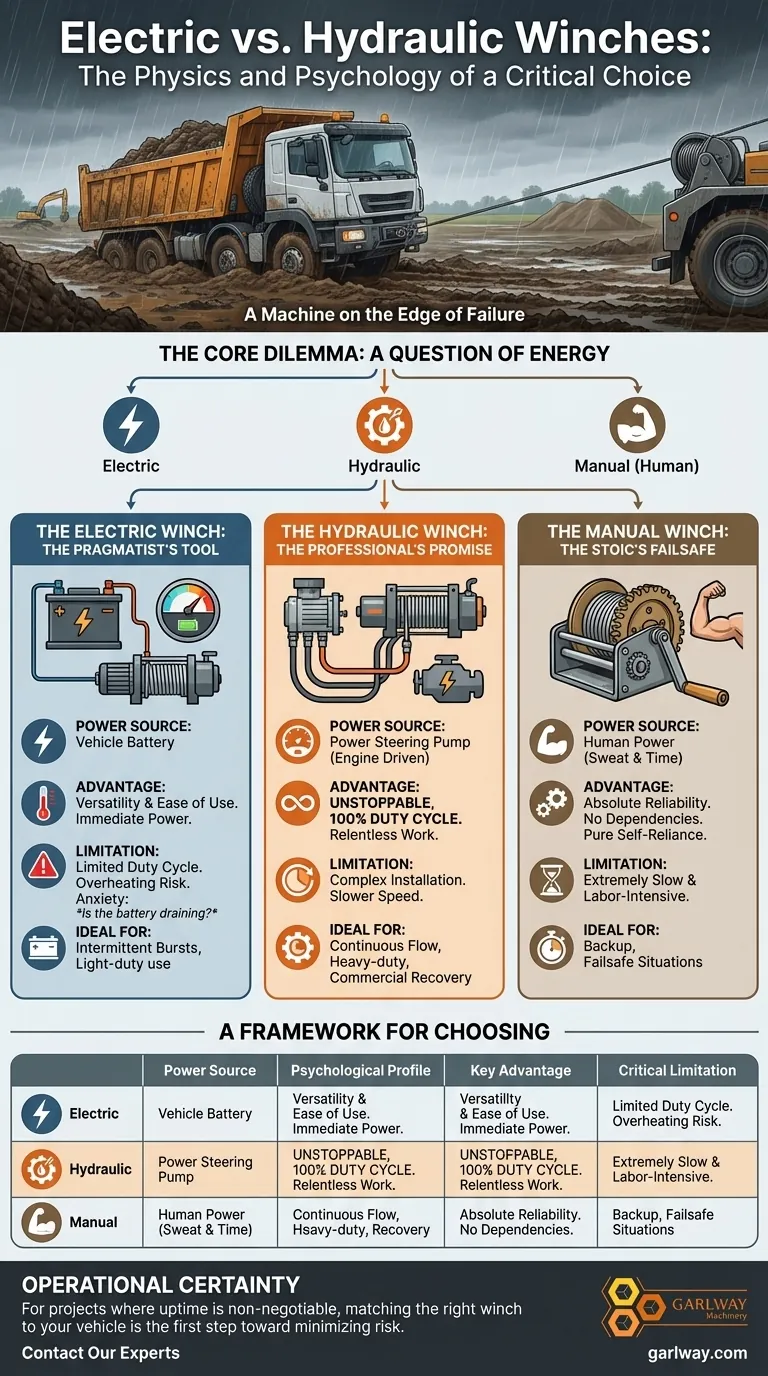
| Winch Type | Power Source | Psychological Profile | Key Advantage | Critical Limitation |
|---|---|---|---|---|
| Electric | Vehicle Battery | The Pragmatist | Versatility & Ease of Use | Limited Duty Cycle; Overheating Risk |
| Hydraulic | Power Steering Pump | The Professional | Unstoppable, 100% Duty Cycle | Complex Installation; Slower Speed |
| Manual | Human Power | The Stoic | Absolute Reliability; No Dependencies | Extremely Slow & Labor-Intensive |
For construction companies and contractors, where vehicle uptime is directly tied to profitability, the logic points toward systems that minimize risk. An electric winch on a supervisor's truck makes sense. But for the heavy-duty machinery at the heart of the operation, the endurance of a hydraulic system is not a luxury—it's a requirement.
Ultimately, the choice of a winch is a reflection of how you view risk. It's about ensuring that when a critical moment arrives in the mud and the rain, you have engineered a system that will not fail.
For projects where uptime is non-negotiable, matching the right winch from a reliable supplier like GARLWAY to your vehicle is the first step toward operational certainty. Contact Our Experts
Visual Guide
Related Products
- Warn Winch Windlass Boat Trailer Winch
- Electric and Hydraulic Winch for Heavy Duty Applications
- Small Electric Winch 120V and 240V for Compact Applications
- 12000 lb Electric Boat Trailer Winch with Windlass Anchor Warn
- Quick Windlass Portable Winch for Truck and Boat Best Boat Winch
Related Articles
- Beyond the Bumper: The Critical System Choice in Powering Your Trailer Winch
- Force vs. Mass: The Critical Difference in Sizing a Boat Winch
- Lines of Force: The Unseen Geometry of a Boat Winch
- More Than a Number: The Engineering Psychology of Choosing a Boat Winch
- How to Choose and Optimize Winch Speed for Maximum Efficiency