The Moment of Truth
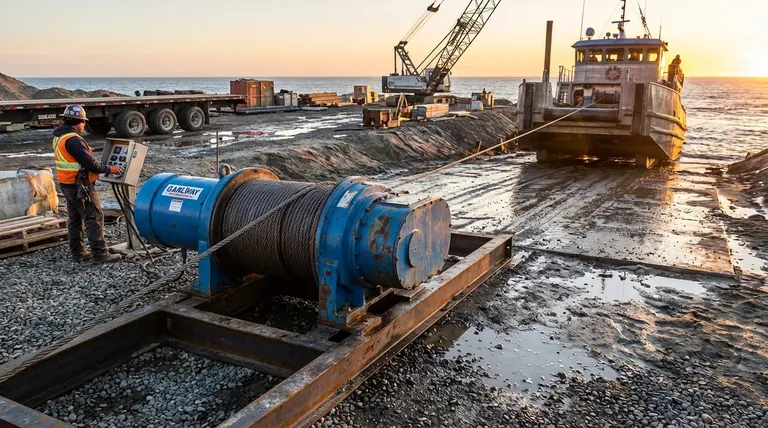
Picture the end of a long day at a coastal construction site. A crew needs to pull a heavy workboat onto its trailer. The tide is turning, the ramp is slick, and fatigue is setting in. All that stands between the multi-ton vessel and a controlled, safe loading is a small, geared device bolted to the trailer: the winch.
In this moment, the winch is not merely a convenience. It is the focal point for immense potential energy. It's a physical system designed to manage forces that a human cannot, but it's also a psychological one—we must trust it completely. Yet, we often misunderstand this simple machine, leading to preventable and catastrophic failures.
Two Jobs, Two Tools
The term "winch" is deceptively simple. In the world of heavy machinery and marine applications, it represents a category, not a single tool. Confusing their roles is like using a scalpel for a task that requires an axe. The two primary contexts are fundamentally different.
The Trailer Winch: A Controlled Ascent
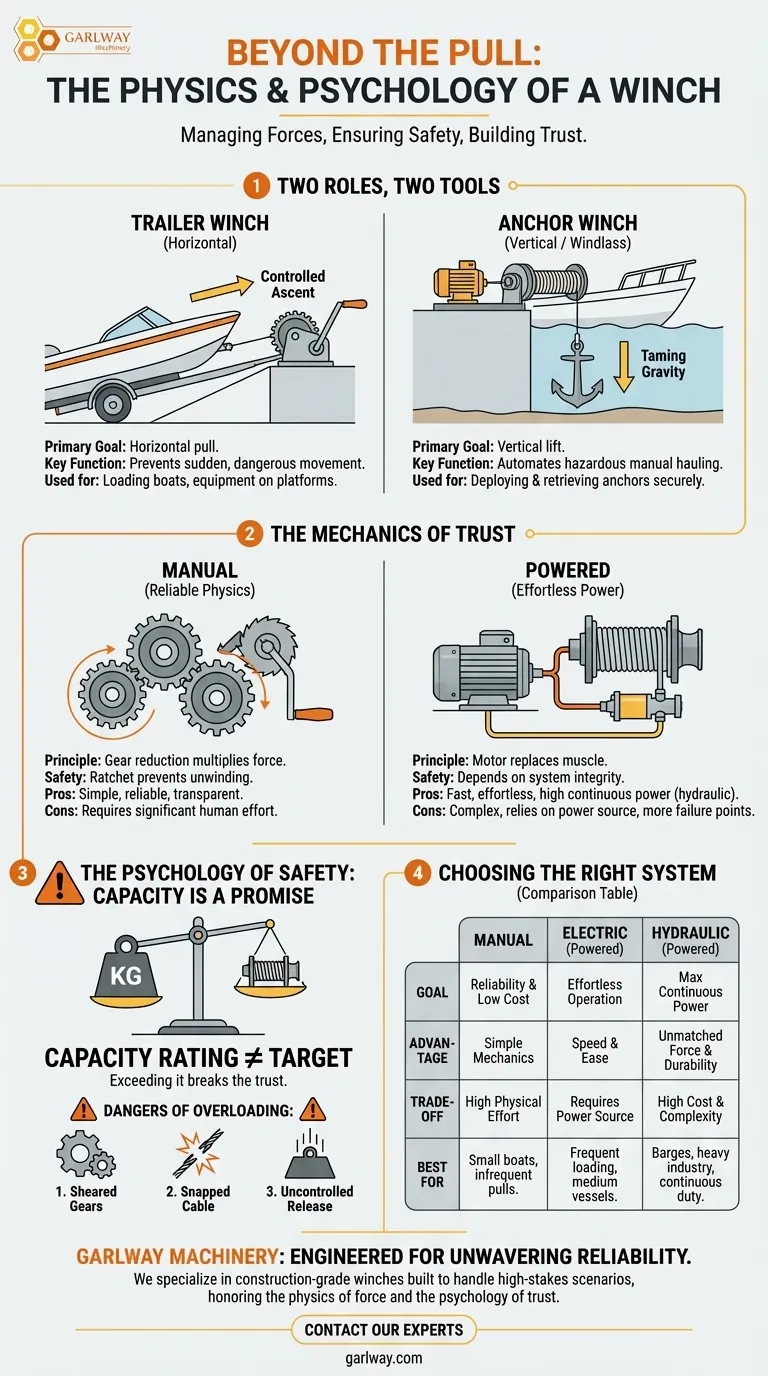
This is the winch of our shoreline scenario. Its sole purpose is to pull a heavy object, like a boat or piece of equipment, horizontally or up a slight incline onto a transport platform.
By translating the rotational force from a crank or motor through a series of gears, it gives a single operator the power of many. Its most critical, yet underappreciated, function is control. It prevents the sudden, dangerous movement that can damage hulls, injure personnel, and turn a routine task into a crisis.
The Anchor Winch: Taming the Vertical
Mounted on the deck, the anchor winch (or windlass) serves an entirely different master: gravity. Its job is to raise and lower an anchor and its heavy chain or rope.
This isn't just about saving your back. Manually hauling an anchor on a moving deck is a recipe for injury and error. An anchor winch automates this hazardous process, ensuring the anchor is deployed and retrieved safely and securely, allowing the crew to focus on positioning and operations.
The Mechanics of Trust
How a winch multiplies force is a beautiful principle of mechanical engineering. But the choice between a manual or powered system is a trade-off between simplicity and effort.
Manual Winches: The Elegance of the Gear
A manual winch is a testament to reliable physics. You turn a crank, which drives a small pinion gear. This gear engages a larger drum gear, multiplying your input force. A simple pawl, or ratchet, clicks into place, preventing the drum from unwinding.
It is a closed, transparent system. You can feel the tension and hear the mechanics. Its reliability is its greatest strength; with minimal maintenance, it works every time. The only variable is your physical effort.
Powered Winches: The Burden of Complexity
Electric and hydraulic winches replace muscle with a motor. They make the operation effortless, which is a massive advantage for larger loads or frequent use. An electric winch draws from a battery, while a hydraulic winch uses pressurized fluid for immense, continuous pulling power suitable for the most demanding industrial tasks.
This convenience, however, introduces complexity. Motors, wiring, solenoids, batteries, and hydraulic lines all become potential points of failure. The trade-off isn't just cost; it's exchanging the predictable limit of human endurance for the less predictable risk of system failure.
The Psychology of Underestimation
The single most critical specification on any winch is its capacity rating. And it is the most dangerously ignored.
The human mind is notoriously bad at estimating weight and risk. We see a large boat and a small winch, and a cognitive bias toward optimism and frugality might lead us to believe "it's probably strong enough."
A winch's capacity rating isn't a target; it's a promise. Exceeding it doesn't just void a warranty; it breaks a fundamental law of trust between operator and machine. When a winch fails under load, it doesn't just stop working. Gears can shear. Cables can snap with explosive force. The load is released suddenly and uncontrollably.
Choosing a System, Not Just a Tool
The right winch is part of a larger system of safety and efficiency. The decision hinges on a clear-eyed assessment of the task.
| Consideration | Manual Winch | Powered (Electric) Winch | Powered (Hydraulic) Winch |
|---|---|---|---|
| Primary Goal | Reliability & low cost for moderate loads | Effortless operation & speed | Maximum, continuous power for heavy industry |
| Key Advantage | Simple mechanics, few failure points | Eliminates physical strain, faster | Unmatched pulling force and durability |
| Main Trade-Off | Requires significant physical effort | More complex, requires a reliable power source | Highest cost and installation complexity |
| Best For | Smaller workboats, infrequent light-duty pulls. | Frequent loading, heavier vessels, operator safety. | Barges, large-scale construction, continuous duty. |
Whether you are trailering a survey boat, deploying underwater equipment, or securing materials on a floating platform, the principles remain the same. The winch is the critical node where force is controlled and safety is determined. In industrial environments, where equipment is heavier and the stakes are higher, selecting a robust, properly rated winch isn't just good practice—it's essential.
At GARLWAY, we specialize in construction-grade machinery built to handle these precise, high-stakes scenarios. Our winches are engineered not just to pull, but to provide the unwavering reliability and control that your operations depend on. If you're looking for a solution that honors the physics of force and the psychology of trust, Contact Our Experts
Visual Guide
Related Products
- Warn Winch Windlass Boat Trailer Winch
- Electric and Hydraulic Winch for Heavy Duty Applications
- Small Electric Winch 120V and 240V for Compact Applications
- 12000 lb Electric Boat Trailer Winch with Windlass Anchor Warn
- Quick Windlass Portable Winch for Truck and Boat Best Boat Winch
Related Articles
- Beyond the Bumper: The Critical System Choice in Powering Your Trailer Winch
- Force vs. Mass: The Critical Difference in Sizing a Boat Winch
- Lines of Force: The Unseen Geometry of a Boat Winch
- More Than a Number: The Engineering Psychology of Choosing a Boat Winch
- How to Choose and Optimize Winch Speed for Maximum Efficiency