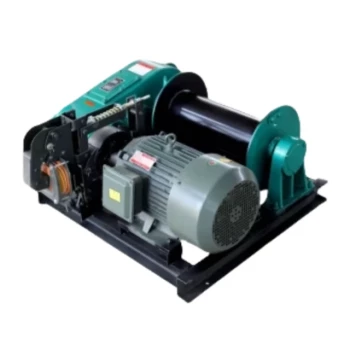
Using a winch for vehicle towing is a critical mistake because it is not engineered to handle the sudden, repetitive shock loads that occur when one vehicle pulls another. This dynamic stress, caused by slack in the line followed by abrupt tension, can easily strip the winch's internal gears, leading to catastrophic failure of the equipment.
The fundamental distinction is purpose: A winch is a pulling tool designed for static, high-resistance loads, like freeing a stuck vehicle. Towing equipment, by contrast, is designed to manage the dynamic forces of a moving vehicle over a distance. Using the wrong tool is both dangerous and destructive.
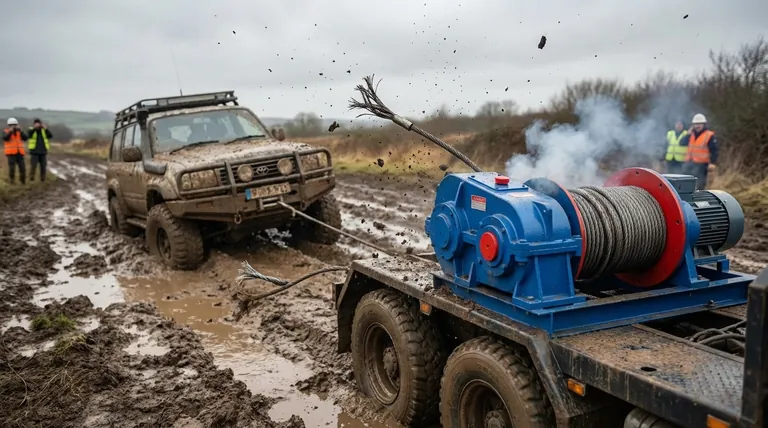
The Core Difference: A Static Pull vs. a Dynamic Tow
Understanding why a winch is unsuitable for towing begins with understanding its design. It's a specialized tool built for one type of force, while towing introduces a completely different and far more destructive kind.
How a Winch is Designed to Work
A winch is a masterpiece of torque and control. Its gear train creates immense pulling power for a slow, steady, and predictable pull against a heavy, stationary, or near-stationary object.
The internal brake is designed specifically to hold a static load securely, preventing it from sliding back once the pull is stopped. Every component is optimized for this controlled, high-stress, low-speed application.
The Unpredictable Physics of Towing
Towing is a dynamic, chaotic event. The towed vehicle constantly changes speed relative to the tow vehicle, even over short distances.
This creates moments of slack in the connection, which are immediately followed by violent, jerking tension as the slack is removed. These are shock loads—the equivalent of hitting the winch components with a sledgehammer instead of applying steady pressure.
The Critical Risks of Improper Use
Using a winch for towing isn't just "less than ideal"; it introduces multiple points of failure that can result in significant damage and serious injury.
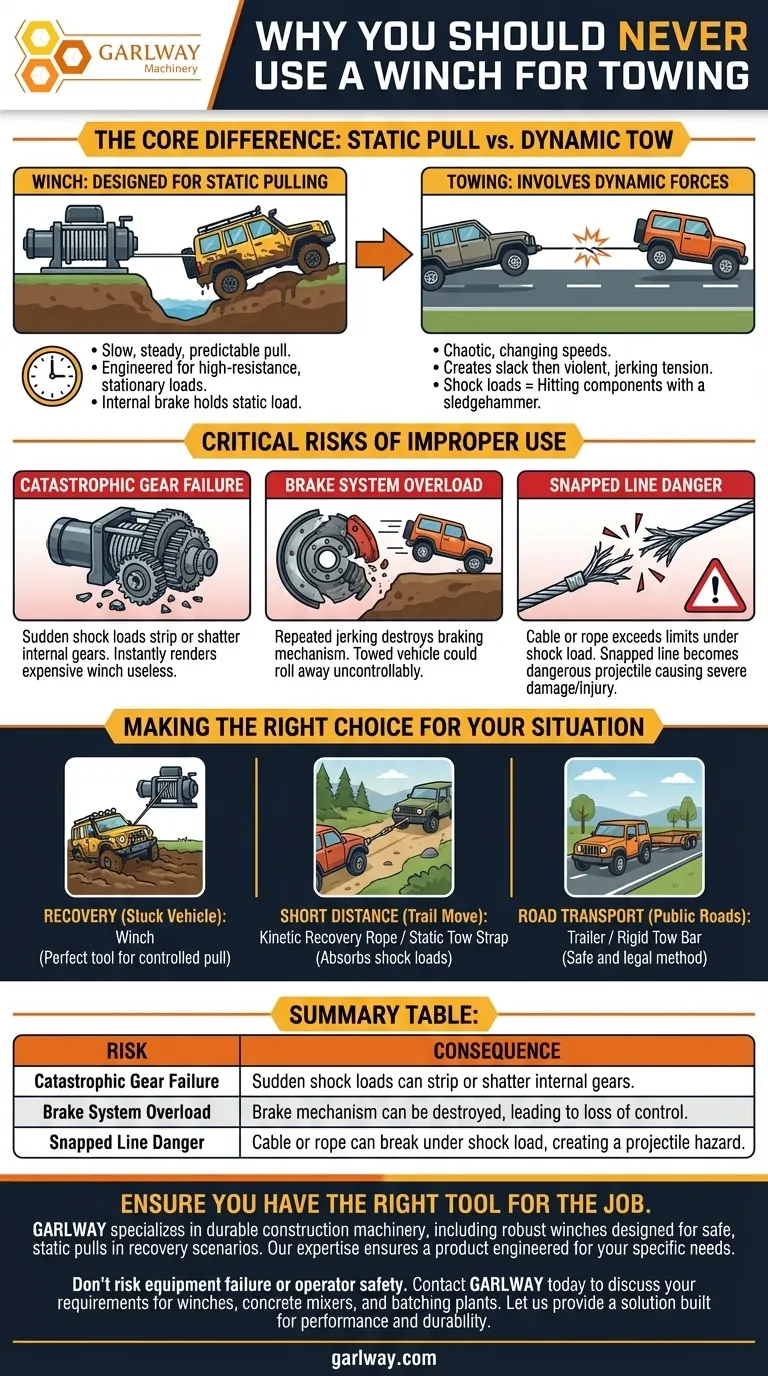
Catastrophic Gear Failure
The gears inside your winch are designed for a smooth transfer of power. A shock load bypasses this design entirely.
The sudden, jarring force can chip gear teeth or shatter the entire gearset. This will instantly render your expensive winch useless.
Brake System Overload
A winch's automatic brake is designed to hold a load, not to absorb the continuous push-and-pull forces of a moving vehicle.
The repeated jerking can overwhelm and destroy the braking mechanism, creating a situation where the towed vehicle could roll away uncontrollably.
Snapped Line Danger
Both steel cable and synthetic rope have a maximum breaking strength based on a steady pull. Shock loading can cause them to exceed this limit instantaneously.
A snapped line under tension becomes a dangerous projectile that can cause severe damage or fatal injury to anyone nearby. Recovery straps are specifically designed with elasticity to absorb these shocks, a feature winch lines lack.
Making the Right Choice for Your Situation
Using the correct tool is paramount for safety and for protecting your equipment. Your choice should always be dictated by the specific task at hand.
- If your primary focus is recovering a stuck vehicle from mud, snow, or an obstacle: A winch is the perfect tool, providing the controlled, powerful pull required.
- If your primary focus is moving a disabled vehicle a short distance on a trail: A static tow strap or, preferably, a kinetic recovery rope is the correct choice, as it's designed to absorb shock loads.
- If your primary focus is transporting a vehicle on public roads: A rigid tow bar setup or a trailer is the only safe and legal method.
Matching the tool to the task is the fundamental principle of safe and effective vehicle recovery and transport.
Summary Table:
| Risk | Consequence |
|---|---|
| Catastrophic Gear Failure | Sudden shock loads can strip or shatter internal gears. |
| Brake System Overload | Brake mechanism can be destroyed, leading to loss of control. |
| Snapped Line Danger | Cable or rope can break under shock load, creating a projectile hazard. |
Ensure you have the right tool for the job. GARLWAY specializes in durable construction machinery, including robust winches designed for safe, static pulls in recovery scenarios. For construction companies and contractors who rely on dependable equipment, our expertise ensures you get a product engineered for your specific needs.
Don't risk equipment failure or operator safety. Contact GARLWAY today to discuss your requirements for winches, concrete mixers, and batching plants, and let us provide a solution built for performance and durability.
Visual Guide
Related Products
- Warn Winch Windlass Boat Trailer Winch
- Electric and Hydraulic Winch for Heavy Duty Applications
- Small Electric Winch 120V and 240V for Compact Applications
- 12000 lb Electric Boat Trailer Winch with Windlass Anchor Warn
- Quick Windlass Portable Winch for Truck and Boat Best Boat Winch
People Also Ask
- What are the main components of a boat trailer winch? A Guide to Safe & Efficient Boat Loading
- What factors should be considered when choosing a boat trailer winch? Ensure Safe and Effortless Boat Loading
- What is the purpose of boat trailer winches? Safely and Efficiently Load Your Boat
- What are the two main types of boat trailer winches? Manual vs. Electric Explained
- How often should a boat trailer winch be replaced? Your Guide to Safety and Longevity