In hazardous environments, hydraulic winches are overwhelmingly preferred because their fundamental design eliminates the risk of electrical sparks. Unlike electric models, their power comes from pressurized fluid, a non-ignition source, making them intrinsically safer for use in explosive atmospheres containing flammable gas or dust.
The core reason for choosing a hydraulic winch in a hazardous location is risk mitigation. Its mechanical operation, powered by fluid dynamics rather than electricity, removes the single most common ignition source—electrical arcing—that an electric winch could introduce.
The Core Safety Advantage: Eliminating Ignition Risk
The primary differentiator between winch types in hazardous settings is their potential to start a fire or explosion. The choice is less about power and more about the physics of how that power is generated.
How Electric Winches Pose a Risk
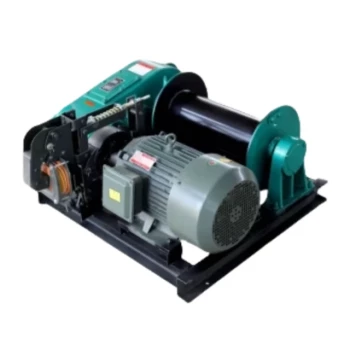
Electric winches rely on an electric motor. The brushes within these motors can create small sparks during normal operation, especially under heavy load or during startup.
In a controlled environment, these sparks are harmless. In an atmosphere with combustible dust or flammable vapors, a single spark can be catastrophic.
The Hydraulic Alternative
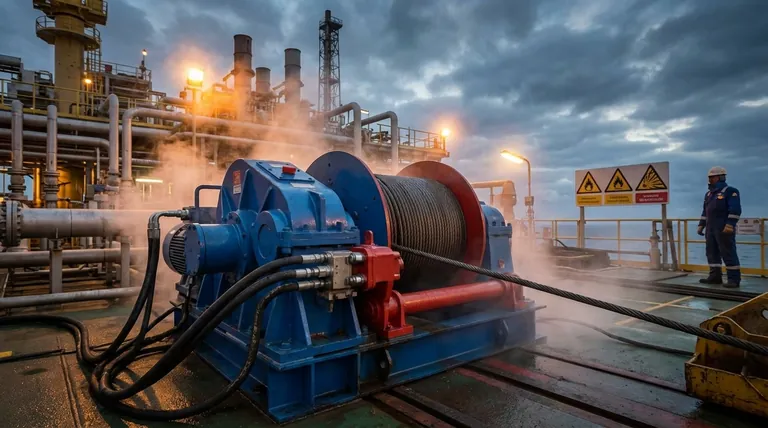
Hydraulic winches are driven by a hydraulic motor that uses the force of pressurized fluid to create rotational motion. This process is purely mechanical.
There are no brushes, electrical windings, or commutators at the winch itself that can create an arc or spark. This fundamental design difference makes it the default choice for safety-critical applications.
Cooler Operation Under Load
Beyond sparks, extreme heat can also be an ignition source. Hydraulic systems are generally more adept at dissipating heat over long, strenuous pulls.
This allows them to perform continuous duty cycles without the risk of overheating components to a point where they could ignite surrounding materials.
Built for Harsh and Demanding Conditions
Hazardous environments are often harsh in other ways—corrosive, remote, or physically demanding. The characteristics that make hydraulic winches safe also make them exceptionally durable and reliable.
Superior Durability and Power
Hydraulic systems are known for their high power-to-size ratio and robust construction. They are built to withstand the tough conditions found in industries like mining, marine, and oil and gas.
This inherent durability ensures they function reliably when called upon in critical situations.
Precise and Safe Load Control
Hydraulic winches offer exceptionally smooth and variable speed control without needing complex and expensive electronics like Variable Frequency Drives (VFDs).
Many are also equipped with fail-safe mechanisms that prevent overloading or abrupt load movements, adding another layer of operational safety in a sensitive environment.
Understanding the Trade-offs and Alternatives
While superior for hazardous zones, hydraulic winches are not the universal solution. Their primary drawback is their power source requirement.
The Hydraulic Power Unit Requirement
An electric winch can be wired to a battery. A hydraulic winch requires a hydraulic power source, such as a vehicle's power take-off (PTO), its power steering pump, or a separate hydraulic power unit (HPU).
This adds a layer of complexity and dependency that may not be available or practical for all applications.
The Key Alternative: Air Winches
Air (pneumatic) winches are another excellent choice for explosive environments. Powered by compressed air, they also lack any internal electrical components that could create sparks or heat.
The decision between a hydraulic and an air winch often comes down to which power source—a hydraulic pump or an air compressor—is more readily available on-site.
Making the Right Choice for Your Environment
Selecting the appropriate winch requires a clear assessment of the operational environment and its inherent risks.
- If your primary focus is absolute safety in an explosive atmosphere: A hydraulic or air winch is the only responsible choice, as they eliminate the risk of electrical ignition.
- If your primary focus is continuous, heavy-duty operation in a non-hazardous area: A hydraulic winch is an excellent choice for its durability and resistance to overheating.
- If your primary focus is convenience and occasional use in a safe environment: An electric winch is often the most practical and cost-effective solution.
Ultimately, prioritizing the specific risks of your environment will always guide you to the correct and safest technology.
Summary Table:
| Feature | Hydraulic Winch | Electric Winch |
|---|---|---|
| Ignition Risk | None (spark-free) | Present (sparks from motor) |
| Power Source | Pressurized Fluid | Electricity |
| Heat Dissipation | Excellent | Can overheat under load |
| Ideal For | Hazardous, explosive areas | Safe, non-hazardous areas |
Ensure maximum worksite safety with GARLWAY hydraulic winches.
Our winches are specifically designed for hazardous environments where safety is non-negotiable. GARLWAY specializes in robust construction machinery, offering reliable winches, concrete mixers, and concrete batching plants for construction companies and contractors globally.
Let us help you mitigate risk and enhance operational safety. Contact our experts today to find the perfect explosion-proof solution for your project.
Visual Guide

Related Products
- Hydraulic Winding Engine Harbor Freight Winch
- Electric and Hydraulic Winch for Heavy Duty Applications
- Small Electric Winch 120V and 240V for Compact Applications
- Electric 120V Boat Winch by Badlands
- 12000 lb Electric Boat Trailer Winch with Windlass Anchor Warn
People Also Ask
- What role does hydraulic fluid play in hydraulic winches? It's the Lifeblood of Your Heavy-Duty Pulling Power
- What vehicles commonly use hydraulic winches? For Industrial Trucks Needing Unmatched Power
- What are the features of hydraulic winches? Unmatched Power and Continuous Duty for Heavy Loads
- What preventive measures can be taken to avoid oil leakage in hydraulic winches? Ensure Long-Term Reliability
- What does 'power out' mean in a hydraulic winch? Achieve Absolute Control When Lowering Heavy Loads