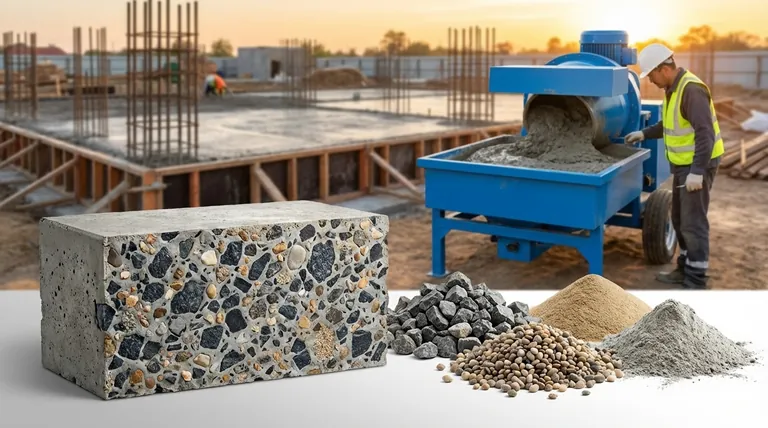
At its core, the strongest concrete is not defined by a single magic ingredient but by a principle of maximum density. It is a carefully engineered composition where cement paste completely fills the voids between sand particles, and this resulting mortar then perfectly fills the voids between the larger coarse aggregate, creating a solid, unified mass.
The fundamental goal in designing high-strength concrete is the systematic elimination of empty space. Strength is achieved when every particle, from the largest stone to the finest grain of cement, is perfectly packed and bonded together, leaving no voids to become points of failure.
The Principle of Maximum Density
To understand strength, it's helpful to visualize concrete not as a single material, but as a system of particles within particles.
The Jar Analogy
Imagine filling a glass jar with large rocks. You can still see significant empty spaces, or voids, between them. The jar is not at its maximum density.
Now, if you pour pebbles into that same jar, they will fill the large voids between the rocks. The jar's contents are now much denser.
Finally, if you pour sand into the jar, it will fill the even smaller voids between the pebbles. If you could then pour in water with a binding agent to fill the final microscopic voids and lock everything in place, you would have an incredibly dense and solid block. This is the guiding principle of strong concrete.
The Three Critical Components
Each ingredient in a concrete mix has a specific role in achieving this packed, void-free structure.
Coarse Aggregate: The Structural Skeleton
Coarse aggregates, like crushed stone or gravel, form the primary structure of the concrete. They are the "large rocks" in our analogy. Their own inherent strength and shape contribute significantly to the final product's ability to resist loads.
Fine Aggregate (Sand): The First Void Filler
Sand acts as the fine aggregate. Its purpose is to fill the spaces between the coarse aggregate particles, just as the pebbles filled the gaps between the rocks. A proper mix ensures there's just enough sand to fill these voids without pushing the coarse aggregates apart.
Cement Paste: The Ultimate Binder
The cement paste, a mixture of cement and water, is the final and most critical element. It performs two jobs:
- It coats every single particle of sand and gravel, acting as the glue that bonds the entire matrix together.
- It fills the final, microscopic voids that remain between the sand particles, ensuring the mixture achieves its maximum possible density.
The quality of this paste, primarily determined by the water-to-cement ratio, is paramount. Less water leads to a denser, stronger paste with fewer internal voids.
Understanding the Trade-offs
Pursuing maximum theoretical strength often involves practical compromises that must be considered.
Strength vs. Workability
A concrete mix designed for extreme strength often has a very low water-to-cement ratio. This makes the paste very thick and the overall mix stiff. While strong, this "low-slump" concrete can be incredibly difficult to pour, place into forms, and finish properly.
The Myth of "More Cement"
Simply adding more cement is not a guaranteed path to stronger concrete. The strength is dictated by the ratios between the components. An excess of cement paste can lead to increased cost, higher shrinkage, and a greater potential for cracking, which can compromise the structure's long-term durability.
Making the Right Choice for Your Goal
The "strongest" composition depends on balancing theoretical ideals with practical requirements.
- If your primary focus is maximum compressive strength: Prioritize a low water-to-cement ratio and use a well-graded aggregate mix that ensures particles of many sizes are present to fill voids efficiently.
- If your primary focus is a balance of strength and usability: You will need a mix with enough workability to be placed correctly, which may mean accepting a slightly higher water content or using chemical admixtures (superplasticizers) to improve flow without sacrificing strength.
Ultimately, building the strongest concrete is an exercise in mastering density.
Summary Table:
| Component | Role in Achieving Maximum Strength |
|---|---|
| Coarse Aggregate | Forms the structural skeleton; its strength and grading are critical. |
| Fine Aggregate (Sand) | Fills voids between coarse aggregate particles for denser packing. |
| Cement Paste | Binds all particles and fills microscopic voids; low water-to-cement ratio is key. |
| Principle | Systematic elimination of voids through optimal particle packing. |
Need high-strength concrete for your next project? GARLWAY specializes in providing robust construction machinery, including concrete mixers and batching plants, designed to help contractors and construction companies achieve optimal concrete density and strength. Let our expertise support your success. Contact us today to discuss your specific requirements!
Visual Guide

Related Products
- Portable Concrete Mixer Machine Equipment for Mixing Concrete
- Portable Cement Mixer with Lift Concrete Machine
- Portable Ready Mix Concrete Mixer Equipment
- HZS180 Ready Mix Concrete Plant for Foundations with Sand and Cement
- Construction Products Concrete Plant Machine Mixing Concrete Mixer
People Also Ask
- Why is it necessary to use a portable concrete mixer? Gain Total Control & Efficiency
- How much concrete can you pour with a portable mixer? Find the Perfect Fit for Your Project
- What types of projects are portable concrete mixers suitable for? Ideal for DIY & Small-Scale Construction
- How much does a portable concrete mixer hold? A Guide to Choosing the Right Capacity
- What types of portable concrete mixers exist? Find the Perfect Mixer for Your Project