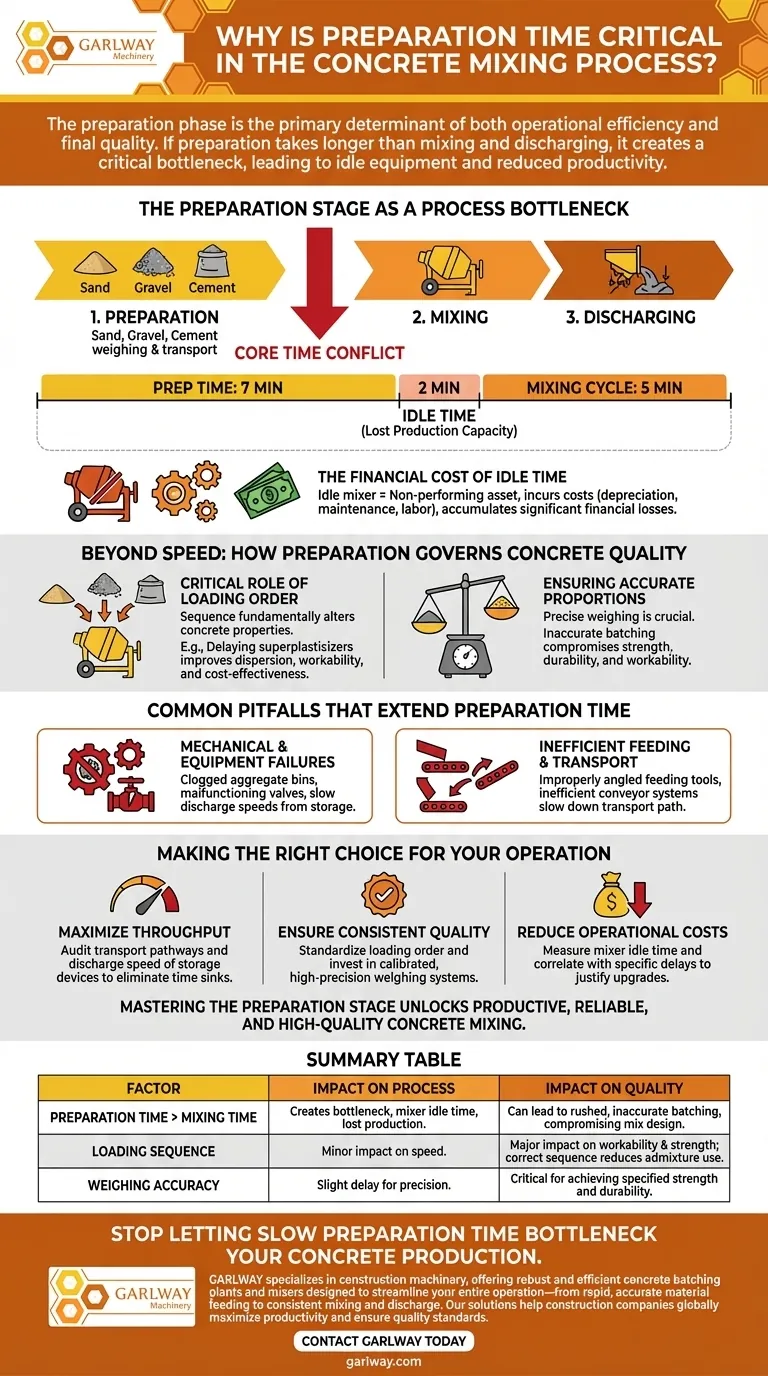
The preparation phase in concrete mixing is far more than simple setup; it is the primary determinant of both operational efficiency and the final quality of the material. If the time required to accurately weigh and transport raw materials like sand and gravel exceeds the time spent on mixing and discharging, it creates a critical bottleneck. This leads directly to idle equipment and a significant reduction in overall productivity.
The importance of preparation time extends beyond preventing process bottlenecks. While a slow prep stage creates costly delays, the sequence of material loading during this phase also directly impacts the concrete's final workability and strength.
The Preparation Stage as a Process Bottleneck
The entire concrete production cycle is a sequence of events: preparation, mixing, and discharging. The efficiency of the whole system is dictated by its slowest part.
The Core Time Conflict
The fundamental challenge is that the mixer can only work as fast as it is fed. If the mixing and discharge cycle takes 5 minutes, but preparing the next batch takes 7 minutes, the mixer will sit idle for 2 minutes every single cycle.
This idle time represents a direct loss of production capacity. The equipment is available, but it cannot be used because the preceding step is lagging.
The Financial Cost of Idle Time
An idle mixer is a non-performing asset that still incurs costs like depreciation, maintenance, and operator labor. Over the course of a day or week, these small delays accumulate into significant financial losses and missed production targets.
Beyond Speed: How Preparation Governs Concrete Quality
While efficiency is a major concern, rushing the preparation stage or performing it incorrectly has severe consequences for the final product.
The Critical Role of Loading Order
The sequence in which materials are added to the mixer can fundamentally alter the concrete's properties.
For example, delaying the addition of high-range water reducers (superplasticizers) can improve cement particle dispersion. This allows for achieving the desired workability with a lower dosage, improving both cost-effectiveness and performance.
Ensuring Accurate Proportions
The preparation stage is where the precise weighing of all constituents occurs. An inaccurate or rushed weighing process compromises the entire mix design, potentially leading to a batch with inadequate strength, durability, or workability.
Common Pitfalls That Extend Preparation Time
Several mechanical and logistical issues can slow down the preparation phase, turning it into the primary bottleneck.
Mechanical and Equipment Failures
The smooth operation of the feeding system is paramount. Issues like clogged aggregate bins, malfunctioning valves, or slow discharge speeds from temporary storage can add significant time to each cycle.
Inefficient Feeding and Transport
The physical path materials take from storage to the mixer can be a source of delay. Improperly angled feeding tools or inefficient conveyor systems slow down the entire transport process.
Making the Right Choice for Your Operation
To transform your preparation stage from a liability into an asset, focus your improvements on your most critical goal.
- If your primary focus is maximizing throughput: Audit your material transport pathways and the discharge speed of storage devices to identify and eliminate the most significant time sinks.
- If your primary focus is ensuring consistent quality: Standardize your constituent loading order and invest in regularly calibrated, high-precision weighing systems to guarantee mix accuracy.
- If your primary focus is reducing operational costs: Directly measure mixer idle time and correlate it with specific delays in the preparation phase to justify targeted equipment upgrades or process changes.
Ultimately, mastering the preparation stage is the key to unlocking a more productive, reliable, and high-quality concrete mixing operation.
Summary Table:
| Factor | Impact on Process | Impact on Quality |
|---|---|---|
| Preparation Time > Mixing Time | Creates a bottleneck, causing mixer idle time and lost production. | Can lead to rushed, inaccurate batching, compromising mix design. |
| Loading Sequence | Minor impact on speed. | Major impact on workability and strength; correct sequence can reduce admixture use. |
| Weighing Accuracy | Slight delay for precision. | Critical for achieving specified strength and durability. |
Stop letting slow preparation time bottleneck your concrete production.
GARLWAY specializes in construction machinery, offering robust and efficient concrete batching plants and mixers designed to streamline your entire operation—from rapid, accurate material feeding to consistent mixing and discharge.
Our solutions help construction companies and contractors globally maximize productivity, reduce costly idle time, and ensure every batch meets your quality standards.
Contact GARLWAY today to discuss how we can optimize your concrete mixing process!
Visual Guide
Related Products
- Portable Concrete Mixer Machine Equipment for Mixing Concrete
- Construction Products Concrete Plant Machine Mixing Concrete Mixer
- Portable Electric Concrete Mixer Machine for Cement Mixing
- Concrete Cement Mixer Machine Drum Mixer for Construction
- HZS90 Large Multiquip Concrete Mixers for Construction
People Also Ask
- Why is it necessary to use a portable concrete mixer? Gain Total Control & Efficiency
- How much concrete can you pour with a portable mixer? Find the Perfect Fit for Your Project
- What types of projects are portable concrete mixers suitable for? Ideal for DIY & Small-Scale Construction
- How much does a portable concrete mixer hold? A Guide to Choosing the Right Capacity
- What types of portable concrete mixers exist? Find the Perfect Mixer for Your Project