At its core, a Ready-Mix Concrete (RMC) plant is important because it industrializes concrete production. This shift from manual on-site mixing to a centralized, automated system provides the high-volume, precision-engineered concrete essential for the speed, scale, and structural demands of modern construction. It ensures every batch meets exact specifications, a level of quality control that is virtually impossible to achieve otherwise.
The fundamental importance of an RMC plant lies in its ability to remove guesswork and human error from concrete production. It transforms concrete from a simple mixture into a reliable, factory-produced material with guaranteed performance characteristics.
The Core Advantages of Centralized Production
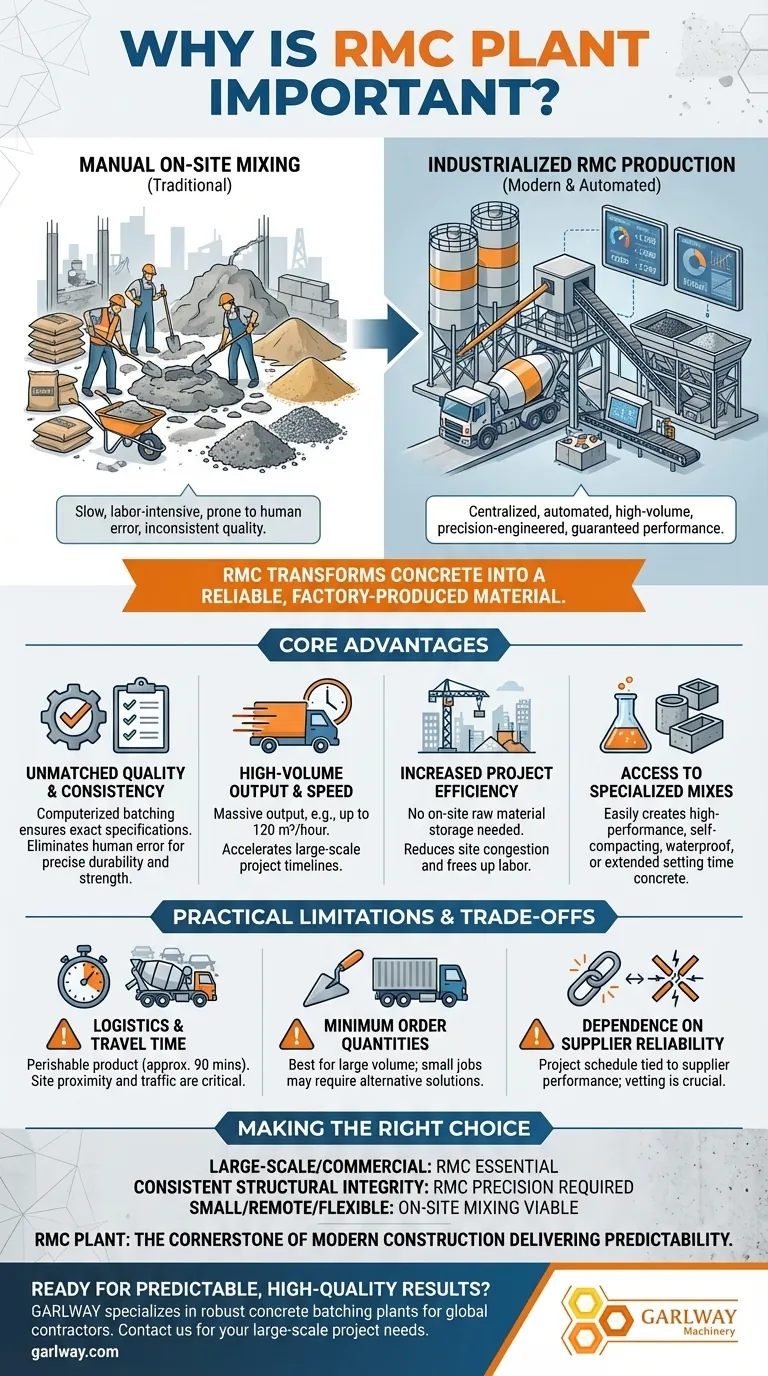
The value of an RMC plant stems from centralizing the entire production process in a controlled environment, away from the chaos of the construction site. This single change unlocks several critical benefits.
Unmatched Quality Control and Consistency
An RMC plant operates using computerized batching systems. These systems precisely weigh every component—cement, aggregates, water, and chemical admixtures—according to a pre-programmed mix design.
This automation eliminates the human error inherent in manual mixing, ensuring that every cubic meter of concrete has the exact same properties. This consistency is critical for achieving the specified durability and strength required for modern infrastructure.
High-Volume Output and Speed
Commercial RMC plants are engineered for massive output. A plant like an HZS120 model can produce up to 120 cubic meters of concrete per hour.
This high capacity allows for continuous pouring on large-scale projects, such as foundations for high-rise buildings or long stretches of highway. It drastically accelerates project timelines compared to the slow, labor-intensive process of on-site mixing.
Increased Project Efficiency
By outsourcing concrete production, construction sites become more efficient. There is no need for large on-site storage areas for raw materials like sand, gravel, and cement bags.
This reduces site congestion, minimizes material waste from spillage or weather damage, and frees up labor to focus on placement and finishing rather than mixing.
Access to Specialized Concrete Mixes
Modern construction often demands high-performance or specialized concrete mixes that are difficult to create manually.
RMC plants can easily and accurately incorporate a wide range of admixtures to create concrete that is self-compacting, high-strength, waterproof, or has an extended setting time. This capability enables more advanced and resilient architectural and engineering designs.
Understanding the Practical Limitations
While invaluable, the RMC model is not without its operational trade-offs. Recognizing these limitations is key to effective project planning.
The Challenge of Logistics and Travel Time
Concrete is a perishable product. Once water is added, the hydration process begins, and the concrete must be placed and finished within a limited timeframe, typically 90 minutes.
The distance between the RMC plant and the construction site is therefore critical. Traffic delays or long travel times can cause a truckload of concrete to be rejected, leading to costly waste and project setbacks.
Minimum Order Quantities
RMC plants are designed for volume. For very small projects, such as a minor repair or a small residential patio, the required amount of concrete may be less than the plant's minimum order quantity.
In these specific scenarios, manual on-site mixing or using bagged concrete mixes can be a more practical and cost-effective solution.
Dependence on Supplier Reliability
When you rely on an RMC supplier, your project's schedule is directly tied to their operational performance.
Any breakdown at the plant, shortage of raw materials, or dispatching errors can bring your on-site work to an immediate halt. This dependency requires careful vetting and communication with your concrete provider.
Making the Right Choice for Your Project
The decision to use Ready-Mix Concrete should be based on the scale, specifications, and logistical realities of your construction project.
- If your primary focus is large-scale infrastructure or commercial building: The high volume and strict quality control of an RMC plant are absolutely essential.
- If your primary focus is consistent structural integrity: The precision of an automated RMC plant is the only way to guarantee that every batch of concrete meets engineering requirements.
- If you're working on a small, remote, or time-flexible project: The logistical challenges and costs of RMC might make carefully managed on-site mixing a more viable alternative.
Ultimately, the RMC plant is a cornerstone of modern construction because it delivers the one thing every major project needs: predictability.
Summary Table:
| Key Benefit | Description |
|---|---|
| Quality & Consistency | Computerized batching ensures every batch meets exact strength and durability specifications. |
| High-Volume Output | Capable of producing up to 120 cubic meters per hour for large-scale projects. |
| Project Efficiency | Eliminates on-site material storage and mixing, freeing up labor and space. |
| Specialized Mixes | Enables the production of advanced, high-performance concrete for complex designs. |
| Operational Consideration | Description |
| Logistics & Travel Time | Concrete is perishable; site proximity is critical to avoid waste. |
| Minimum Order Quantities | Best suited for large projects; small jobs may require alternative solutions. |
Ready to achieve predictable, high-quality results on your next project?
GARLWAY specializes in providing robust and reliable concrete batching plants for construction companies and contractors globally. Our solutions are engineered to deliver the consistent, high-volume output your large-scale projects demand.
Contact GARLWAY today to discuss how our concrete batching plants can become the reliable cornerstone of your construction operations.
Visual Guide
Related Products
- HZS120 Ready Mix Concrete Batching Plant Commercial Mud Cement Mixer
- HZS180 Ready Mix Concrete Plant for Foundations with Sand and Cement
- Portable Ready Mix Concrete Mixer Equipment
- Ready Mixer Machine for Construction Ready Mix Machinery
- HZS35 Small Cement Concrete Mixing Batch Plant
People Also Ask
- What is a ready mix concrete batching plant? The Engine of Modern Construction
- What is the name of the machine used in ready mix? Unpacking the Complete Concrete System
- What is the core component of a concrete batching plant? The Mixer Unit Defines Your Concrete Quality
- What are the types of concrete mixers used in batching plants? Choose the Right Mixer for Your Project
- What are the advantages and disadvantages of concrete batching plants? Maximize Quality & Efficiency