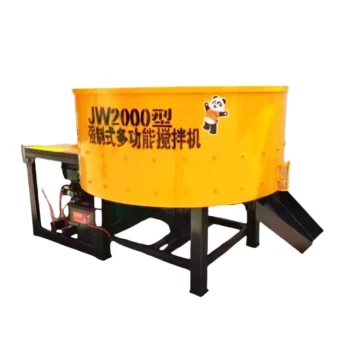
In essence, concrete batching plants are the industrial heart of any project requiring large volumes of high-quality, precisely mixed concrete. They are most commonly deployed for large-scale infrastructure, high-volume commercial construction, and the manufacturing of precast concrete products where consistency and efficiency are paramount.
The decision to use a concrete batching plant is driven by project scale. It becomes essential when the demand for concrete is too large, too sustained, or requires a level of quality control that cannot be achieved with manual or small-scale mixing methods.
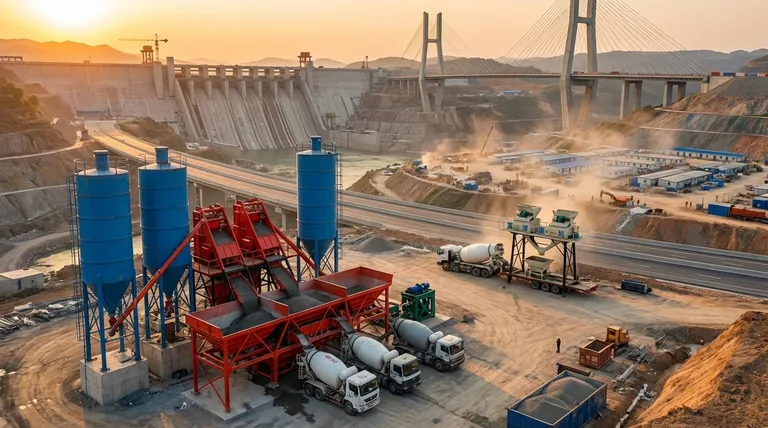
The Core Application: Large-Scale Infrastructure
The most common use for concrete batching plants is in major civil infrastructure projects. These endeavors are defined by their massive concrete requirements, long durations, and the need for unwavering material consistency.
Water, Power, and Bridge Construction
These projects—such as dams, power plants, and large bridges—form the bedrock of batching plant usage. The construction involves enormous, continuous pours that can last for many hours or days.
A batching plant ensures a steady, uninterrupted supply of concrete mixed to exact engineering specifications, which is critical for the structural integrity of these massive structures.
Road and Highway Development
Building roads requires a continuous supply of concrete for paving over long distances. A dedicated plant, often a mobile one, can move with the project or be set up at a strategic point to feed paving machines efficiently.
This on-site or near-site production minimizes transport time, ensuring the concrete maintains its optimal properties before it's laid.
Beyond Infrastructure: Commercial and Industrial Uses
While massive public works are a primary driver, batching plants are equally vital in the private sector for producing concrete as a finished product or a core component.
Ready-Mix Concrete Production
Stationary batching plants are the backbone of the ready-mix concrete industry. These facilities are permanent installations that supply concrete to a wide variety of local projects, from residential foundations to urban high-rises.
They function as a central hub, taking orders and dispatching mixer trucks to various construction sites within a specific radius.
Precast Concrete Manufacturing
The precast industry relies on batching plants to produce standardized concrete components in a controlled factory environment. This includes items like wall panels, beams, pipes, and blocks.
Because these elements are manufactured, the precision and repeatability offered by an automated batching plant are non-negotiable for meeting quality standards.
Specialized Industrial Roles
The versatility of these plants allows them to be used in other heavy industries. In mining, they are used for ground support and infrastructure, while in recycling, they can process construction waste into new aggregate materials.
Understanding the Key Trade-off: Stationary vs. Mobile
The choice between a stationary and a mobile plant is a critical decision that reflects the core logistics of the project itself.
The Role of Stationary Plants
A stationary batching plant is a large, permanent facility built for long-term, high-volume output. It is the standard choice for ready-mix companies and precast concrete factories that serve a consistent, regional market.
Their size and stability allow for higher production capacities and more complex batching systems, making them ideal for continuous commercial operations.
The Advantage of Mobile Plants
A mobile batching plant provides a flexible solution for on-site production. It is designed to be transported, assembled, and operated directly at a large, temporary construction site.
This is the ideal solution for remote projects like dams or for linear projects like highways, where transporting wet concrete from a distant central plant would be impractical and costly.
Making the Right Choice for Your Goal
Selecting the correct batching plant strategy is fundamental to a project's budget and timeline. Your decision should be guided by the nature of the demand.
- If your primary focus is supplying a metropolitan area: A permanent, high-capacity stationary plant is the correct choice for a ready-mix business.
- If your primary focus is building a remote dam or a long highway: A mobile batching plant offers the on-site efficiency needed to overcome logistical challenges.
- If your primary focus is mass-producing identical concrete products: A dedicated stationary plant integrated into a precast factory is essential for quality control.
Ultimately, a concrete batching plant is the tool that enables modern construction to achieve the necessary scale and precision.
Summary Table:
| Project Type | Common Plant Type | Key Benefit |
|---|---|---|
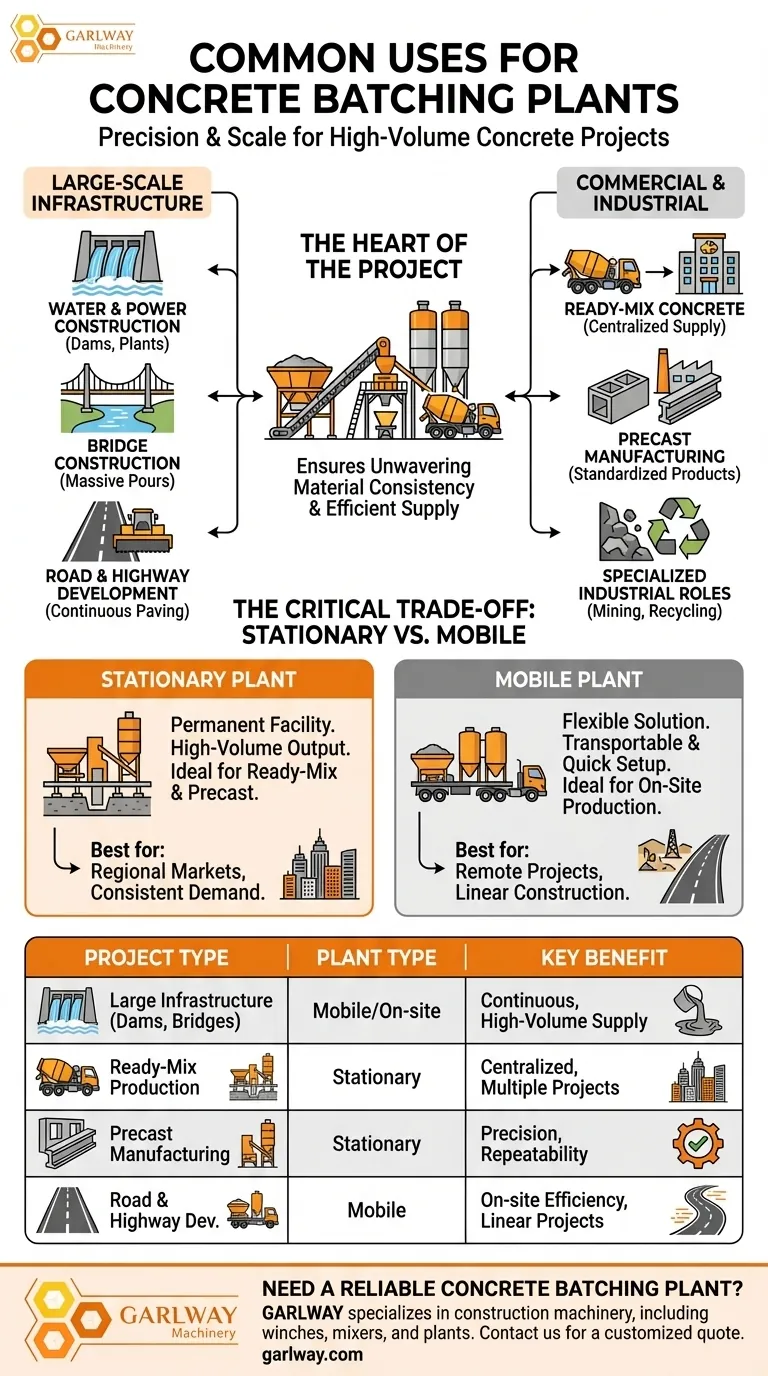
| Large Infrastructure (Dams, Bridges) | Mobile or On-site Plant | Continuous, high-volume supply for massive pours |
| Ready-Mix Concrete Production | Stationary Plant | Centralized supply for multiple local projects |
| Precast Concrete Manufacturing | Stationary Plant | Precision and repeatability for standardized products |
| Road & Highway Development | Mobile Plant | On-site efficiency for linear projects |
Need a reliable concrete batching plant for your next project? GARLWAY specializes in construction machinery, offering durable and efficient winches, concrete mixers, and concrete batching plants for construction companies and contractors globally. Let us help you choose the right solution to meet your project's scale and quality demands. Contact our experts today to discuss your requirements and get a customized quote!
Visual Guide
Related Products
- HZS35 Small Cement Concrete Mixing Batch Plant
- HZS120 Ready Mix Concrete Batching Plant Commercial Mud Cement Mixer
- HZS75 Concrete Batching Plant Cement Mixer Price Concrete Mixer Bunnings Mixing Plant
- HZS180 Ready Mix Concrete Plant for Foundations with Sand and Cement
- Commercial Electric Concrete Mixer Machine HZS 50 Small Batch Plant for Sale
People Also Ask
- Why buy concrete batch plant parts only from the manufacturer? Protect Your Investment and Maximize Uptime
- Why is proper maintenance important for a concrete batch mix plant? Maximize Uptime & Profitability
- What is the advantage of a mobile concrete batching plant? Achieve On-Site Production & Total Control
- What are the advantages and disadvantages of concrete batching plants? Maximize Quality & Efficiency
- What are the two methods of material charging in a concrete mixing station? Single vs. Multiple Charging Explained