
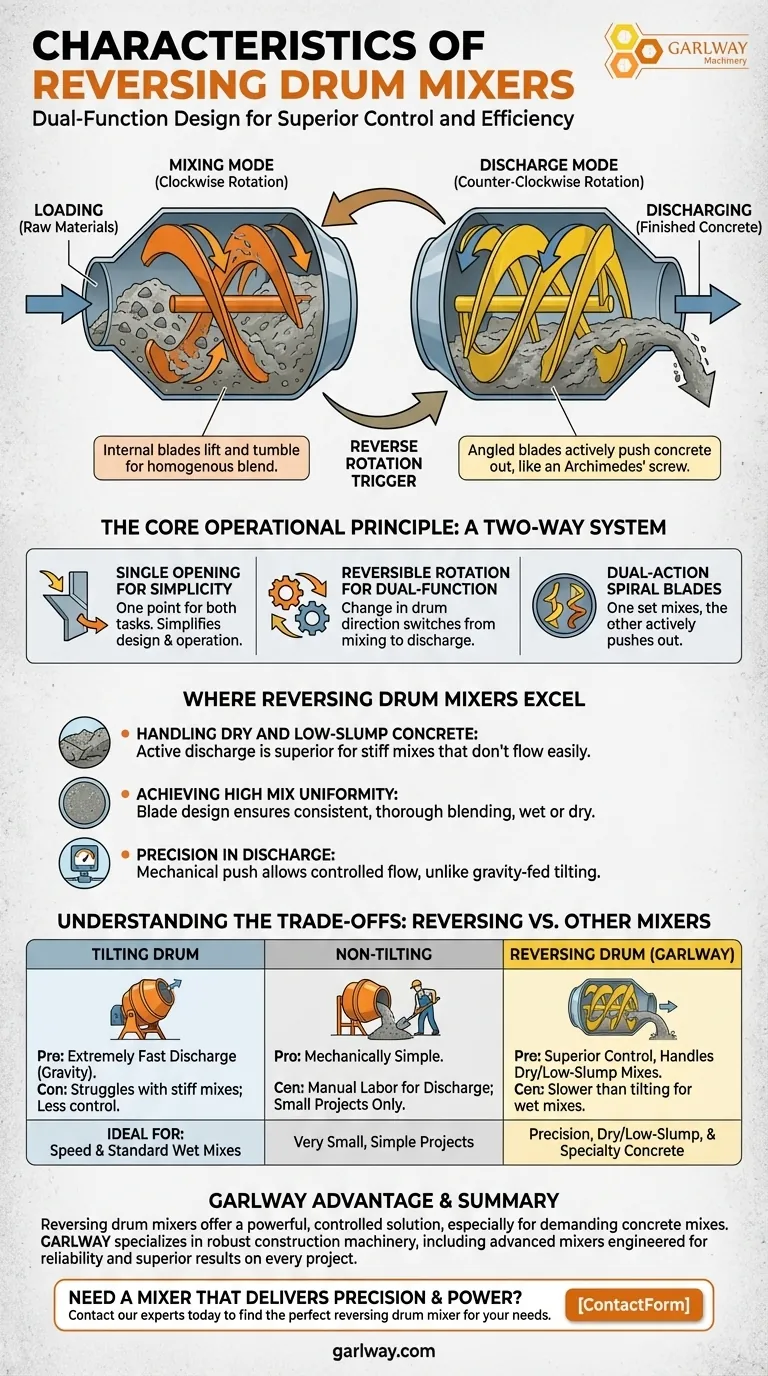
At its core, a reversing drum mixer is defined by its unique dual-function design. It uses a single opening for both loading raw materials and discharging the finished concrete, relying on a change in the drum's rotational direction to switch between these two tasks.
The defining characteristic of a reversing drum mixer is not just that it reverses, but why it reverses. Its specialized internal blades are designed to mix in one direction and actively push concrete out in the other, offering superior control and efficiency, especially with drier, less-flowable mixes.
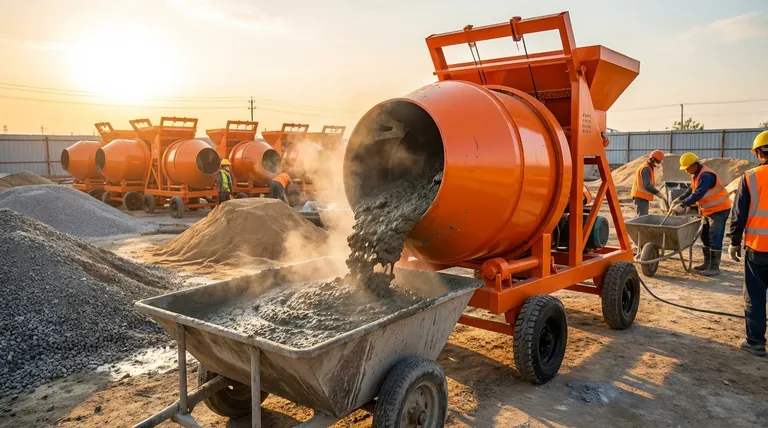
The Core Operational Principle: A Two-Way System
To understand the value of a reversing drum mixer, you must first understand its three key mechanical features that work in concert.
A Single Opening for Simplicity
Unlike some mixers that have separate loading and discharge points, the reversing drum uses the same opening for both. This simplifies the overall machine design and operation.
Reversible Rotation for Dual-Function
The mixer’s drum rotates in one direction to perform the mixing action. The internal blades lift and tumble the materials to create a homogenous blend.
When the mix is ready, the direction of the drum’s rotation is reversed. This change in direction is the trigger that switches the machine from mixing mode to discharge mode.
Dual-Action Spiral Blades
This is the most critical component. Inside the drum are two distinct sets of spiral blades.
One set is designed for mixing, efficiently lifting and combining ingredients as the drum turns. The second set is angled differently, acting like an Archimedes' screw to push the concrete out of the opening when the drum's rotation is reversed.
Where Reversing Drum Mixers Excel
The unique mechanism of a reversing drum mixer makes it particularly suitable for specific types of concrete and project requirements.
Handling Dry and Low-Slump Concrete
The active discharge mechanism is highly effective at moving stiff, dry, or "low-slump" concrete mixes that do not flow easily on their own. This is a significant advantage over tilting mixers, which rely on gravity.
Achieving High Mix Uniformity
These mixers are known for producing extremely uniform and consistent concrete. The blade design ensures thorough blending of all components, whether the final product is intended to be wet or dry.
Precision in Discharge
Because the discharge is mechanical (pushed out by the blades) rather than gravitational (poured out by tilting), the operator has more precise control over the flow of concrete.
Understanding the Trade-offs: Reversing vs. Other Drum Mixers
No single mixer type is perfect for every job. The choice depends on the specific requirements of the concrete and the project's scale.
Comparison with Tilting Drum Mixers
Tilting drum mixers discharge their contents by tilting the entire drum downward. This is an extremely fast method for unloading standard, flowable concrete.
However, a reversing drum mixer offers more control and is far more effective for the stiffer mixes that a tilting mixer would struggle to empty completely.
Comparison with Non-Tilting Mixers
Non-tilting drum mixers are mechanically simpler but lack an automated discharge mechanism. They require manual labor to unload the concrete, making them suitable only for very small projects.
The reversing drum mixer provides a far more efficient and automated solution, bridging the gap between simple non-tilting models and large-scale continuous systems.
Making the Right Choice for Your Project
Selecting the appropriate mixer requires matching its core strengths to your primary goal.
- If your primary focus is speed with standard wet mixes: A tilting drum mixer is likely the most efficient choice for its rapid, gravity-assisted discharge.
- If your primary focus is handling dry, low-slump, or specialty concrete: The controlled, powered discharge of a reversing drum mixer makes it the superior option.
- If your primary focus is large-scale, continuous production: A continuous drum mixer, which mixes and discharges simultaneously, is designed for this purpose.
Understanding that a mixer's discharge method directly dictates its ideal application is the key to making an informed decision.
Summary Table:
| Characteristic | Advantage |
|---|---|
| Reversible Rotation | Switches between mixing and powered discharge modes. |
| Dual-Action Blades | One set mixes, the other actively pushes concrete out. |
| Single Opening | Simplified design for both loading and discharging. |
| Ideal for Dry Mixes | Superior handling of low-slump, stiff concrete. |
| High Uniformity | Produces a consistent, homogenous blend. |
Need a mixer that delivers precision and power for your toughest concrete jobs?
GARLWAY specializes in robust construction machinery, including advanced concrete mixers designed for contractors and construction companies who demand reliability and control. Our equipment is engineered to handle demanding mixes, helping you achieve superior results on every project.
Contact our experts today to find the perfect reversing drum mixer for your specific needs and discover the GARLWAY advantage in performance and durability.
Visual Guide
Related Products
- Belle Mixer Drum Self Loading Mortar Mixers JS3000
- Concrete Cement Mixer Machine Drum Mixer for Construction
People Also Ask
- What are the features of mobile transporting in a self loading mixer? Boost On-Site Efficiency
- Why is timely cleaning important for a self loading mixer? Prevent Costly Downtime and Mix Failure
- How is discharging accomplished in a self loading mixer? Master Precise Concrete Placement
- What is the purpose of keeping the drum rotating during transportation in a self loading concrete mixer? Ensure Quality & Consistency
- What components are involved in the loading process of a self loading concrete mixer? A Guide to the Key Systems

