
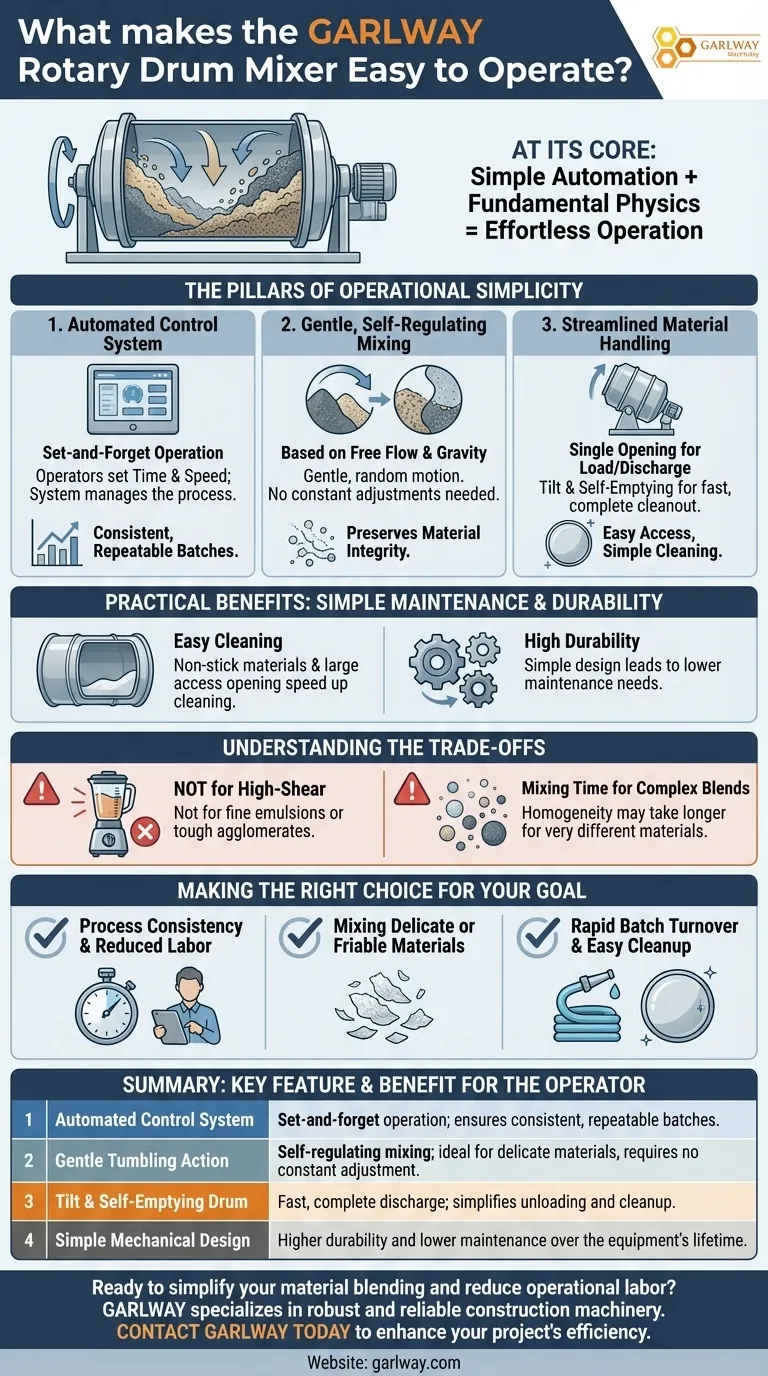
At its core, the rotary drum mixer is easy to operate because its design replaces complex manual intervention with simple automation and fundamental physics. Operators primarily set key parameters like mixing time and rotation speed, and the equipment's automated control system manages the entire process from start to finish.
The true advantage of a rotary drum mixer isn't just its automated controls, but how its entire design—from its gentle mixing action to its simple discharge and cleaning—minimizes the need for specialized operator skill and constant oversight.
The Pillars of Operational Simplicity
A rotary drum mixer's ease of use stems from three integrated design philosophies: automated process control, a passive mixing mechanism, and a streamlined physical layout for material handling.
The Automated Control System
The most direct contributor to its ease of use is the automated control system.
Operators do not need to manually manage the mixing cycle. They simply input the desired parameters through a control panel.
This includes setting the mixing time, rotation speed, and the operating mode for any internal agitators, if present. The machine then executes the cycle automatically and consistently.
The Gentle, Self-Regulating Mixing Action
The inherent physics of the mixer's operation reduces complexity. The method is based on the free flow of product within a slowly rotating vessel.
Rotation and gravity gently tumble and spread the materials. This creates a mild, random mixing motion that naturally results in a homogenous product without requiring aggressive or complex mechanical action.
This process is largely self-regulating, meaning it doesn't need constant adjustments to achieve a consistent result.
Streamlined Material Handling
The physical design is focused on simplifying the loading and unloading process.
Many designs feature a single opening for both charging materials and discharging the final product, minimizing complexity.
The ability to tilt the drum allows for a faster and more complete discharge rate. The internal vanes are designed to gently guide the product out, ensuring the mixer empties itself completely.
The Practical Benefit: Simple Maintenance
Operational simplicity extends beyond the mixing cycle to include cleanup and upkeep.
Ease of Cleaning
Features like a single, large opening and the ability to tilt the drum provide easy access to the interior for cleaning.
Drums made from materials like polyethylene offer non-stick surfaces, which further simplifies and speeds up the cleaning process between batches.
Durability and Reliability
The simple mechanical design, with fewer complex moving parts compared to more intensive mixers, often leads to higher durability and lower maintenance requirements over the equipment's lifetime.
Understanding the Trade-offs
The simplicity of the rotary drum mixer is its greatest strength, but it also defines its limitations.
Not for High-Shear Applications
The gentle, tumbling action is ideal for blending powders, granules, or delicate materials. However, it is not suitable for applications requiring high shear, such as creating fine emulsions or breaking down tough agglomerates.
Mixing Time for Complex Blends
While effective for most blends, achieving perfect homogeneity with materials of vastly different densities or particle sizes may take longer than in more aggressive mixer types. The process relies on randomization rather than forceful mechanical action.
Making the Right Choice for Your Goal
Your specific operational needs will determine if the rotary drum mixer's simplicity is the right fit.
- If your primary focus is process consistency and reduced labor: The automated controls ensure repeatable batches with minimal operator training or intervention.
- If your primary focus is mixing delicate or friable materials: The gentle, gravity-led tumbling action preserves particle integrity better than high-impact mixers.
- If your primary focus is rapid batch turnover and easy cleanup: The self-emptying design and simple-to-clean drum materials are significant operational advantages.
Ultimately, the rotary drum mixer empowers operators by using a simple, reliable design to deliver consistent results.
Summary Table:
| Key Feature | Benefit for the Operator |
|---|---|
| Automated Control System | Set-and-forget operation; ensures consistent, repeatable batches. |
| Gentle Tumbling Action | Self-regulating mixing; ideal for delicate materials, requires no constant adjustment. |
| Tilt & Self-Emptying Drum | Fast, complete discharge; simplifies unloading and cleanup. |
| Simple Mechanical Design | Higher durability and lower maintenance over the equipment's lifetime. |
Ready to simplify your material blending and reduce operational labor?
GARLWAY specializes in construction machinery, offering robust and reliable rotary drum mixers for construction companies and contractors globally. Our equipment is designed for ease of use, durability, and consistent performance.
Contact GARLWAY today to discuss how our concrete mixers and batching plants can enhance your project's efficiency and profitability.
Visual Guide
Related Products
- Belle Mixer Drum Self Loading Mortar Mixers JS3000
- Concrete Cement Mixer Machine Drum Mixer for Construction
- Harbor Freight JS1500 On Site Concrete Mixing Volumetric Cement Mixer
- JS1000 Volumetric Concrete Mortar Mixer for Sale Skid Steer Cement Mixer
- Shaft Mixer Machine for Cement and Regular Concrete Mixing
People Also Ask
- What are the features of mobile transporting in a self loading mixer? Boost On-Site Efficiency
- Why is timely cleaning important for a self loading mixer? Prevent Costly Downtime and Mix Failure
- How is discharging accomplished in a self loading mixer? Master Precise Concrete Placement
- What is the purpose of keeping the drum rotating during transportation in a self loading concrete mixer? Ensure Quality & Consistency
- What components are involved in the loading process of a self loading concrete mixer? A Guide to the Key Systems


