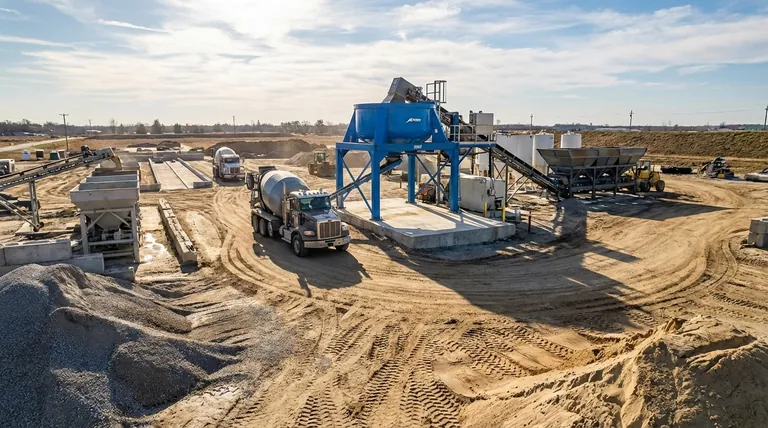
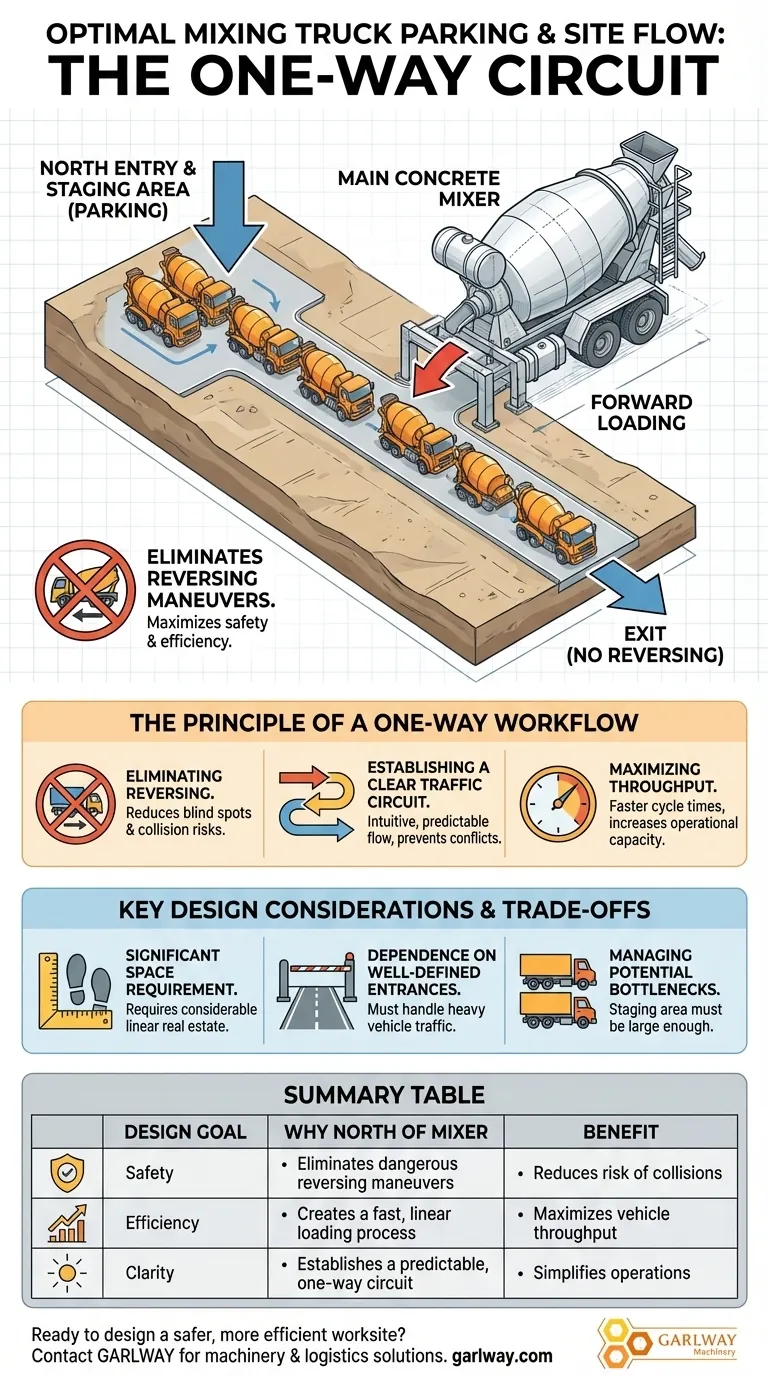
The parking area for mixing trucks is strategically located north of the main mixer. This placement is designed to create a one-way traffic circuit, allowing trucks to enter from the north, load by driving directly under the mixer, and exit to the south without ever needing to reverse.
The specific location of the parking area is not about convenience; it is a critical design choice that dictates the entire logistical flow of the site. The goal is to establish a safe, efficient, and linear path that minimizes complex maneuvers and maximizes vehicle throughput.
The Principle of a One-Way Workflow
The core reason for this layout is to engineer an efficient and safe process from the ground up. By controlling the path of large vehicles, you reduce variables and minimize risk.
Eliminating Reversing Maneuvers
Reversing a large mixing truck is inherently slow and dangerous. It creates significant blind spots for the operator, drastically increasing the risk of collisions with infrastructure, equipment, or personnel. A forward-only route eliminates this risk entirely.
Establishing a Clear Traffic Circuit
This layout creates an intuitive and predictable flow. Drivers enter at a designated point, proceed to the loading area, and continue forward to a separate exit. This removes any ambiguity, prevents traffic conflicts, and simplifies operations, especially for new drivers or during high-pressure periods.
Maximizing Throughput
Every moment saved in a vehicle's cycle time adds up. By removing the need to stop, reposition, and reverse, the loading process becomes significantly faster. This allows more trucks to be serviced per hour, directly increasing the operational capacity of the entire facility.
Key Design Considerations and Trade-offs
While highly effective, this linear design is not without its specific requirements and potential challenges. Understanding these is key to successful implementation.
Significant Space Requirement
The primary trade-off is space. A one-way circuit with separate entry and exit points requires a considerable amount of linear real estate. This design may not be feasible for compact or irregularly shaped industrial sites.
Dependence on Well-Defined Entrances
This system relies on having clearly marked and controlled access points. The north entrance and south exit must be designed to handle heavy vehicle traffic and integrate smoothly with external road networks.
Managing Potential Bottlenecks
The parking or staging area north of the mixer must be large enough to accommodate a queue of trucks waiting to be loaded. If the staging area is too small, arriving trucks could back up and block the site entrance, disrupting the entire workflow.
Applying This Logic to Your Site
When evaluating a site layout, your primary goals will determine the best approach.
- If your primary focus is high-volume output and maximum safety: A linear, forward-only traffic circuit is the industry gold standard and should be your default design.
- If your operation is on a space-constrained site: You may need to accept layouts that require reversing, but this demands rigorous safety protocols, such as mandatory spotters and enhanced visual aids.
- If you are in the initial planning stages: Prioritize a site layout that provides enough linear space to implement a one-way flow, as retrofitting this later is often impossible.
Designing vehicle flow around your core process is the foundation of an efficient and secure industrial operation.
Summary Table:
| Design Goal | Why the Parking Area is North of the Mixer |
|---|---|
| Safety | Eliminates dangerous reversing maneuvers for large trucks. |
| Efficiency | Creates a fast, linear loading process to maximize vehicle throughput. |
| Clarity | Establishes a predictable, one-way traffic circuit for all drivers. |
Ready to design a safer, more efficient worksite?
At GARLWAY, we specialize in construction machinery and site logistics for companies like yours. Our concrete mixers, batching plants, and winches are engineered to integrate seamlessly into optimized workflows, helping you eliminate bottlenecks and enhance safety.
Let our experts help you plan your vehicle flow for maximum productivity. Contact GARLWAY today for a consultation tailored to your project's needs.
Visual Guide
Related Products
- Mini Cement Mortar Mixer Truck for Construction
- Ready Mixer Machine for Construction Ready Mix Machinery
- JW1000 Mobile Cement Mixer Concrete Mixer Truck and Batching Plant
- Harbor Freight JS1500 On Site Concrete Mixing Volumetric Cement Mixer
- Portable Concrete Mixer Machine Equipment for Mixing Concrete
People Also Ask
- Why might mixing mortar in a cement truck be problematic? Avoid Costly Mixing Mistakes
- What are the main types of construction cement mixers available? Choose the Right Mixer for Your Project
- What are the two primary methods for filling a cement mixer truck? Central vs. Transit Mix Explained
- What are the common uses of cement mixer trucks? Boosting Construction Efficiency and Quality
- What are the primary methods to fill a cement mixer truck? Central Mix vs. Transit Mix Explained