
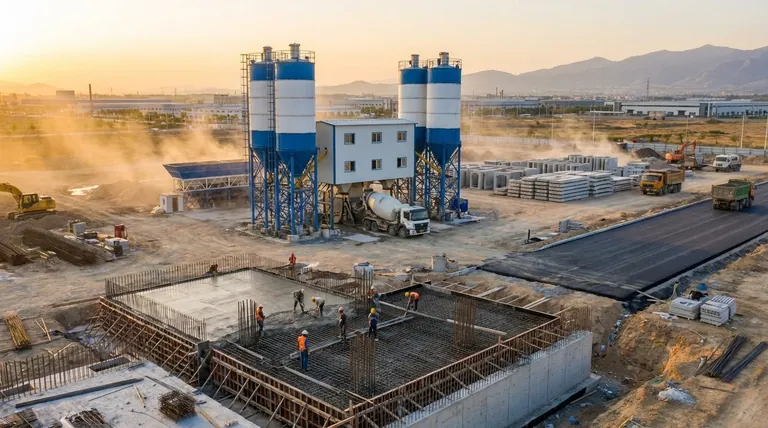
In essence, a concrete batching plant can produce virtually any type of modern concrete. Its function is not limited to a few specific kinds; rather, it is designed to precisely combine ingredients to meet the specifications of a vast range of construction needs, from standard structural mixes like hard concrete to more specialized formulas for precast components.
The true capability of a concrete batching plant lies not in a pre-defined list of concrete types, but in its precise control over the mix design. By accurately weighing and blending aggregates, cement, water, and additives, it can be configured to produce concrete for nearly any application.
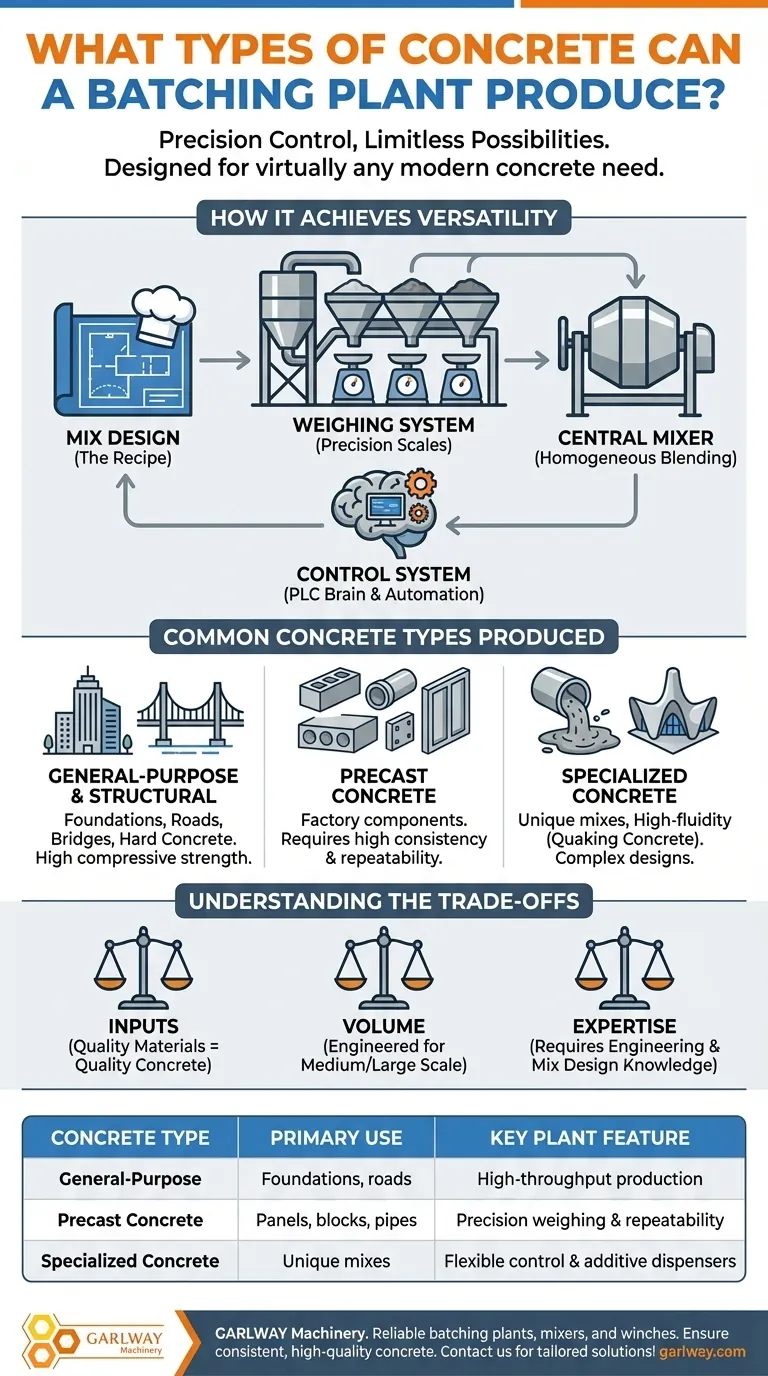
How a Batching Plant Achieves This Versatility
A batching plant is fundamentally a system for guaranteeing precision and consistency at scale. This control is what allows it to produce such a wide variety of concrete types.
The Core Principle: The Mix Design
The plant's versatility comes from its ability to execute a specific mix design, which is the recipe for a particular type of concrete. The plant itself doesn't invent the concrete; it perfectly executes the recipe it's given.
The Material Weighing System
This is the most critical system for ensuring quality and customization. Separate, highly accurate scales for aggregates, cement, water, and chemical additives allow the plant to weigh each component to exact specifications.
This precision is what makes it possible to create everything from a simple foundation mix to a high-performance architectural concrete.
The Central Mixer
The mixer is the heart of the plant. It ensures that all the precisely weighed ingredients are blended into a homogeneous and uniform mixture.
This thorough blending is essential for the concrete to achieve its designed strength, workability, and long-term durability.
The Control System
The entire process is governed by a PLC (Programmable Logic Controller), which acts as the plant's brain. The operator inputs the desired mix design, and the automated system manages the weighing, conveying, and mixing processes to ensure every batch is identical.
Common Concrete Types Produced
While theoretically limitless, most concrete produced by batching plants falls into a few key categories suited for large or medium-scale work.
General-Purpose and Structural Concrete
This is the most common output, used for building foundations, roads, bridges, and other large infrastructure. This category includes what is often referred to as hard concrete, valued for its high compressive strength.
Precast Concrete
Batching plants are essential for precast concrete manufacturing. The plant's ability to produce highly consistent batches is critical for factory settings where identical components are made repeatedly.
Examples include precast panels, concrete blocks, pipe piles, and structural bridge segments.
Specialized Concrete
By adjusting the mix design and incorporating various additives, a batching plant can produce specialized concrete. This includes mixes with different workability characteristics, such as quaking concrete (a term for concrete with higher fluidity or slump).
Understanding the Trade-offs
While incredibly versatile, a batching plant's output is still governed by practical constraints.
It's All About the Inputs
A batching plant cannot improve the quality of its raw materials. The final concrete's strength and durability are entirely dependent on the quality of the cement, sand, aggregates, and water used.
Designed for Volume
These plants are engineered for medium to large-scale production. Their efficiency is realized when producing significant quantities of concrete, making them less suitable for very small, one-off projects.
Expertise is Still Required
The plant is a tool that executes a recipe. The expertise to design a mix that meets specific performance criteria—factoring in weather, application, and structural requirements—must come from engineers and concrete technologists.
Making the Right Choice for Your Goal
The type of concrete you need dictates the plant configuration required.
- If your primary focus is large-scale infrastructure (buildings, roads): You need a plant optimized for the high-throughput production of standardized, high-strength structural concrete.
- If your primary focus is manufacturing precast elements: Prioritize a plant with exceptional precision and repeatability in its weighing and control systems to ensure consistent product quality.
- If your primary focus is specialized engineering projects: The key is a plant with a flexible control system and sophisticated additive dispensers to accommodate complex and unique mix designs.
Ultimately, a modern concrete batching plant is best understood as a highly precise tool, capable of delivering the exact concrete mix your project demands.
Summary Table:
| Concrete Type | Primary Use | Key Plant Feature |
|---|---|---|
| General-Purpose & Structural | Foundations, roads, bridges | High-throughput production |
| Precast Concrete | Panels, blocks, pipes | Precision weighing & repeatability |
| Specialized Concrete | High-fluidity or unique mixes | Flexible control & additive dispensers |
Need a precise concrete mix for your project? GARLWAY specializes in construction machinery, offering reliable concrete batching plants, mixers, and winches for construction companies and contractors globally. Our solutions ensure consistent, high-quality concrete for any application. Contact us today to discuss your specific needs and get a tailored solution!
Visual Guide
Related Products
- HZS120 Ready Mix Concrete Batching Plant Commercial Mud Cement Mixer
- HZS35 Small Cement Concrete Mixing Batch Plant
- HZS75 Concrete Batching Plant Cement Mixer Price Concrete Mixer Bunnings Mixing Plant
- HZS180 Ready Mix Concrete Plant for Foundations with Sand and Cement
- Commercial Electric Concrete Mixer Machine HZS 50 Small Batch Plant for Sale
People Also Ask
- What is a ready mix concrete batching plant? The Engine of Modern Construction
- What is the name of the machine used in ready mix? Unpacking the Complete Concrete System
- What is the core component of a concrete batching plant? The Mixer Unit Defines Your Concrete Quality
- What are the types of concrete mixers used in batching plants? Choose the Right Mixer for Your Project
- What are the advantages and disadvantages of concrete batching plants? Maximize Quality & Efficiency





