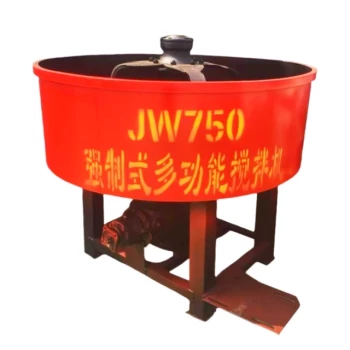
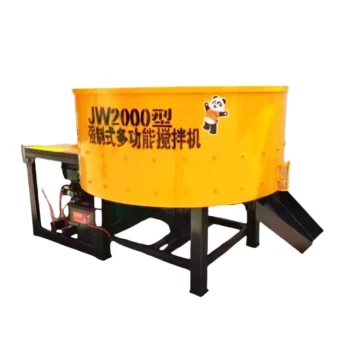
At its core, a concrete plant is a manufacturing hub that produces two primary categories of products: versatile ready-mixed concrete delivered to construction sites and precisely engineered precast concrete elements. These products serve a vast range of needs, from massive infrastructure projects like roads and bridges to the structural components of buildings.
A concrete plant's true capability lies not just in making concrete, but in formulating specific mixes and fabricating structural components that are precisely tailored to the engineering demands of a given project.
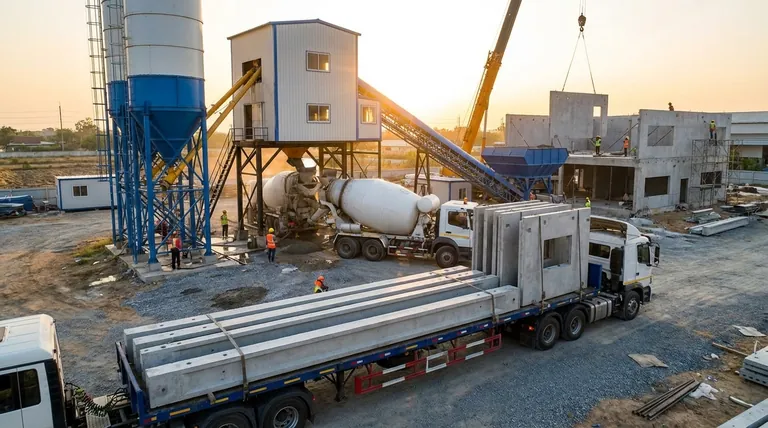
The Two Core Categories of Concrete Production
Every product from a concrete plant falls into one of two main classifications, distinguished by where the concrete is ultimately placed and cured.
Ready-Mixed Concrete
This is what most people picture: liquid concrete manufactured in the plant and transported to a job site in a familiar rotating drum truck.
Its primary purpose is to be poured on-site into forms for foundations, slabs, walls, and other custom shapes.
Precast Concrete
Precast concrete involves pouring concrete into a reusable mold or "form" in a controlled factory environment. It is cured, then transported to the construction site for installation.
This method is used to create standardized, high-quality structural components like beams, columns, wall panels, and pipes.
Understanding Different Concrete Mixes
Beyond the delivery method, concrete plants can formulate a wide variety of mixes with different properties to suit specific applications.
Flowable or "Quaking" Concrete
This type of mix has a higher water content or special admixtures, giving it high fluidity (high "slump").
It is ideal for pouring into complex forms or areas with dense steel reinforcement, as it flows easily and fills voids without extensive vibration.
Hard or Low-Slump Concrete
This is a drier, stiffer mix with a lower water-to-cement ratio, resulting in exceptionally strong and durable hardened concrete.
It is often specified for high-performance applications like roadways, bridge decks, and large-scale building foundations where maximum strength is the critical factor.
Understanding the Trade-offs: Ready-Mix vs. Precast
Choosing between these product types involves clear trade-offs in flexibility, quality control, and project timelines.
Flexibility and Timing (Ready-Mix)
Ready-mix concrete offers maximum flexibility for on-site adjustments. However, its quality can be affected by weather conditions during the pour and travel time from the plant.
Project timelines are also highly dependent on the logistics of truck scheduling and site accessibility.
Quality and Speed (Precast)
Precast elements are manufactured in a controlled factory setting, ensuring consistent quality, strength, and finish, regardless of weather.
On-site construction is significantly faster because it becomes a process of assembly rather than fabrication, though it requires heavy machinery for lifting and placement.
Making the Right Choice for Your Goal
The best product depends entirely on your project's specific requirements for strength, speed, and design.
- If your primary focus is on-site flexibility for foundations and slabs: Standard ready-mixed concrete is the industry-standard solution.
- If your primary focus is rapid assembly and high, consistent quality for structural elements: Precast components like beams and columns are the superior option.
- If your primary focus is maximum durability for infrastructure: A specialized, low-slump (hard) ready-mix concrete will be engineered for the task.
Understanding these core capabilities allows you to specify the exact concrete product needed to achieve your project's engineering and commercial goals.
Summary Table:
| Product Category | Key Characteristics | Primary Applications |
|---|---|---|
| Ready-Mixed Concrete | Mixed at plant, delivered wet to site. Offers flexibility. | Foundations, slabs, walls, on-site pours. |
| Precast Concrete | Cast and cured in a factory, then installed on-site. Ensures high, consistent quality. | Beams, columns, wall panels, pipes, for rapid assembly. |
| Flowable Concrete | High fluidity, easy to pour into complex forms. | Areas with dense reinforcement, complex shapes. |
| Hard Concrete | Low water content, very strong and durable. | Roadways, bridge decks, high-strength foundations. |
Need the Right Concrete Solution for Your Project?
Choosing between ready-mix and precast concrete is critical for your project's success. GARLWAY specializes in providing construction companies and contractors with the reliable machinery needed to produce high-quality concrete products.
We offer:
- Concrete Batching Plants for efficient ready-mix production.
- Concrete Mixers for consistent and reliable mixing.
Let us help you achieve your project's goals for strength, speed, and quality. Contact our experts today to discuss your specific needs and find the perfect equipment solution!
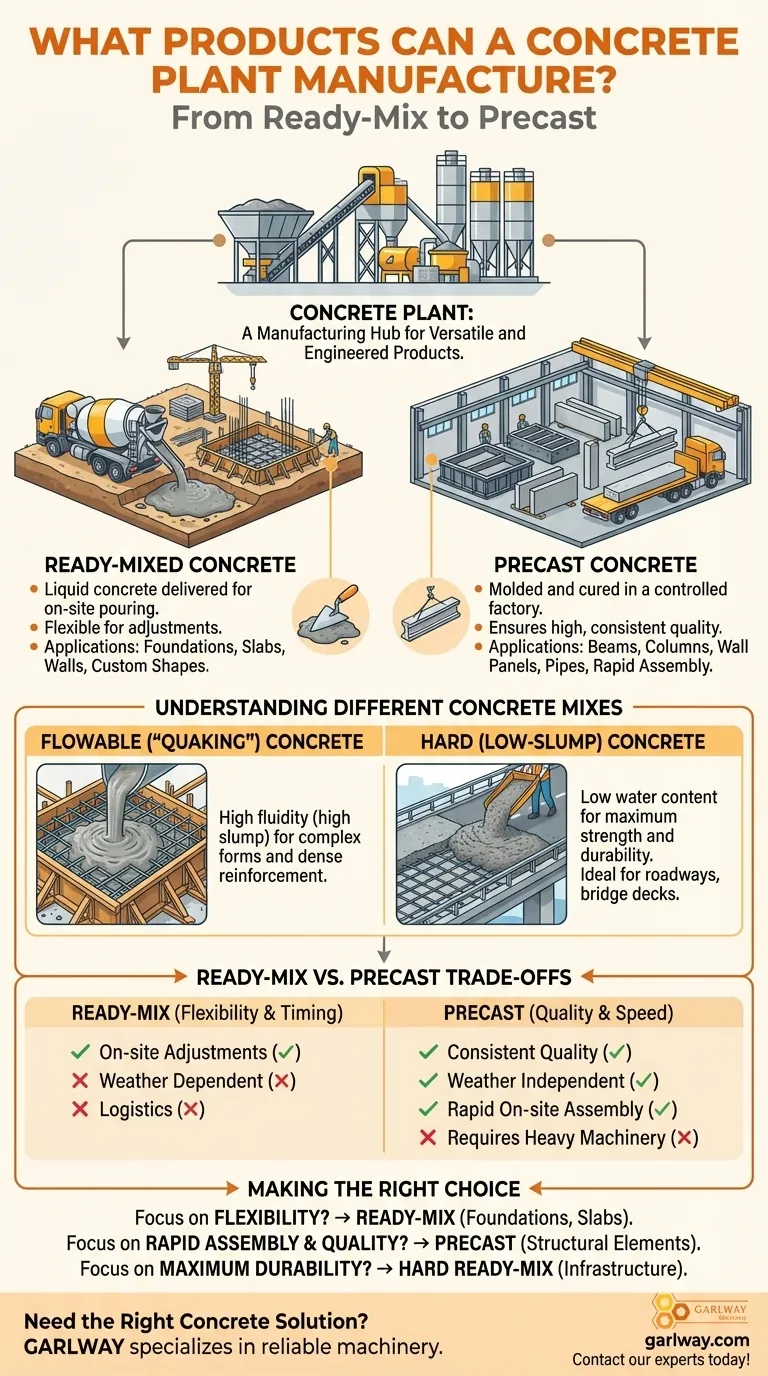
Visual Guide
Related Products
- Construction Products Concrete Plant Machine Mixing Concrete Mixer
- HZS180 Ready Mix Concrete Plant for Foundations with Sand and Cement
- HZS35 Small Cement Concrete Mixing Batch Plant
- HZS120 Ready Mix Concrete Batching Plant Commercial Mud Cement Mixer
- Commercial Electric Concrete Mixer Machine HZS 50 Small Batch Plant for Sale
People Also Ask
- What factors should be considered when choosing between volumetric and traditional mixers? Optimize Your Concrete Project Strategy
- What is the difference between pan and planetary mixers? Choose the Right Mixer for Your Concrete Project
- When was the first concrete mixer developed and by whom? Discover the 1900 Breakthrough
- What is the average lifespan of a concrete mixer? Maximize Your Equipment's Lifespan & ROI
- What are the two broad types of concrete mixers? Choose the Right Mixer for Your Project