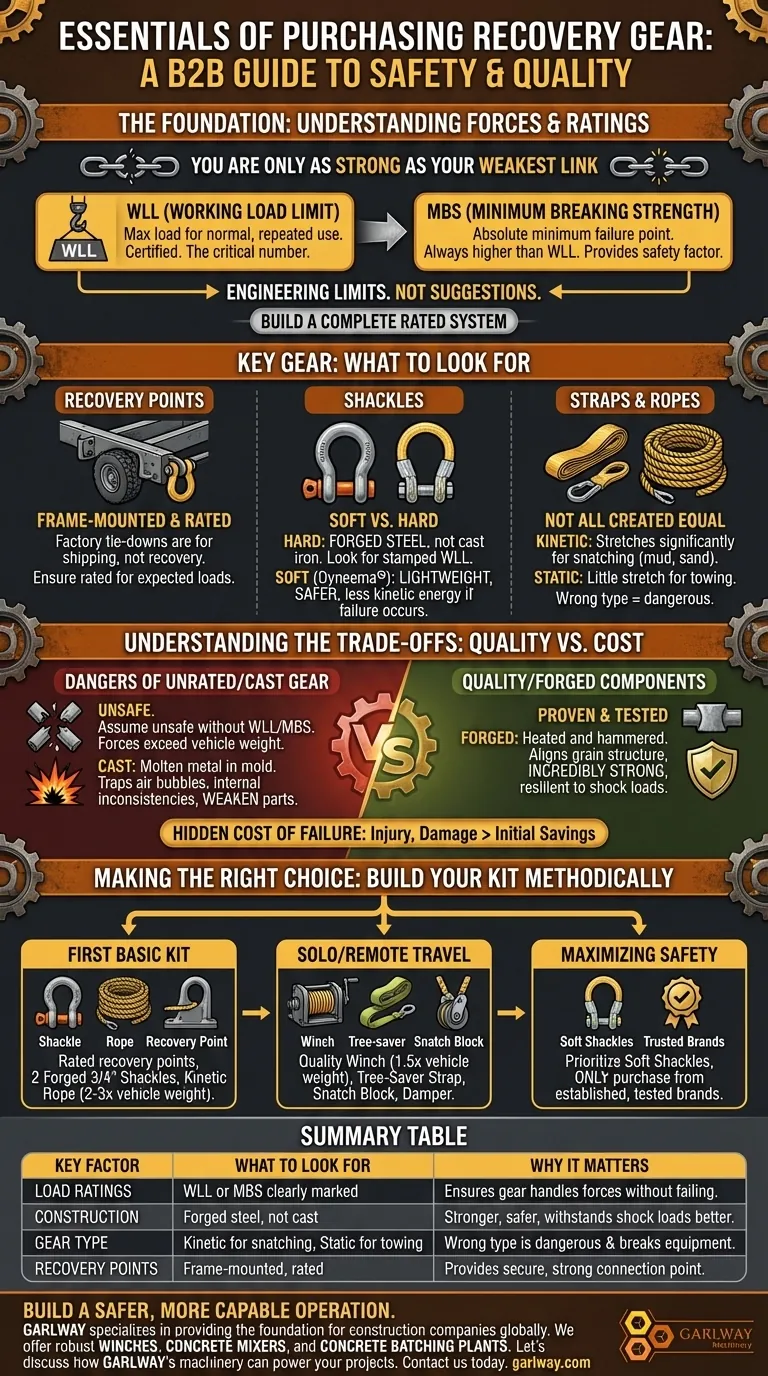
When purchasing recovery gear, the most critical factor to consider is its documented load rating and the quality of its manufacturing. This means sourcing components from reputable brands that clearly mark a Working Load Limit (WLL) or Minimum Breaking Strength (MBS) on the product, as low-quality gear made from inferior materials like cheap cast metal can fail catastrophically under load.
Your recovery setup is a system where you are only as strong as your weakest link. The goal isn't just to buy individual pieces of gear, but to build a complete, rated system where every component is trusted to handle the immense forces involved in safely freeing a stuck vehicle.
The Foundation: Understanding Forces and Ratings
Before buying any gear, you must understand the language of load ratings. These numbers are not suggestions; they are the engineering limits that ensure a safe recovery.
Working Load Limit (WLL)
The WLL is the maximum load a piece of equipment is certified to handle during normal, repeated use without fear of failure. It is the most important number to look for on components like shackles and hooks.
Minimum Breaking Strength (MBS)
The MBS is the absolute minimum force at which a component is engineered to fail. This is typically found on ropes and straps. The WLL is always a fraction of the MBS, creating a crucial safety factor.
The "System" Approach
Every component in your recovery chain—from the vehicle's recovery point to the shackle to the strap—must be rated appropriately. A 20,000-pound winch is useless if you connect it with a shackle only rated for 8,000 pounds.
Key Gear and What to Look For
A basic recovery kit consists of several core components. Quality is paramount for each one.
Recovery Points: The Critical Connection
The gear is useless without a solid place to attach it. Factory vehicle tie-downs are for shipping, not recovery. You need frame-mounted recovery points that are rated for the loads you expect.
Shackles: Soft vs. Hard
Hard shackles (bow shackles) should be made of forged steel, not cast iron. Look for the WLL permanently stamped or forged into the shackle body.
Soft shackles, made from synthetic rope like Dyneema®, are an excellent, safer alternative. They are lightweight and store less kinetic energy, reducing the risk of them becoming a projectile if another part of the system fails.
Straps and Ropes: Not All Are Created Equal
There are two primary types. A static tow strap has very little stretch and is for pulling a free-rolling vehicle. A kinetic recovery rope stretches significantly, storing and then releasing energy to "snatch" a vehicle out of mud, sand, or snow.
Using a static strap for a kinetic recovery is incredibly dangerous and can break equipment. Ensure any strap or rope you buy has its rating clearly stitched on the tag.
Understanding the Trade-offs: Quality vs. Cost
It can be tempting to buy inexpensive gear, but the potential consequences far outweigh the initial savings. The primary trade-off is between a proven, tested component and an unknown one that could lead to disaster.
The Dangers of Unrated Gear
If a component doesn't have a WLL or MBS from a reputable manufacturer, you must assume it is unsafe for recovery. The forces involved can easily exceed the weight of the vehicle, and equipment failure is often explosive.
Cast vs. Forged Metal Components
As the references highlight, cheap recovery points and shackles are often cast, a process where molten metal is poured into a mold. This can trap air bubbles and create internal inconsistencies that severely weaken the part.
Quality components are forged, a process where metal is heated and hammered into shape. This aligns the grain structure of the metal, making it incredibly strong and resilient to the shock loads common in a recovery situation.
The Hidden Cost of Failure
A single failed part can destroy a radiator, send a metal shackle through a windshield, or cause serious injury. The cost of vehicle repair or medical bills will make any initial savings on cheap gear seem trivial.
Making the Right Choice for Your Goal
Build your kit methodically based on your needs, ensuring every piece is a quality investment in your safety.
- If you are building your first basic kit: Start with properly installed, rated recovery points, two forged 3/4" shackles, and a kinetic recovery rope rated for 2-3 times your vehicle's weight.
- If you are preparing for solo or remote travel: Add a quality winch (rated for at least 1.5x your vehicle's gross weight), a tree-saver strap, a snatch block, and a winch-line damper to your kit.
- If your primary focus is maximizing safety: Prioritize soft shackles over metal ones to reduce the risk of projectiles, and only purchase gear from established, trusted brands known for rigorous testing.
Investing in properly engineered recovery gear is an investment in your safety and your ability to confidently explore.
Summary Table:
| Key Factor | What to Look For | Why It Matters |
|---|---|---|
| Load Ratings | WLL (Working Load Limit) or MBS (Minimum Breaking Strength) clearly marked. | Ensures gear can handle the immense forces of a recovery without failing. |
| Construction | Forged steel components, not cheap cast metal. | Forged parts are stronger and safer, withstanding shock loads better. |
| Gear Type | Kinetic ropes for snatching, static straps for towing. | Using the wrong type is dangerous and can break equipment. |
| Recovery Points | Frame-mounted, rated points, not factory tie-downs. | Provides a secure, strong connection point for the entire recovery system. |
Ready to Build a Safer, More Capable Operation?
Just as reliable recovery gear is essential for safe off-roading, durable and powerful machinery is the foundation of a successful construction project. GARLWAY specializes in providing that foundation for construction companies and contractors globally.
We offer a range of robust equipment designed for demanding work:
- Winches: For powerful, controlled pulling and lifting.
- Concrete Mixers: For efficient and consistent concrete production.
- Concrete Batching Plants: For high-volume, precise batching operations.
Invest in equipment engineered for performance and durability. Let's discuss how GARLWAY's machinery can power your projects—contact our team today for a consultation!
Visual Guide