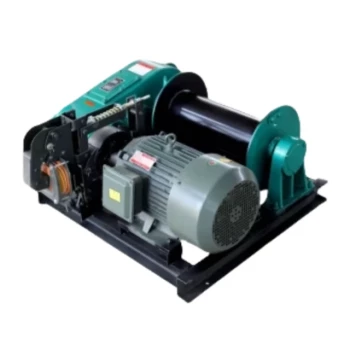
Industrial winches are primarily equipped with a suite of integrated safety systems designed to prevent mechanical failure and operator error. The most common features include load monitoring systems to prevent overloads, emergency stop functions for immediate shutdown, and operational controls that ensure predictable, manageable motion during heavy-duty tasks.
The core principle of modern winch safety is not about a single feature, but about creating a system of controls. This system is designed to provide operators with precise command while actively preventing the machine from being used beyond its designated structural and operational limits.
The Foundation of Safety: System Control
Before looking at specific add-on features, it's crucial to understand that the fundamental design of an industrial winch is its first line of defense. The ability to manage immense forces requires inherent control.
The Importance of Predictable Motion
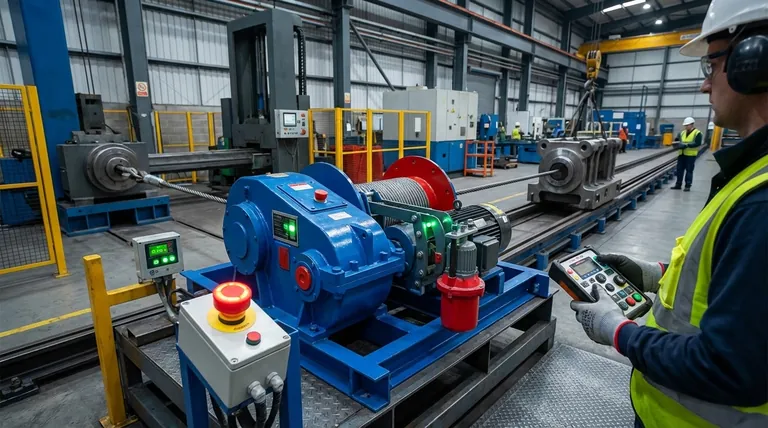
Industrial electric winches provide a highly controlled and predictable pulling or lifting motion. This consistency is a safety feature in itself, reducing the jerking or sudden movements that can lead to accidents and injuries.
Enhancing Operator Control
Features like variable speed controls and remote operation further enhance safety. They allow the operator to fine-tune the winch’s action to suit the specific task and to position themselves away from the load and the direct line of pull, offering a better vantage point and keeping them out of immediate danger zones.
Critical Protective Systems
These systems act as automated guards, intervening when the winch approaches or exceeds its safe operating parameters. They are designed to prevent the most common causes of catastrophic failure.
Preventing Overload Conditions
Load limiters and load monitoring systems are arguably the most critical safety features. They use sensors to constantly measure the force being exerted by the winch. If the load exceeds the machine's rated capacity, the system can automatically stop the operation, preventing equipment failure.
Immediate Failsafe Mechanisms
An emergency stop is a mandatory, easily accessible button or switch. When activated, it immediately cuts all power to the winch motor, bringing the operation to a halt. This is essential for responding to sudden hazards or equipment malfunctions.
Communicating Status and Risk
Alarms and indicator lights provide audible and visual feedback to the operator and surrounding personnel. These alerts can signify normal operation, proximity to a load limit, or an active fault condition, ensuring everyone in the area is aware of the equipment's status.
Alternative Designs: The Capstan Winch
Some winch designs incorporate safety at an even more fundamental level. The capstan winch is a prime example of how a different mechanical approach can inherently reduce risk.
Mitigating Line Breakage Hazards
Capstan winches often use high-strength rope instead of steel cable. While both are strong, a rope that breaks is significantly less likely to store and violently release the same amount of kinetic energy as a snapping steel cable, reducing the risk of severe injury.
Operator Positioning and Manual Control
With a capstan winch, the operator is not just a button-pusher; they are in manual control by applying tension to the rope. Releasing that tension immediately stops the pull. This design also requires the operator to stand away from the direct line of pull, naturally placing them in a safer position.
Understanding the Limitations
Even the most advanced safety features are not foolproof. Their effectiveness is entirely dependent on proper implementation, training, and maintenance.
Reliance on Operator Competence
Safety systems can be bypassed or misinterpreted. Thorough and recurring operator training is non-negotiable to ensure that users understand what the winch's alerts mean and how to operate the machinery within its design limits.
The Critical Role of Maintenance
Load sensors can fail, and emergency stop circuits can degrade. A strict inspection and maintenance schedule is essential to verify that all safety features are functioning correctly before any operation begins. A feature that doesn't work provides a false and dangerous sense of security.
Making the Right Choice for Your Operation
Selecting a winch requires matching its safety features to the specific risks of your work environment.
- If your primary focus is repetitive manufacturing: Prioritize winches with precise variable speed controls and integrated load monitoring to ensure consistency and prevent overload from constant use.
- If your primary focus is a dynamic construction site: Emphasize robust emergency stops, clear alarm systems, and remote operation to manage complex lifts with multiple personnel in the area.
- If your primary focus is maximum personnel safety in unpredictable situations: Consider alternative designs like capstan winches that inherently reduce the risks associated with line breaks and operator positioning.
Ultimately, understanding these safety systems empowers you to create a more controlled and secure working environment.
Summary Table:
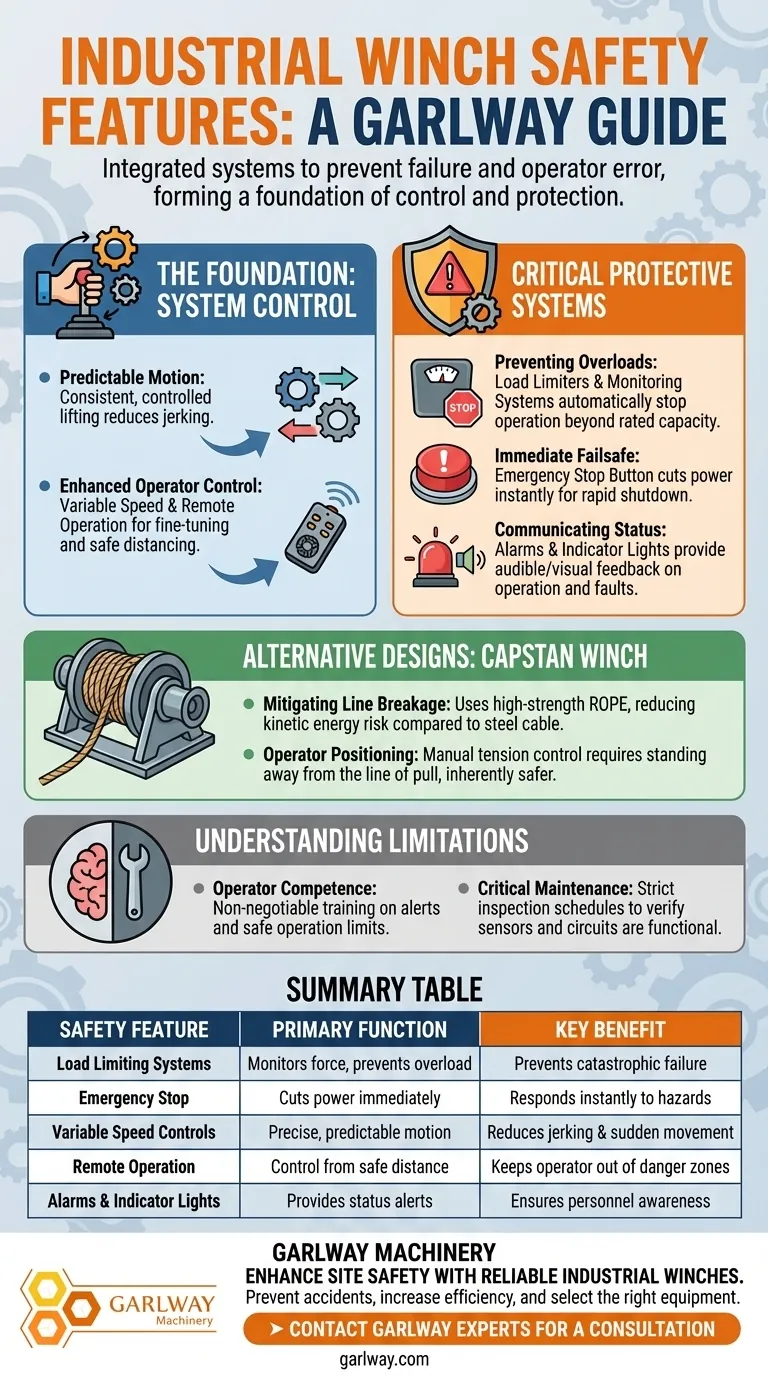
| Safety Feature | Primary Function | Key Benefit |
|---|---|---|
| Load Limiting Systems | Monitors force to prevent exceeding rated capacity | Prevents catastrophic equipment failure |
| Emergency Stop | Cuts power immediately for a rapid shutdown | Responds instantly to hazards or malfunctions |
| Variable Speed Controls | Allows precise, predictable motion management | Reduces jerking and sudden movements |
| Remote Operation | Enables control from a safe distance | Keeps operator out of direct danger zones |
| Alarms & Indicator Lights | Provides audible/visual status alerts | Ensures all personnel are aware of machine status |
Ready to Enhance Your Site's Safety with a Reliable Industrial Winch?
At GARLWAY, we specialize in providing robust construction machinery, including industrial winches, concrete mixers, and batching plants, designed with the advanced safety features discussed here. Our winches are engineered for construction companies and contractors who prioritize operator safety and operational control.
We help you:
- Prevent accidents with integrated load monitoring and emergency stop systems.
- Increase efficiency through precise, remote-controlled operations.
- Select the right equipment tailored to the specific risks of your construction or manufacturing site.
Let's discuss your project's needs and find the perfect winch solution for a safer, more productive worksite.
➤ Contact GARLWAY Experts Today for a Consultation
Visual Guide
Related Products
- Hydraulic Winding Engine Harbor Freight Winch
- Electric and Hydraulic Winch for Heavy Duty Applications
- Small Electric Winch 120V and 240V for Compact Applications
- Portable Small Trailer Winch
- Warn Winch Windlass Boat Trailer Winch
People Also Ask
- What role does hydraulic fluid play in hydraulic winches? It's the Lifeblood of Your Heavy-Duty Pulling Power
- What vehicles commonly use hydraulic winches? For Industrial Trucks Needing Unmatched Power
- What are the features of hydraulic winches? Unmatched Power and Continuous Duty for Heavy Loads
- What preventive measures can be taken to avoid oil leakage in hydraulic winches? Ensure Long-Term Reliability
- What does 'power out' mean in a hydraulic winch? Achieve Absolute Control When Lowering Heavy Loads