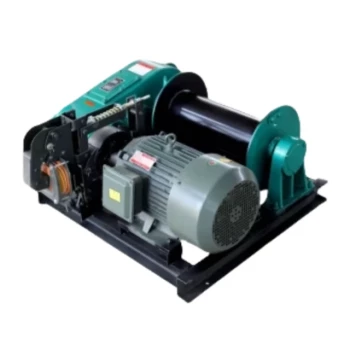
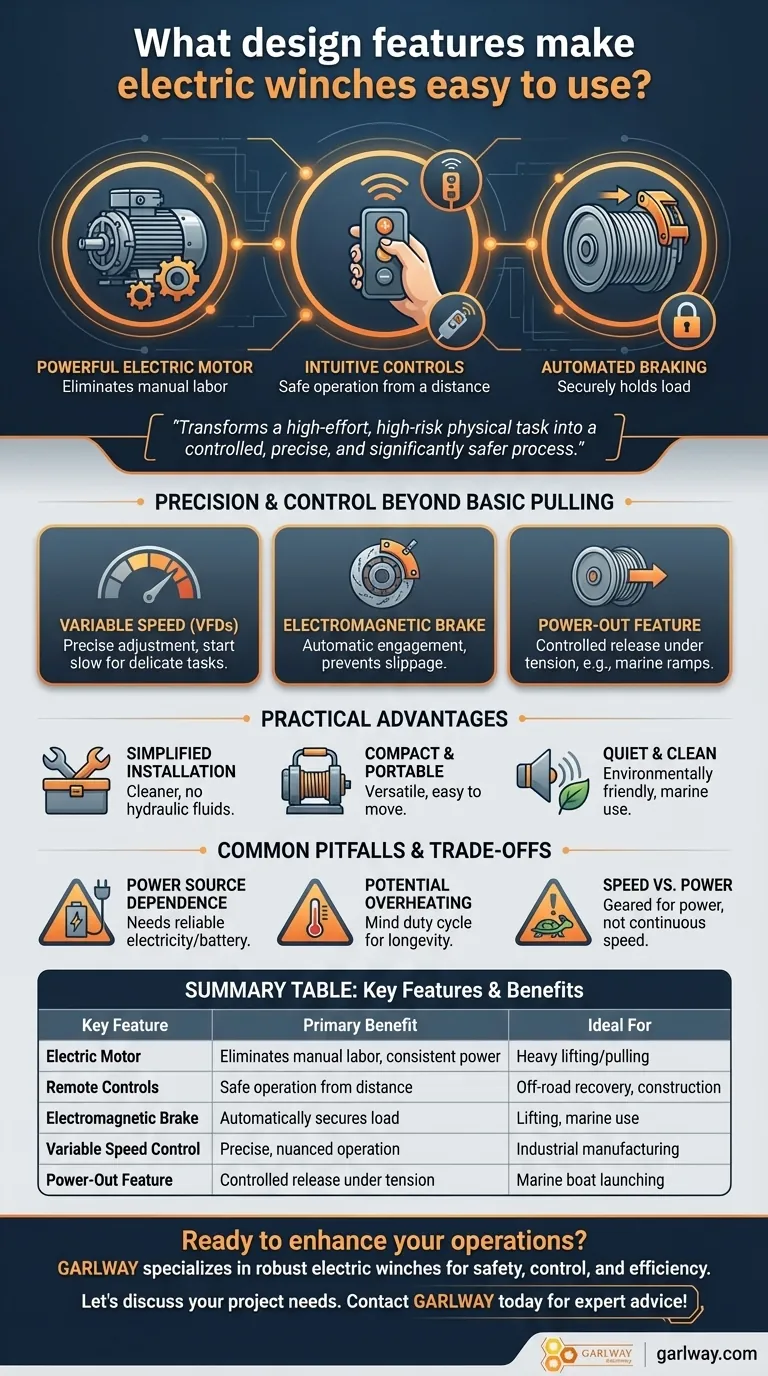
At their core, electric winches are designed for ease of use through three primary features: a powerful electric motor that eliminates manual labor, intuitive push-button or remote controls that allow for safe operation from a distance, and automated braking systems that securely hold a load without constant operator input.
The true advantage of an electric winch isn't just that it's "easier" to pull something. It's that it transforms a high-effort, high-risk physical task into a controlled, precise, and significantly safer process managed by an operator, not by brute force.
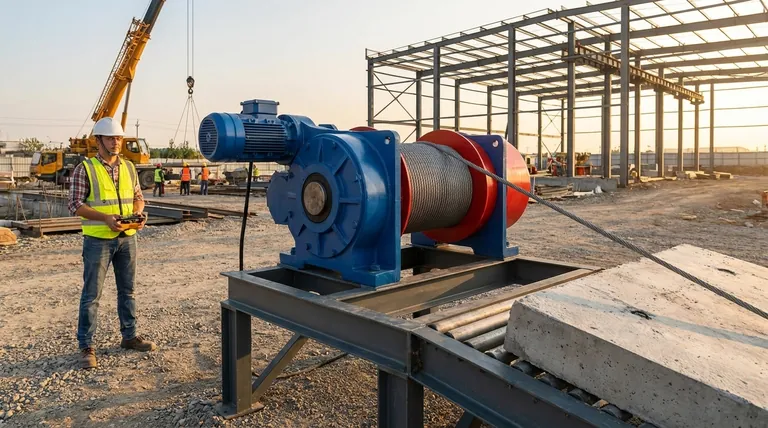
From Manual Effort to Automated Power
The most fundamental design shift that defines an electric winch is the replacement of manual, physical exertion with automated, motorized power. This changes the nature of the work entirely.
The Core of Simplicity: The Electric Motor
An electric motor is the heart of the winch. It powers a gear reducer system that multiplies the motor's force, allowing it to pull immense weight with minimal input from the user. This automation is the foundation of its convenience and efficiency.
Push-Button and Remote Controls
Instead of cranking a handle, operators use simple, intuitive controls. These are often in the form of a wired remote or a wireless fob, allowing the user to stand clear of the cable and the load. This distance dramatically increases safety and provides a better vantage point to manage the operation.
Precision and Control Beyond Basic Pulling
Modern electric winches offer more than just raw power. Their design incorporates features that give the operator a high degree of control over the load, which is critical for both safety and effectiveness.
Variable Speed for Nuanced Operation
In industrial settings, many electric winches use variable frequency drives (VFDs). This allows the operator to precisely adjust the pulling speed, starting slowly for delicate tasks or increasing speed for efficiency when appropriate.
The "Power-Out" Feature for Controlled Release
Some winches, especially those used in marine applications, feature a power-out option. This uses the motor in reverse to pay out the line under tension, providing excellent control when launching a heavy boat on a steep ramp, preventing it from releasing too quickly.
Automated Safety with Electromagnetic Braking
A key design feature is the electromagnetic braking system. When the motor stops, the brake automatically engages, securely holding the load in place. This prevents slippage and removes the need for the operator to manually secure the line, reducing the chance of human error.
Understanding the Practical Advantages
The "ease of use" extends beyond the immediate operation to include the entire lifecycle of installing, using, and maintaining the equipment.
Simplified Installation
Compared to complex hydraulic systems, electric winches generally have lower installation costs. They don't require hydraulic pumps, reservoirs, or fluid lines, making them a cleaner and more self-contained solution.
Compact and Portable Design
Electric winches are engineered to be highly versatile. Their compact, often lightweight construction makes them easier to mount on vehicles, move to different job sites, or integrate into existing structures.
Quiet and Clean Operation
The electric motor operates far more quietly than a hydraulic system or gas engine. Furthermore, with no risk of hydraulic fluid leaks, they are an environmentally cleaner option, which is especially important in marine or sensitive environments.
Common Pitfalls and Trade-offs
While exceptionally user-friendly, the design of an electric winch presents a few inherent trade-offs that are important to understand.
Dependence on a Power Source
The most obvious limitation is the need for a reliable source of electricity. For vehicle-mounted winches, this means a healthy battery and a running engine during heavy pulls to avoid draining the battery. For industrial use, it requires a stable power grid.
Potential for Motor Overheating
Under continuous, heavy load, an electric motor can overheat. Operators must be mindful of the winch's duty cycle—the recommended ratio of operating time to rest time—to prevent damage to the motor and ensure longevity.
Speed vs. Power
Most electric winches are geared for power, not speed. While they are much faster than manual winching, they are not designed for rapid, continuous pulling and can be slower than some hydraulic alternatives in high-volume industrial applications.
Making the Right Choice for Your Application
Selecting the right features depends entirely on your intended use.
- If your primary focus is off-road recovery or general utility: A standard model with a reliable remote control and a robust electromagnetic brake offers the best combination of power, safety, and simplicity.
- If your primary focus is industrial lifting or manufacturing: Seek out a winch with variable speed control and programmable stop positions to ensure maximum precision and operational safety.
- If your primary focus is marine use, such as launching a boat: A winch with a dedicated "power-out" feature is non-negotiable for maintaining control on steep ramps.
Ultimately, the design of an electric winch is focused on one goal: to convert a challenging task into a manageable and controlled operation.
Summary Table:
| Key Feature | Primary Benefit | Ideal For |
|---|---|---|
| Electric Motor | Eliminates manual labor, provides consistent power | All applications requiring heavy lifting/pulling |
| Remote Controls | Allows safe operation from a distance | Off-road recovery, construction sites |
| Electromagnetic Brake | Automatically secures load when stopped | Lifting operations, marine use |
| Variable Speed Control | Enables precise, nuanced operation | Industrial manufacturing, delicate tasks |
| Power-Out Feature | Provides controlled release under tension | Marine boat launching, steep ramps |
Ready to enhance your operations with an easy-to-use electric winch?
GARLWAY specializes in providing robust and reliable construction machinery, including a range of electric winches designed for safety, control, and efficiency. Our winches are engineered for construction companies and contractors globally who demand precision and reliability.
We can help you:
- Increase worksite safety with intuitive remote controls and automated braking systems.
- Improve operational efficiency by replacing manual labor with powerful, motorized pulling.
- Select the perfect winch for your specific application, from industrial lifting to marine use.
Let's discuss your project needs. Contact GARLWAY today for expert advice and a tailored solution!
Visual Guide
Related Products
- Electric 120V Boat Winch by Badlands
- Electric and Hydraulic Winch for Heavy Duty Applications
- Small Electric Winch 120V and 240V for Compact Applications
- 12000 lb Electric Boat Trailer Winch with Windlass Anchor Warn
- Electric Hoist Winch Boat Anchor Windlass for Marine Applications
People Also Ask
- How do electric boat winches work? Unlock Effortless Launching & Retrieval
- How much current does an electric boat winch draw? Plan Your Electrical System for Peak Performance
- Can I run a winch straight from a battery? Essential Power Setup for Safe Operation
- What are the types of electric winches available? Choose the Right Winch for Your Job
- What are the uses of electric winches in mining and tunneling? Enhance Safety and Efficiency Underground