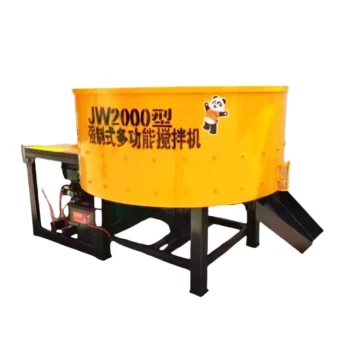
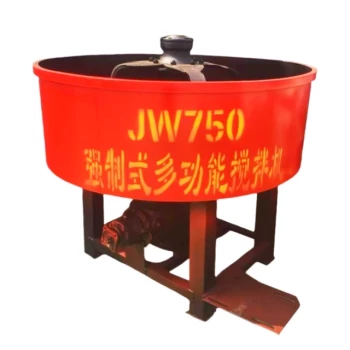
At its core, the cement silo and the cement hopper serve as the primary storage and delivery systems for cement within a concrete batching plant. The silo is designed to hold large quantities of cement delivered in bulk, while the hopper is used to add smaller amounts, typically from bags. Both components are fundamental to feeding the production process.
The critical role of a silo or hopper is not merely storage; it is to ensure a continuous, protected, and precisely controlled supply of cement, preventing costly interruptions and guaranteeing the quality of the final concrete mix.
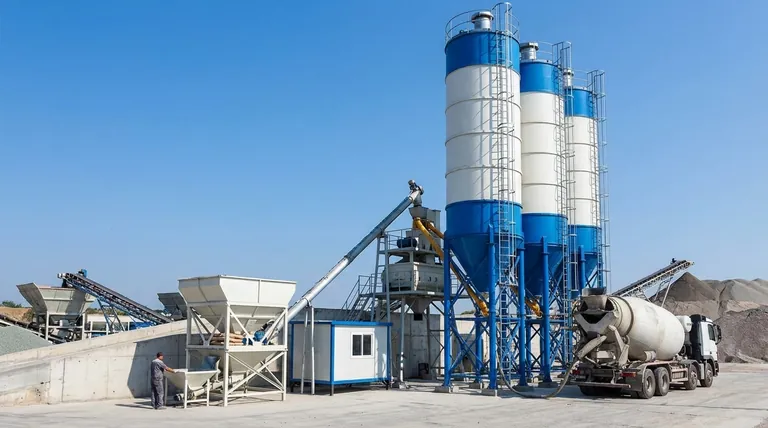
The Foundation of Production: Cement Storage and Transfer
A concrete batching plant is an assembly line, and cement is one of its most critical raw materials. The storage system is the first step in managing this essential ingredient.
The Cement Silo: The Bulk Reservoir
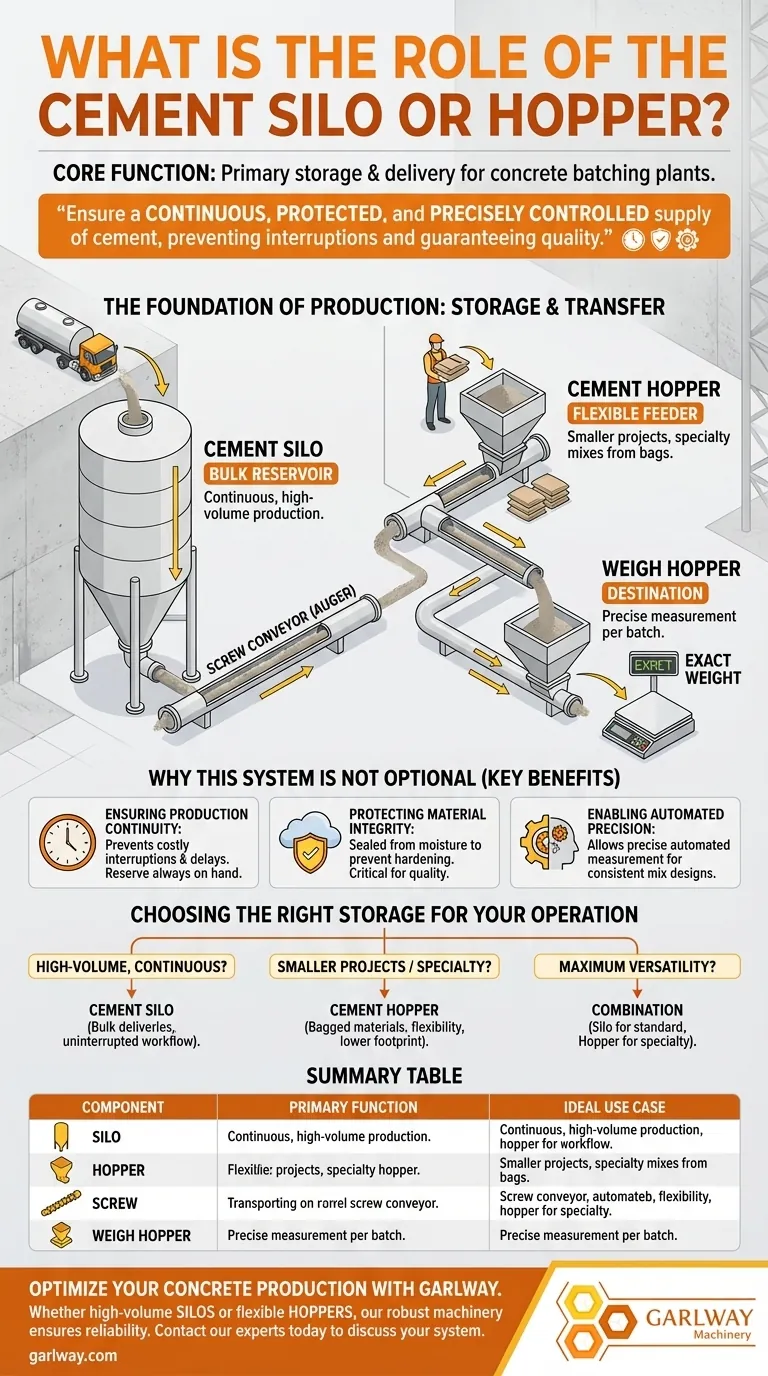
A cement silo is a large, vertical structure designed to store vast quantities of cement powder. It is filled directly from bulk delivery trucks.
Its primary purpose is to act as a buffer, holding enough material to ensure the plant can operate continuously without waiting for deliveries. This prevents downtime and maintains a seamless production flow.
The Cement Hopper: The Flexible Feeder
The cement hopper serves a similar function but on a much smaller scale. It is typically used for adding bagged cement to the system.
This is ideal for smaller operations that don't require bulk storage or for larger plants that need to introduce specialty cements or additives for specific mix designs without dedicating an entire silo.
The Connecting Link: The Screw Conveyor
Both silos and hoppers rely on a screw conveyor (or auger) to function. This is a large, rotating screw inside a tube.
As the screw turns, it pulls the cement powder from the bottom of the silo or hopper and transports it horizontally or at an incline.
The Destination: The Weigh Hopper
The screw conveyor transfers the cement into a separate container called a weigh hopper. This component is equipped with scales to measure the exact amount of cement required for a specific batch of concrete. Once the correct weight is reached, the cement is discharged into the mixer with the other ingredients.
Why This System Is Not Optional
Failing to manage cement properly can bring an entire operation to a halt. The silo and conveyor system mitigates several key operational risks.
Ensuring Production Continuity
The most obvious benefit is preventing interruptions. Running out of cement means stopping production entirely, leading to project delays and significant costs. The silo ensures a reserve is always on hand.
Protecting Material Integrity
Cement powder is highly sensitive to moisture. A sealed silo protects the material from the elements, preventing it from hardening prematurely and becoming unusable. This is a critical aspect of quality control.
Enabling Automated Precision
Modern concrete production relies on automation for consistency. The silo and conveyor system is the start of this automated process, allowing a plant's control system to draw and measure the precise amount of cement needed for any given mix design, batch after batch.
Choosing the Right Storage for Your Operation
The choice between a silo, a hopper, or a combination of both depends entirely on the scale and nature of your work.
- If your primary focus is high-volume, continuous production: A large-capacity cement silo is essential to handle bulk deliveries and support an uninterrupted workflow.
- If your primary focus is smaller projects or specialty mixes: A cement hopper provides the flexibility to work with bagged materials without the investment and footprint of a full silo.
- If your primary focus is maximum versatility: A plant equipped with a primary silo for standard cement and a smaller hopper for specialty additives offers the greatest operational flexibility.
Ultimately, a well-designed cement storage system is the starting point for an efficient, reliable, and high-quality concrete production process.
Summary Table:
| Component | Primary Function | Ideal Use Case |
|---|---|---|
| Cement Silo | Bulk storage from tanker trucks | High-volume, continuous production |
| Cement Hopper | Smaller-scale feeding from bags | Smaller projects or specialty mixes |
| Screw Conveyor | Transports cement to the weigh hopper | Essential for automated material transfer |
| Weigh Hopper | Precisely measures cement for each batch | Guarantees mix design accuracy and consistency |
Optimize your concrete production with the right cement storage solution from GARLWAY.
Whether you are a large construction company requiring high-volume silos or a contractor needing the flexibility of a hopper, GARLWAY's robust construction machinery—including winches, concrete mixers, and complete batching plants—is engineered for reliability and efficiency.
Contact our experts today to discuss how we can design a system that ensures your operation runs smoothly and profitably.
Visual Guide
Related Products
- HZS35 Small Cement Concrete Mixing Batch Plant
- HZS120 Ready Mix Concrete Batching Plant Commercial Mud Cement Mixer
- JW1000 Mobile Cement Mixer Concrete Mixer Truck and Batching Plant
- Portable Cement Mixer with Lift Concrete Machine
- HZS75 Concrete Batching Plant Cement Mixer Price Concrete Mixer Bunnings Mixing Plant
People Also Ask
- Why buy concrete batch plant parts only from the manufacturer? Protect Your Investment and Maximize Uptime
- Why is proper maintenance important for a concrete batch mix plant? Maximize Uptime & Profitability
- What is the advantage of a mobile concrete batching plant? Achieve On-Site Production & Total Control
- What are the advantages and disadvantages of concrete batching plants? Maximize Quality & Efficiency
- What are the two methods of material charging in a concrete mixing station? Single vs. Multiple Charging Explained