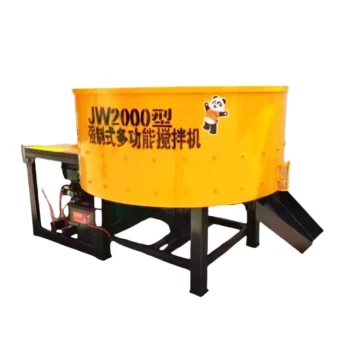
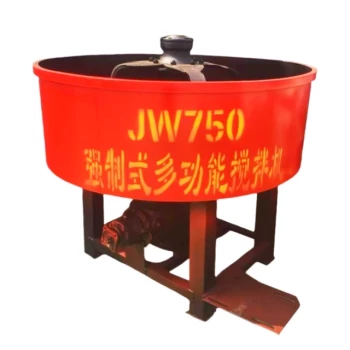
The interior turbine is the functional heart of a concrete mixer. Often referred to as spiral blades or fins, this component is not merely a stirrer. Its primary purpose is to lift and fold the heavy concrete mixture against gravity, ensuring a consistent and uniform blend during transport and then reversing its function to precisely discharge the material at the job site.
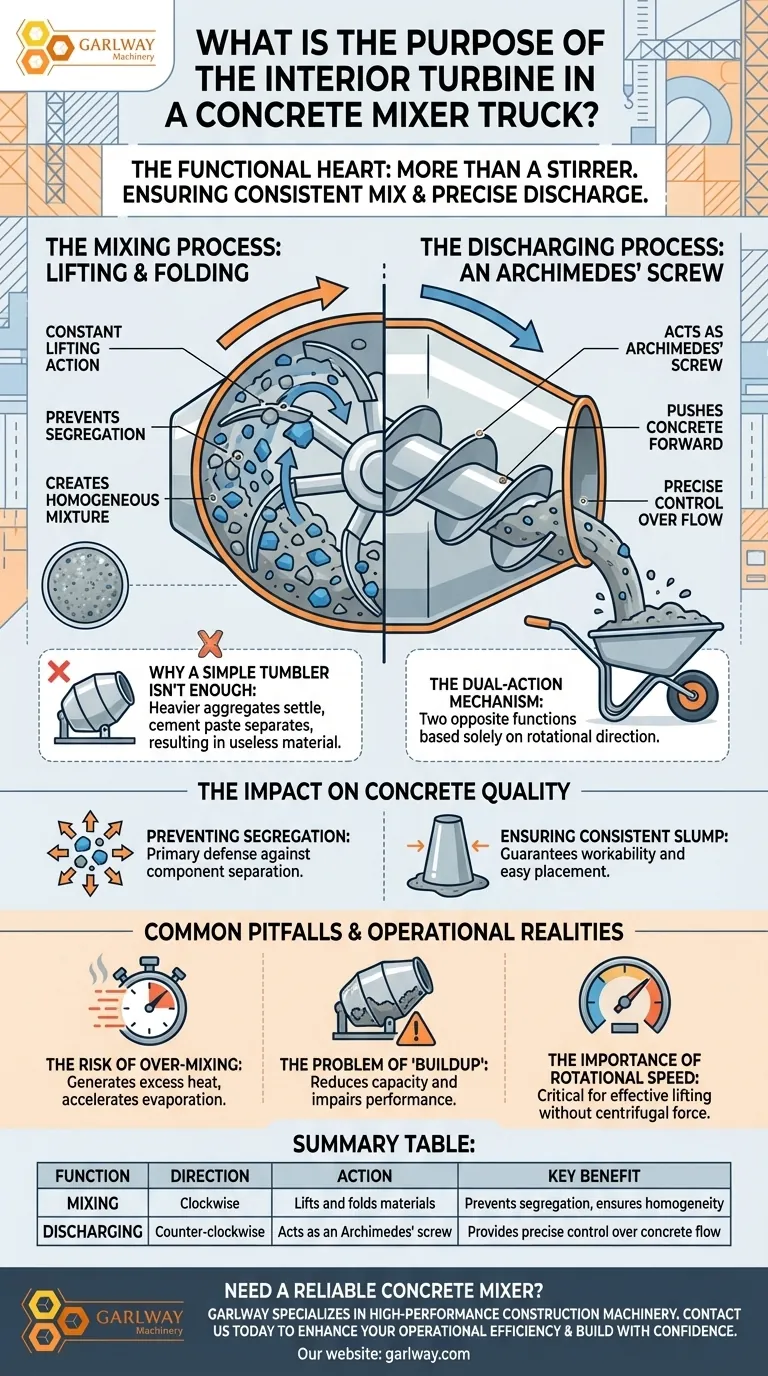
The internal blades of a concrete mixer serve a critical dual purpose. Their spiral design creates a complex folding motion for thorough mixing, and by reversing the drum's rotation, they transform the mixer into an Archimedes' screw to control the discharge of concrete.
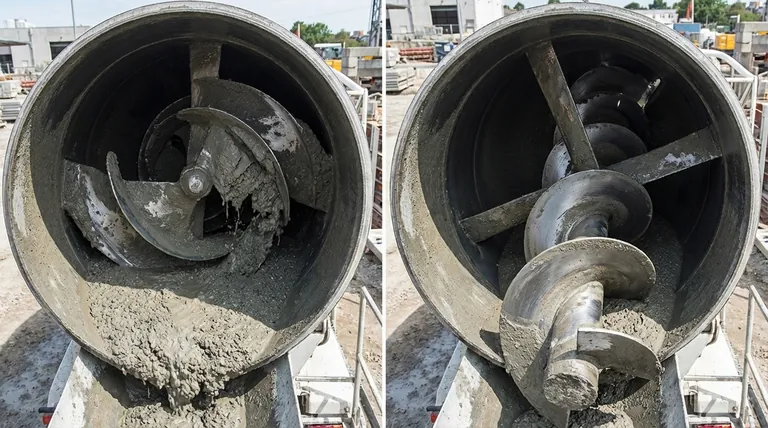
The Dual-Action Mechanism: Mixing vs. Discharging
A concrete mixer drum isn't just a simple spinning container. The design of the internal turbine is what allows it to perform two completely opposite functions based solely on the direction of its rotation.
The Mixing Process: Lifting and Folding
When the drum rotates in its mixing direction (typically clockwise when viewed from the back), the spiral blades continuously scoop the heavy aggregates like stone and sand from the bottom of the drum. They lift this material up and fold it back into the center of the mix.
This constant lifting action is essential for creating a homogeneous mixture. Without it, the heavier components would settle at the bottom due to gravity and vibration during transit, a phenomenon known as segregation.
The Discharging Process: An Archimedes' Screw
When the drum's rotation is reversed, the same blades perform a completely different function. The spiral now works like an Archimedes' screw, catching the concrete and pushing it forward toward the opening of the drum.
This provides the operator with precise control over the flow of concrete, allowing it to be discharged slowly into a wheelbarrow or quickly into a large form.
Why a Simple Tumbler Isn't Enough
If a mixer drum were just a smooth, empty tumbler like a clothes dryer, it would be disastrous for concrete. The heavier aggregates would immediately settle, and the cement paste and water would separate. The resulting material would be useless, lacking the uniform strength required for construction.
The Impact on Concrete Quality
The turbine's action directly correlates to the final strength and workability of the hardened concrete. Its entire purpose is to maintain the quality of the mix from the plant to the pour.
Preventing Segregation
Segregation is the separation of the main components of concrete. The constant folding motion created by the blades is the primary defense against this, ensuring that the aggregates, cement, and water remain evenly distributed throughout the load.
Ensuring Consistent Slump
Proper mixing guarantees a consistent "slump," which is the measure of concrete's workability or flowability. An uneven mix would have wet and dry spots, making it incredibly difficult to place and finish correctly.
Common Pitfalls and Operational Realities
While the design is effective, its operation is not without challenges. Understanding these limitations is key to managing concrete on a project.
The Risk of Over-Mixing
Continuously mixing concrete at high speed or for too long can be detrimental. It can generate excess heat, accelerate water evaporation, and even grind down the aggregates, all of which compromise the concrete's designed strength and properties.
The Problem of "Buildup"
Hardened concrete can accumulate on the blades over time. This buildup, known as "grout," reduces the drum's capacity and severely impairs the blades' ability to mix and discharge effectively. Regular and thorough cleaning is critical for the machine's performance.
The Importance of Rotational Speed
The speed of the drum's rotation is a critical factor. It must be fast enough to create the lifting and folding action but not so fast that centrifugal force pins the concrete to the sides of the drum, which would prevent it from mixing at all.
Making the Right Choice for Your Goal
Recognizing the function of the internal turbine allows you to better manage concrete delivery and quality control on-site.
- If your primary focus is structural integrity: Ensure the mixer is continuously rotating at the correct, slow speed upon arrival to prevent any segregation before the pour.
- If your primary focus is logistical efficiency: Understand that the discharge rate is controlled by the reverse rotation speed, allowing for precise placement into forms or concrete pumps.
- If your primary focus is quality control: Visually inspect the first part of the discharge to ensure it appears uniform, as this is an immediate indicator of how well the turbine has maintained the mix during transit.
A concrete mixer is not just a transport vehicle; it is a mobile batching plant whose performance hinges entirely on the intelligent design of its internal blades.
Summary Table:
| Function | Direction | Action | Key Benefit |
|---|---|---|---|
| Mixing | Clockwise | Lifts and folds materials | Prevents segregation, ensures homogeneity |
| Discharging | Counter-clockwise | Acts as an Archimedes' screw | Provides precise control over concrete flow |
Need a reliable concrete mixer that guarantees consistent quality on your job site?
GARLWAY specializes in providing high-performance construction machinery, including durable concrete mixers, winches, and batching plants, designed for construction companies and contractors worldwide. Our equipment ensures your concrete is mixed and discharged perfectly, project after project.
Contact GARLWAY today to discuss your needs and discover how our solutions can enhance your operational efficiency and build with confidence.
Visual Guide
Related Products
- Ready Mixer Machine for Construction Ready Mix Machinery
- JW1000 Mobile Cement Mixer Concrete Mixer Truck and Batching Plant
- Mini Cement Mortar Mixer Truck for Construction
- Harbor Freight JS1500 On Site Concrete Mixing Volumetric Cement Mixer
- HZS90 Large Multiquip Concrete Mixers for Construction
People Also Ask
- What are the purposes of low-speed agitation in truck mixers? Preserve Concrete Quality During Transit
- How is ready-mixed concrete transported from a commercial concrete batching plant? Ensuring Quality & Timely Delivery
- What are the main ingredients mixed in a concrete mixer truck? Master the Formula for Strong Concrete
- In what ways does a mobile concrete mixer improve quality control and consistency? Achieve Superior On-Site Concrete Quality
- What types of construction projects typically use concrete mixer trucks? From Highways to Home Foundations