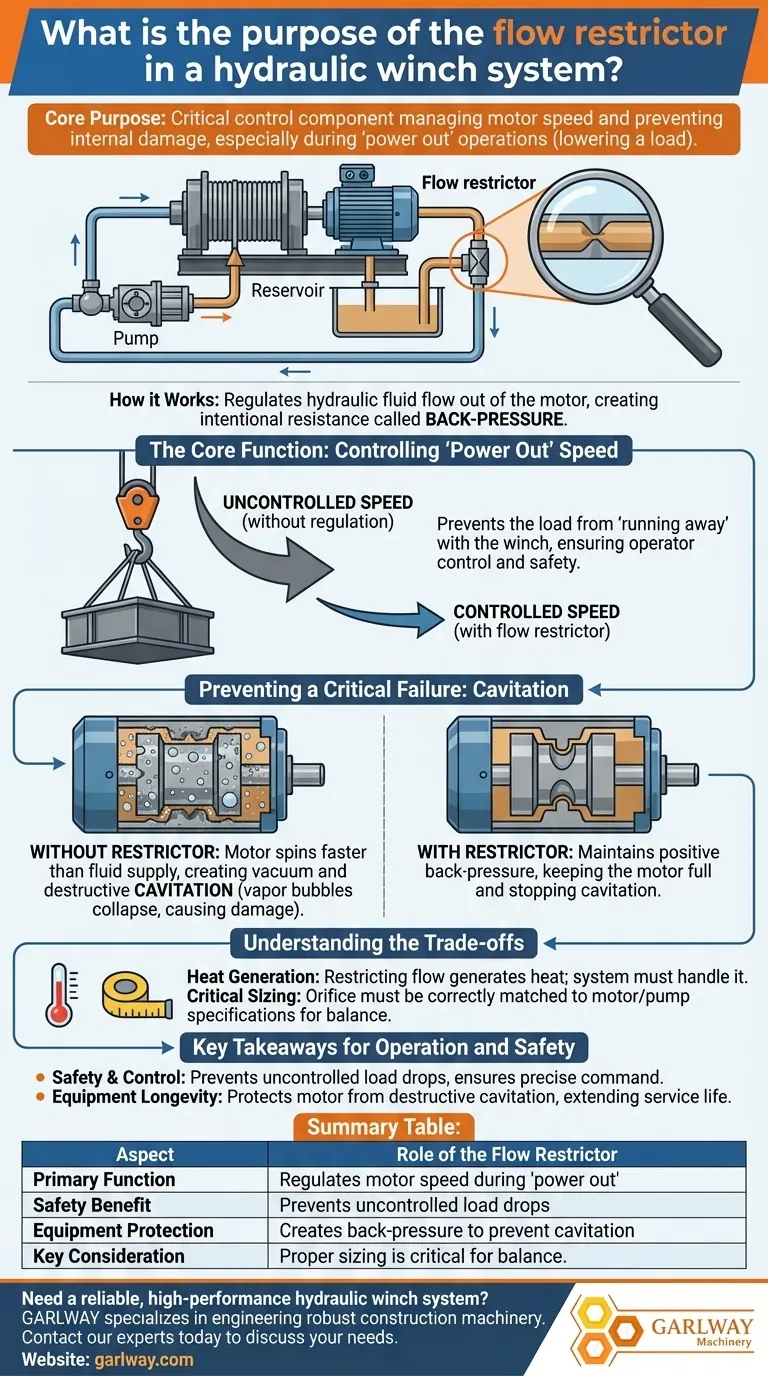
At its core, the flow restrictor in a hydraulic winch system is a critical control component designed to manage the speed of the motor and prevent internal damage. It accomplishes this by regulating the flow of hydraulic fluid out of the motor, particularly during "power out" operations where a load is being lowered.
The flow restrictor's primary purpose is to create back-pressure. This intentional resistance ensures the hydraulic motor doesn't spin faster than the fluid being supplied to it, preventing uncontrolled speeds and a destructive phenomenon known as cavitation.
The Core Function: Controlling 'Power Out' Speed
When lowering a heavy load with a winch, the weight on the line can pull the cable out faster than the hydraulic pump is supplying fluid to the motor. The flow restrictor is engineered to counteract this.
Why Uncontrolled Speed is a Problem
Without regulation, the load can essentially "run away" with the winch. This creates a dangerous situation where the operator loses precise control over the descent speed, posing a significant safety risk.
How the Restrictor Creates Back-Pressure
The flow restrictor is simply a small orifice placed in one of the motor's ports—specifically, the outlet port during power-out. By narrowing the path, it forces the exiting hydraulic fluid to work harder to escape, creating essential resistance or back-pressure.
The Result: A Tamed Motor
This back-pressure acts as a brake on the system. It ensures the motor can only turn as fast as the fluid being pushed out through the small opening, guaranteeing the motor speed remains synchronized with the pump's supply. This gives the operator smooth, predictable control.
Preventing a Critical Failure: Cavitation
Beyond speed control, the flow restrictor's role in creating back-pressure is vital for preventing a damaging condition called cavitation.
What is Cavitation?
Cavitation occurs when the motor spins faster than it receives hydraulic fluid, creating a partial vacuum inside its chambers. This vacuum causes vapor bubbles to form within the hydraulic oil.
The Destructive Impact of Cavitation
When these vapor bubbles travel to an area of higher pressure inside the motor, they collapse violently. These tiny implosions are powerful enough to pit and erode the precision-machined metal surfaces of the motor's internal components, leading to premature wear and catastrophic failure.
The Flow Restrictor as the Solution
By maintaining positive back-pressure, the flow restrictor ensures the motor is always kept full of hydraulic fluid. This prevents the formation of a vacuum, stopping the destructive cycle of cavitation before it can begin.
Understanding the Trade-offs
While essential, the function of a flow restrictor is not without consequences that must be managed in the overall system design.
Potential for Heat Generation
Restricting flow inevitably generates heat as the fluid is forced through a small opening. In high-use or continuous-duty applications, this added heat must be accounted for by the system's cooling capacity.
Sizing is Critical
The orifice size of the restrictor is not arbitrary. If it's too small, the winch will be slow and generate excessive heat. If it's too large, it will fail to create enough back-pressure to prevent motor overspeed and cavitation. Proper sizing is matched to the winch motor and hydraulic pump specifications.
Key Takeaways for Operation and Safety
Understanding this component's function is key to both safe operation and long-term maintenance of your equipment.
- If your primary focus is safety and control: Recognize the flow restrictor as the key component preventing uncontrolled load drops and ensuring you have precise command when lowering a heavy object.
- If your primary focus is equipment longevity: Understand that this simple part directly protects your hydraulic motor from the destructive, internal-pitting effects of cavitation, significantly extending its service life.
Ultimately, this small, often overlooked component is fundamental to making a hydraulic winch system powerful, controllable, and reliable.
Summary Table:
| Aspect | Role of the Flow Restrictor |
|---|---|
| Primary Function | Regulates motor speed during 'power out' operations (lowering a load). |
| Safety Benefit | Prevents uncontrolled load drops, giving the operator precise command. |
| Equipment Protection | Creates back-pressure to prevent cavitation, which can destroy the motor. |
| Key Consideration | Proper sizing is critical to balance speed control and heat generation. |
Need a reliable, high-performance hydraulic winch system for your projects?
At GARLWAY, we specialize in engineering robust construction machinery, including hydraulic winches, concrete mixers, and batching plants. Our equipment is designed with critical components like flow restrictors to ensure maximum safety, control, and longevity for construction companies and contractors worldwide.
Let us help you build with confidence. Contact our experts today to discuss your specific needs and find the perfect solution for your job site.
Visual Guide
Related Products
- Electric and Hydraulic Winch for Heavy Duty Applications
- Hydraulic Winding Engine Harbor Freight Winch
- Small Electric Winch 120V and 240V for Compact Applications
- 12000 lb Electric Boat Trailer Winch with Windlass Anchor Warn
- Portable Small Trailer Winch
People Also Ask
- What are the differences between electric and hydraulic winches? Choose the Right Winch for Your Job
- What are some common uses for a heavy-duty winch? Power Your Construction & Industrial Projects
- What are electro-hydraulic winches and their applications? The Integrated Power Solution for Heavy-Duty Operations
- How do winches assist in bridge launching? Accelerate Bridge Placement with Controlled Pulling Power
- What are the benefits of using heavy-duty winches for large projects? Boost Efficiency & Safety