
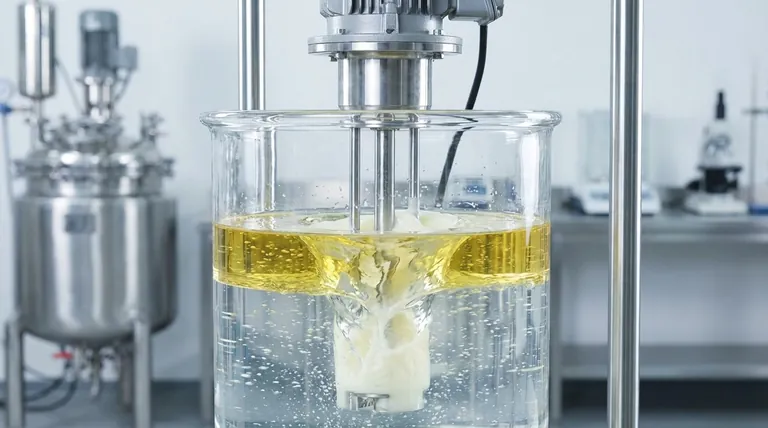
At their core, an emulsifier mixer's purpose is to combine liquids that do not naturally mix, such as oil and water. They use intense mechanical force, often under controlled pressure or vacuum, to create a stable and uniform mixture known as an emulsion. This process is fundamental to manufacturing a vast range of products, from lotions and cosmetics to food and pharmaceuticals.
The central challenge is that oil and water will always try to separate. An emulsifier mixer overcomes this by using high-shear force to violently break down one liquid into microscopic droplets and disperse them evenly throughout the other, resulting in a completely homogenized and stable final product.
The Core Challenge: Overcoming Immiscibility
Why Oil and Water Don't Mix
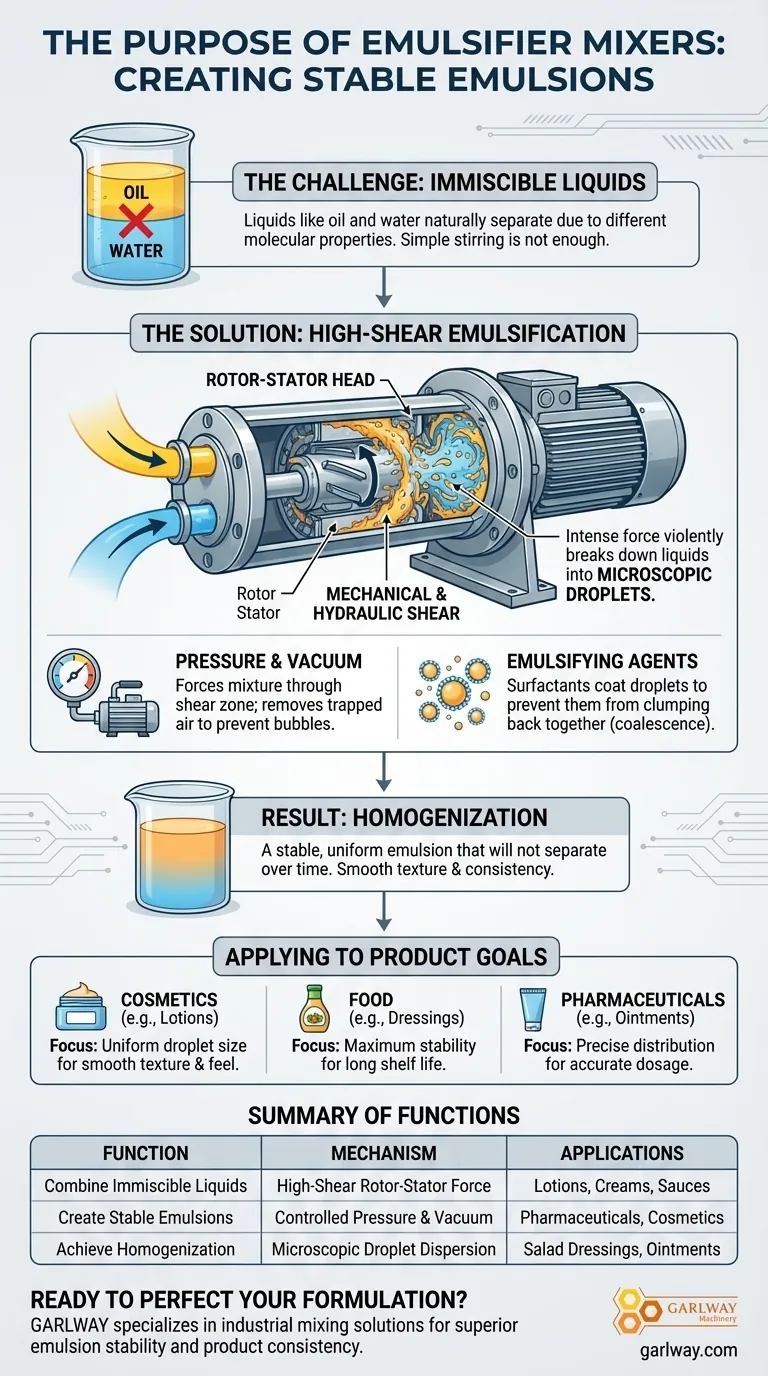
Liquids like oil and water are immiscible, meaning they cannot be blended into a uniform solution. This is due to their different molecular properties.
When simply stirred together, they quickly separate into distinct layers, which is unacceptable for most commercial products that require a consistent texture and composition.
The Goal: A Stable Emulsion
The objective is to create an emulsion—a stable mixture where tiny droplets of one liquid are suspended uniformly throughout another.
An effective emulsifier mixer doesn't just stir the liquids; it fundamentally re-engineers their physical structure at a microscopic level to prevent this separation.
The Mechanics of High-Shear Emulsification
The Principle of High Shear
The heart of an emulsifier mixer is a component called a rotor-stator head. The rotor spins at an extremely high speed within the stationary stator.
This action creates immense mechanical and hydraulic shear, a force that tears the ingredients apart.
Forcibly Breaking Down Droplets
As the liquids are drawn into the rotor-stator, this high-shear environment violently breaks down the dispersed phase (e.g., the oil) into incredibly small droplets, often on the micron or even sub-micron level.
The smaller and more uniform the droplets, the more stable the resulting emulsion will be.
The Role of Pressure and Vacuum
Many emulsifying systems operate under pressure to force the mixture through the high-shear zone effectively, ensuring all material is processed.
A vacuum is often applied simultaneously to remove any trapped air. This prevents bubbles from forming, which could destabilize the emulsion and negatively impact the product's density and appearance.
Achieving Homogenization
The end result of this process is homogenization. The microscopic droplets are now so small and evenly distributed that they remain suspended, creating a smooth, stable, and uniform product that will not separate over time.
Understanding the Trade-offs and Considerations
The Need for Emulsifying Agents
While mechanical shear is powerful, it is often not enough to create long-term stability. Most formulations also require an emulsifying agent or surfactant.
These chemical agents coat the newly formed droplets, preventing them from clumping back together (a process called coalescence) and ensuring the emulsion remains stable for its entire shelf life.
Energy and Heat Generation
High-shear mixing is an energy-intensive process that generates significant heat. For heat-sensitive materials, such as certain active ingredients in pharmaceuticals or cosmetics, this temperature increase must be carefully managed with a cooling jacket to prevent product degradation.
Not a One-Size-Fits-All Solution
The specific design of the rotor-stator, the speed of the mixer, and the processing time must be carefully calibrated to the viscosity of the ingredients and the desired final particle size. What works for a thin lotion will not work for a thick cream.
How to Apply This to Your Product Goal
The specific goal of your product dictates how the emulsification process is approached.
- If your primary focus is cosmetic texture (creams, lotions): The key is achieving a specific, uniform droplet size to ensure a smooth, non-greasy feel and consistent application.
- If your primary focus is product shelf life (salad dressings, sauces): The goal is creating the most stable emulsion possible to prevent separation in the bottle for months or years.
- If your primary focus is ingredient delivery (pharmaceutical ointments, sunscreens): The process must guarantee that active ingredients are perfectly homogenized for precise, even dosage with every use.
Ultimately, emulsifier mixers are the critical technology that transforms otherwise incompatible ingredients into unified, high-performance products.
Summary Table:
| Key Function | Mechanism | Common Applications |
|---|---|---|
| Combine Immiscible Liquids | High-Shear Rotor-Stator Force | Lotions, Creams, Sauces |
| Create Stable Emulsions | Controlled Pressure & Vacuum | Pharmaceuticals, Cosmetics |
| Achieve Homogenization | Microscopic Droplet Dispersion | Salad Dressings, Ointments |
Ready to perfect your product formulation? GARLWAY specializes in industrial mixing solutions, offering robust equipment for demanding production environments. Whether you're a manufacturer in cosmetics, food, or pharmaceuticals, our expertise can help you achieve superior emulsion stability and product consistency. Contact our experts today to discuss how we can support your production goals!
Visual Guide
Related Products
- JDC350 Small Cement Concrete Mortar Mixer
- JDY350 Electric Hydraulic Mortar Mud Concrete Mixer
- Portable Electric Small Cement Mixer Concrete Machine
- Portable Concrete Mixer Machine Equipment for Mixing Concrete
- Portable Ready Mix Concrete Mixer Equipment
People Also Ask
- What are the primary uses of a small cement mixer? Boost Efficiency for Small to Medium Construction Jobs
- What are the physical benefits of using a small cement mixer? Reduce Strain and Prevent Injury
- What are the cost benefits of using a small cement mixer? Save on Labor, Materials & Time
- What makes small cement mixers easy and convenient to use? Boost Productivity on Any Job Site
- What factors should be considered before purchasing a small cement mixer? Find the Perfect Match for Your Project





