
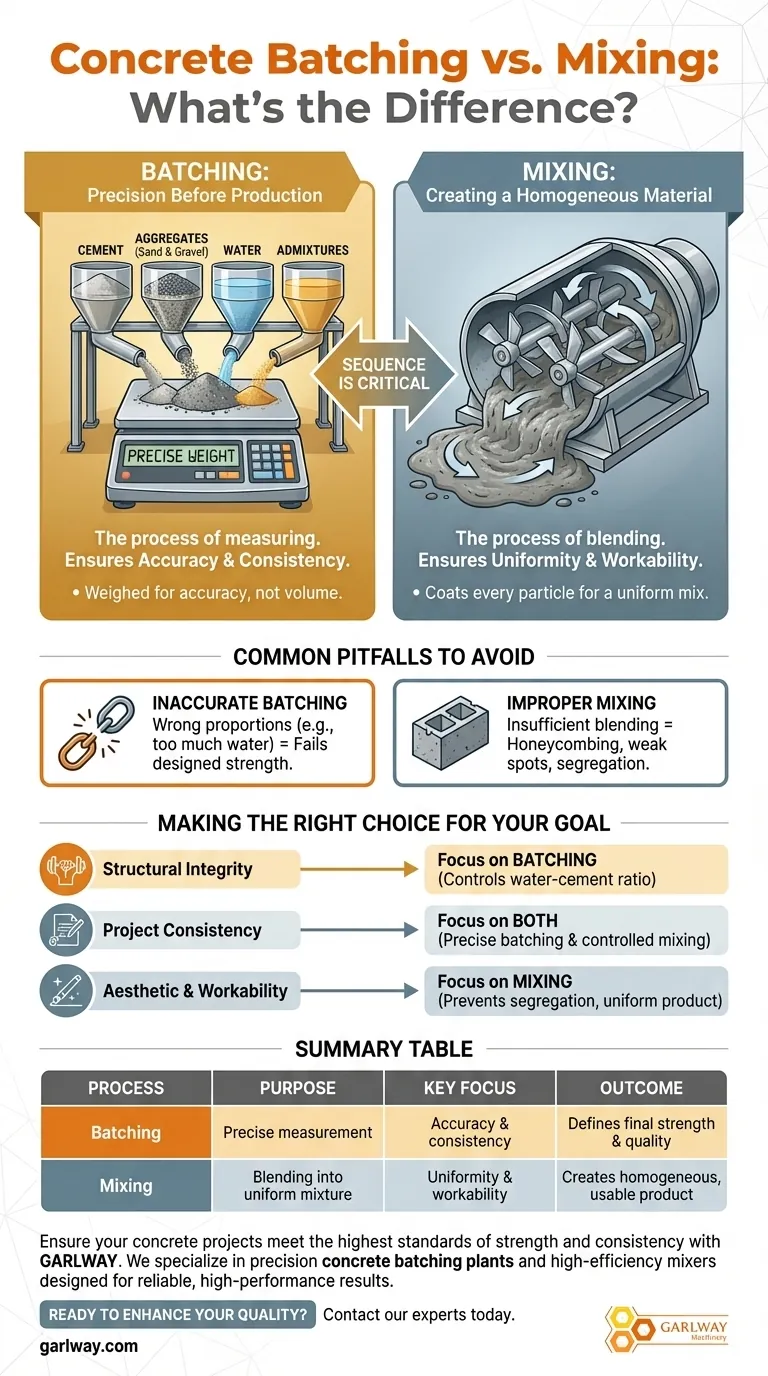
In concrete production, batching is the process of measuring, while mixing is the process of blending. Batching involves the precise weighing of all individual ingredients—cement, aggregates, and water—according to a specific recipe. Once these materials are accurately portioned into a "batch," the mixing process begins, using mechanical action to combine them into a uniform, workable substance.
The core distinction lies in their purpose. Batching ensures accuracy and consistency in the concrete's formula, which dictates its final strength. Mixing ensures the uniformity and workability of that formula, making it a usable construction material.
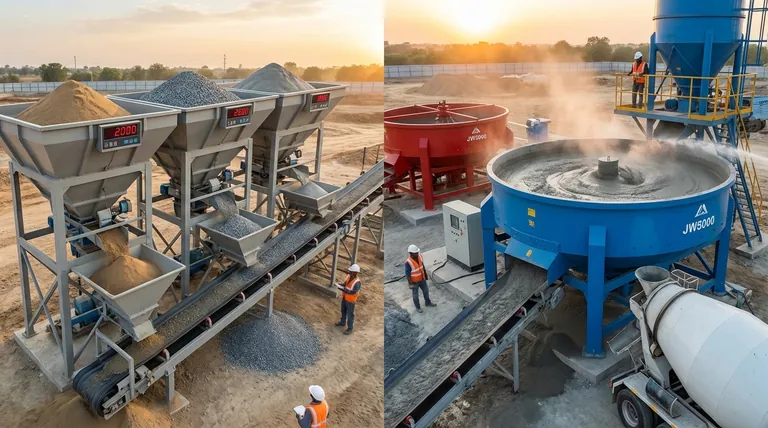
The Role of Batching: Precision Before Production
Batching is the quality control checkpoint at the very beginning of the concrete manufacturing process. It is a step defined by meticulous measurement.
What is Weighed?
A concrete "batch" consists of precisely weighed proportions of cement, fine aggregates (sand), coarse aggregates (gravel), and water. Any chemical admixtures are also measured and added at this stage.
Why Weight, Not Volume?
Measurement is done by weight because it is far more accurate than measuring by volume. The volume of aggregates can change based on moisture content and how tightly they are compacted, but their weight remains constant. This precision is essential for predictable results.
The "Batch" as a Fixed Recipe
Each batch is a discrete, self-contained recipe designed to achieve a specific performance characteristic, such as a certain compressive strength. This ensures that every load of concrete produced from that design is consistent.
The Role of Mixing: Creating a Homogeneous Material
Once the ingredients are batched, they are discharged into a mixer. This step is about transforming a collection of separate materials into a single, cohesive product.
The Goal of Uniformity
The primary objective of mixing is to thoroughly coat the surface of every aggregate particle with cement paste (cement and water). This creates a homogeneous mixture where all ingredients are evenly distributed.
Mixing Time is Critical
The duration of mixing is carefully controlled. Under-mixing results in a non-uniform product with inconsistent strength and potential weak spots. Over-mixing can begin to break down aggregates or entrain excessive air, negatively affecting the concrete's final properties.
Common Mixing Equipment
This process typically occurs in large, powerful units like a twin-shaft mixer at a batch plant or within a transit mixer truck on the way to a job site.
Common Pitfalls to Avoid
The sequence and execution of these two steps are critical. Errors in either phase will compromise the final product, and good mixing cannot fix bad batching.
Inaccurate Batching
This is the most frequent source of concrete quality issues. If the proportions are wrong—too much water, not enough cement—the concrete will fail to achieve its designed strength and durability.
Improper Mixing
Even with a perfect batch, insufficient mixing will lead to problems. This can cause "honeycombing" (voids in the concrete) and variations in color and texture, indicating that the aggregates and cement paste have not been properly combined.
Ignoring the Sequence
You cannot achieve high-quality concrete by focusing on one step alone. Accurate batching provides the potential for good concrete, but thorough mixing is what realizes that potential.
Making the Right Choice for Your Goal
Understanding the distinction helps you focus on what matters for your project's success.
- If your primary focus is structural integrity: Your attention must be on the batching process, as this directly controls the water-to-cement ratio and thus the ultimate strength of the concrete.
- If your primary focus is project consistency: Both precise batching and controlled mixing times are essential to ensure every truckload of concrete performs identically.
- If your primary focus is aesthetic finish and workability: Proper mixing is crucial to prevent segregation of materials and ensure a uniform, easy-to-place product.
Ultimately, mastering the relationship between precise measurement and thorough blending is the foundation of reliable, high-performance concrete construction.
Summary Table:
| Process | Purpose | Key Focus | Outcome |
|---|---|---|---|
| Batching | Precise measurement of ingredients | Accuracy and consistency of the recipe | Defines the concrete's final strength and quality |
| Mixing | Blending ingredients into a uniform mixture | Uniformity and workability of the material | Creates a homogeneous, usable construction product |
Ensure your concrete projects meet the highest standards of strength and consistency with GARLWAY.
At GARLWAY, we specialize in providing robust construction machinery, including precision concrete batching plants and high-efficiency concrete mixers, designed for construction companies and contractors worldwide. Our equipment ensures accurate batching and thorough mixing, helping you achieve reliable, high-performance concrete every time.
Ready to enhance your concrete quality and project efficiency? Contact our experts today to discuss your needs and discover the right solution for your operations.
Visual Guide
Related Products
- HZS120 Ready Mix Concrete Batching Plant Commercial Mud Cement Mixer
- HZS35 Small Cement Concrete Mixing Batch Plant
- HZS75 Concrete Batching Plant Cement Mixer Price Concrete Mixer Bunnings Mixing Plant
- HZS180 Ready Mix Concrete Plant for Foundations with Sand and Cement
- Commercial Electric Concrete Mixer Machine HZS 50 Small Batch Plant for Sale
People Also Ask
- What is a ready mix concrete batching plant? The Engine of Modern Construction
- What is the name of the machine used in ready mix? Unpacking the Complete Concrete System
- What is the core component of a concrete batching plant? The Mixer Unit Defines Your Concrete Quality
- What are the types of concrete mixers used in batching plants? Choose the Right Mixer for Your Project
- What are the advantages and disadvantages of concrete batching plants? Maximize Quality & Efficiency





