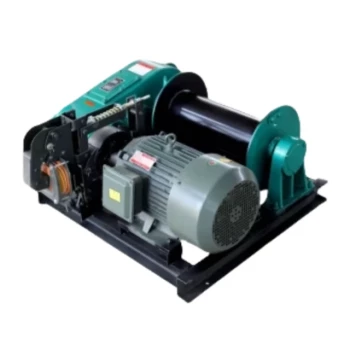
At its core, a winch is a force multiplier. It is a compact and powerful mechanical device designed to pull or lift heavy loads that would otherwise be impossible to move. It achieves this by using a motor to turn a drum, which winds a length of steel wire rope, chain, or synthetic rope, converting rotational energy into immense linear pulling force.
A winch is fundamentally a tool for creating mechanical advantage. It uses a powered, rotating drum to spool a cable, generating controlled tension to lift objects vertically, pull them horizontally, or haul them up an incline.

How a Winch Fundamentally Works
A winch's operation is simple in principle but powerful in execution. Understanding its core mechanism and components reveals how it can move objects many times its own weight.
The Core Mechanism: Rotational to Linear Force
Think of a winch as a highly engineered, super-powered fishing reel. A motor turns a central drum or spool. As the drum rotates, it winds the cable around itself, shortening the line between the winch and the load.
This action creates controlled, powerful tension that pulls the object toward the winch's anchor point. Reversing the motor allows the cable to be paid out in a controlled manner.
The Key Components
Every winch is built around three primary parts:
- The Motor: This provides the rotational power. It can be electric, hydraulic, or even hand-cranked in smaller models.
- The Drum: This is the spool that the cable winds onto. Its rotation is what generates the pulling force.
- The Cable: This is the line that connects the winch to the load. It can be a steel wire rope, a heavy-duty chain, or a modern synthetic rope.
The Principle of Mechanical Advantage
The true power of a winch comes from its gear train. The motor doesn't turn the drum directly. Instead, it turns a series of gears that reduce speed while dramatically increasing torque. This gearing is what allows a relatively small motor to generate thousands of pounds of pulling force.
The Three Primary Functions
While often associated with one specific task, a winch is a versatile tool defined by its ability to move a load along a specific axis. Its function is determined by its orientation and how it's applied.
Horizontal Pulling
This is the most common application, especially in off-road and vehicle recovery scenarios. The winch is used to pull a vehicle that is stuck in mud, water, or otherwise unable to move under its own power. The pulling force is exerted parallel to the ground.
Vertical Lifting
When used for vertical lifting, a winch is often referred to as a hoist. In this configuration, it is used to lift materials or equipment straight up, such as on a construction site or in a workshop. This application requires specific safety features, as the entire load is being suspended against gravity.
Angled or Inclined Hauling
A winch is also highly effective for moving heavy objects up a slope or incline. This combines elements of both pulling and lifting. Examples include hauling equipment onto a trailer or pulling materials up a steep hill.
Common Pitfalls to Avoid
The immense power of a winch also introduces critical considerations. Misunderstanding its limitations can lead to equipment failure or dangerous situations.
An Unstable Anchor Point
A winch is only as strong as its anchor. If the winch is mounted to an insecure point on a vehicle or structure, its pulling force can damage the anchor itself rather than moving the intended load. The anchor point must be able to withstand the winch's maximum pulling capacity.
Ignoring the Load Rating
Every winch has a maximum load rating. Exceeding this rating can burn out the motor, snap the cable, or damage the gear train. Always ensure the winch's capacity is appropriate for the weight of the object you intend to move.
Forgetting the Power Source
A winch is not a standalone device; it's a component in a larger system. Whether installed on lifting machinery or mounted on a vehicle, it relies on that system's power source. For example, an electric winch can drain a vehicle's battery quickly under a heavy load.
Making the Right Choice for Your Goal
Understanding the function you need to perform is the key to selecting or applying a winch correctly.
- If your primary focus is vehicle recovery: You need a winch optimized for horizontal pulling, with a durable cable and a load rating suitable for your vehicle's weight.
- If your primary focus is industrial lifting: You need a device rated as a hoist, which is specifically designed for the safety demands of suspending a load vertically.
- If your primary focus is versatile material handling: You need a winch that can serve as a power source, capable of being integrated into other machinery for both pulling and hauling operations.
Ultimately, a winch is a fundamental tool for applying controlled force to solve problems of movement and recovery.
Summary Table:
| Aspect | Key Takeaway |
|---|---|
| Core Function | A mechanical device that uses a motor and drum to convert rotational energy into linear pulling force. |
| Primary Uses | Horizontal pulling (e.g., vehicle recovery), vertical lifting (as a hoist), and angled hauling. |
| Key Components | Motor, Drum, and Cable (wire rope, chain, or synthetic rope). |
| Critical Consideration | Requires a stable anchor point and must not exceed its rated load capacity for safe operation. |
Need a powerful and reliable winch for your construction or contracting project?
GARLWAY specializes in manufacturing high-performance construction machinery, including durable electric and hydraulic winches designed for demanding applications. Whether you need a winch for vehicle recovery, material lifting on a job site, or integration into other equipment, our solutions are built for safety and efficiency.
Contact our experts today to discuss your specific requirements and find the perfect winch solution for your business.
Visual Guide

Related Products
- Warn Winch Windlass Boat Trailer Winch
- Electric and Hydraulic Winch for Heavy Duty Applications
- Small Electric Winch 120V and 240V for Compact Applications
- Quick Windlass Portable Winch for Truck and Boat Best Boat Winch
- Hydraulic Winding Engine Harbor Freight Winch
People Also Ask
- What are the main components of a boat trailer winch? A Guide to Safe & Efficient Boat Loading
- What factors should be considered when choosing a boat trailer winch? Ensure Safe and Effortless Boat Loading
- What is the purpose of boat trailer winches? Safely and Efficiently Load Your Boat
- What are the two main types of boat trailer winches? Manual vs. Electric Explained
- How often should a boat trailer winch be replaced? Your Guide to Safety and Longevity