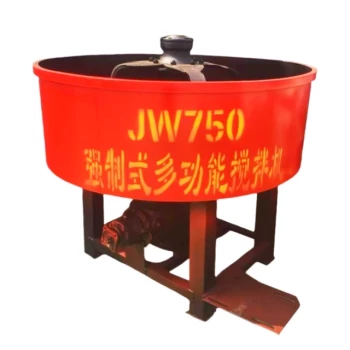
To select the right mixing host for a concrete batching plant, you must first evaluate the performance requirements of the concrete itself, the required production capacity, and the logistical realities of your construction environment. For specialized applications like hydraulic engineering, a forced mixing host is non-negotiable, but this is only one piece of a larger operational puzzle.
The core insight is that selecting a mixing host is not an isolated decision. It's about architecting an entire production system where the mixer, storage, and batching components are perfectly aligned with your project's technical, logistical, and economic goals.

Foundational Technical Requirements
The technical specifications of your final product dictate the starting point for your equipment selection.
Concrete Performance Grade
The type of concrete you need to produce is the most critical factor. Standard mixes may be forgiving, but high-performance or specialized concrete is not.
Projects requiring high-strength or specific consistency, such as hydraulic engineering, demand a forced mixing host to ensure thorough and uniform blending of all materials.
Types of Raw Materials
Consider the full range of materials you will mix. The inclusion of special aggregates, fibers, or multiple chemical admixtures can influence the choice of mixer.
The configuration of your batching station and storage silos must be designed to handle the specific variety and quantity of these materials effectively.
Required Production Capacity
Your plant's output must align with your project's demand. An undersized mixer creates a bottleneck, while an oversized one leads to wasted capital and operational inefficiency.
Assess your project's required cubic meters (or yards) per hour to select a mixer and plant size that can meet peak demand without being excessive.
Operational and Site Logistics
A technically perfect plant is useless if it doesn't fit the operational context of the job site.
Construction Environment and Access
Thoroughly evaluate the physical location of your project. Remote sites with difficult access can pose significant challenges for large plant installations and material delivery.
For hard-to-access locations, a smaller or mobile plant might be a more practical and efficient solution than a large, stationary one.
Project Scale and Continuity
The nature of the concrete pour influences your needs. A project requiring a single, massive, and continuous pour has different demands than one with intermittent needs over a long period.
For critical large-volume pours, using two smaller batching plants can provide redundancy and ensure a continuous supply, mitigating the risk of a single point of failure.
Servicing Multiple Sites
If you need to supply concrete to several job sites that are relatively close to each other, a centralized batching plant or a highly mobile unit can be a major advantage.
This strategy enhances both efficiency and economic benefits by maximizing equipment utilization and reducing mobilization costs for each site.
Understanding the Trade-offs
Making a smart investment requires looking beyond the initial specifications and price tag.
Standard vs. Custom Configurations
Manufacturers offer standard plant configurations that meet common needs. These are often the most cost-effective options.
However, if you have unique requirements, you can propose custom configurations. Be precise about your needs to avoid paying for unnecessary features or extravagance, which leads to economic waste.
Initial Cost vs. Component Quality
When comparing prices from different manufacturers, look closely at the configuration lists. The brand and quality of accessories like motors, sensors, and controls can vary significantly.
A lower upfront price may hide inferior components that lead to higher maintenance costs and more downtime later. The goal is to find the most economical and effective choice for your specific needs.
Simplicity vs. Complexity
The best plant is not necessarily the one with the most features; it's the one that best fits your operational reality.
Unnecessary complexity adds potential points of failure and can make operation and maintenance more difficult, especially if your crew is not highly specialized.
Making the Right Choice for Your Goal
Your final decision should be a direct reflection of your primary business objective.
- If your primary focus is high-performance or specialized concrete: Prioritize the mixer type (e.g., forced-action planetary or twin-shaft) that guarantees the required mix quality and consistency above all else.
- If your primary focus is high-volume output for a major project: Concentrate on matching the plant's production capacity and reliability to the project's schedule, considering redundancy plans for critical pours.
- If your primary focus is versatility and servicing multiple job sites: Evaluate the total cost of ownership and logistical advantages of a mobile batching plant or a network of smaller, strategically placed plants.
Ultimately, a well-chosen mixing host is the heart of a plant that is tailored precisely to the work you intend to do.
Summary Table:
| Factor | Key Consideration | Impact on Selection |
|---|---|---|
| Concrete Performance | Required strength & consistency (e.g., hydraulic engineering) | Dictates mixer type (e.g., forced mixing host) |
| Production Capacity | Required cubic meters per hour | Determines plant and mixer size to avoid bottlenecks |
| Site Logistics | Project scale, access, and number of sites | Influences choice between stationary or mobile plants |
| Economic Efficiency | Initial cost vs. long-term component quality & maintenance | Balances upfront investment with total cost of ownership |
Ready to select the perfect mixing host for your concrete batching plant?
At GARLWAY, we specialize in providing robust construction machinery, including concrete mixers and batching plants, tailored to the unique demands of construction companies and contractors worldwide. We help you balance technical requirements, site logistics, and budget to ensure optimal performance and efficiency for your project.
Contact our experts today for a personalized consultation and let us build a solution that drives your success.
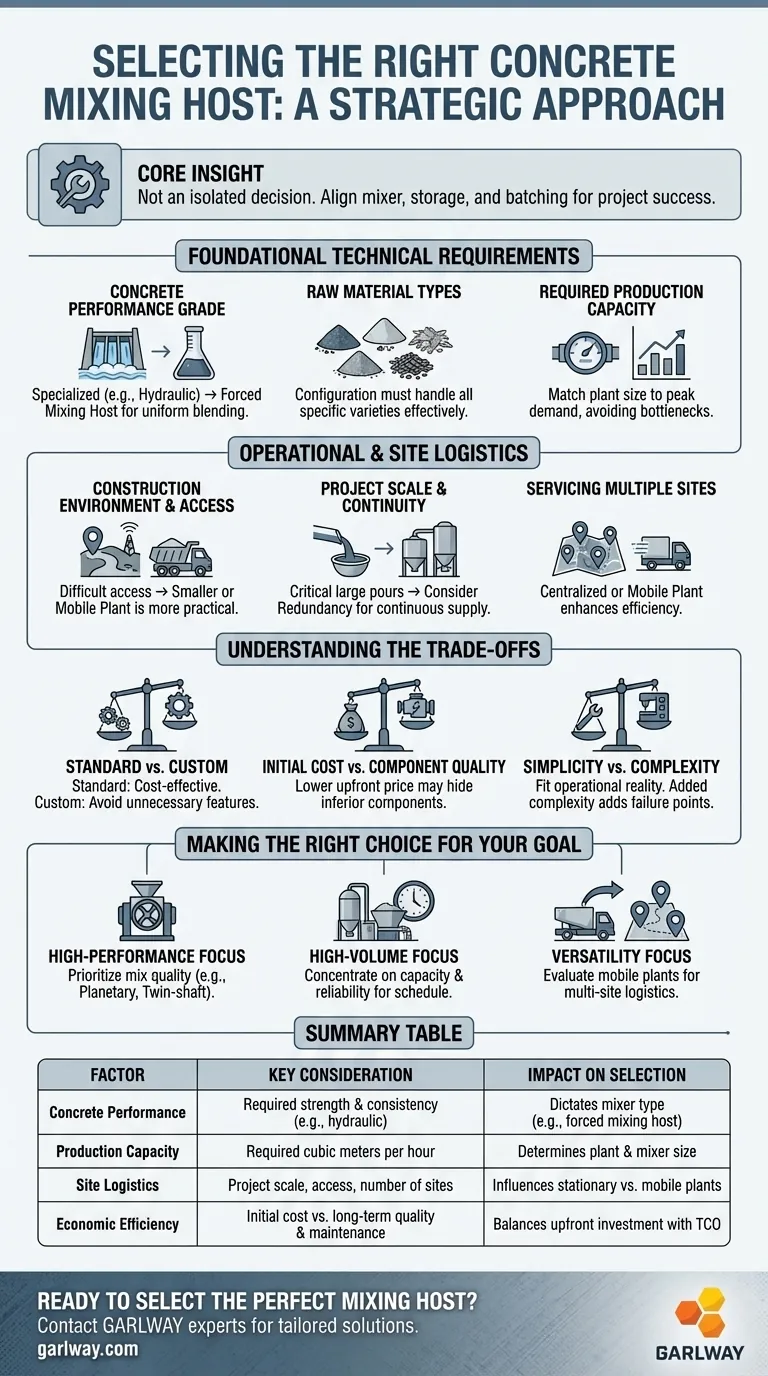
Visual Guide
Related Products
- HZS35 Small Cement Concrete Mixing Batch Plant
- HZS120 Ready Mix Concrete Batching Plant Commercial Mud Cement Mixer
- HZS75 Concrete Batching Plant Cement Mixer Price Concrete Mixer Bunnings Mixing Plant
- HZS180 Ready Mix Concrete Plant for Foundations with Sand and Cement
- Construction Products Concrete Plant Machine Mixing Concrete Mixer
People Also Ask
- Why buy concrete batch plant parts only from the manufacturer? Protect Your Investment and Maximize Uptime
- Why is proper maintenance important for a concrete batch mix plant? Maximize Uptime & Profitability
- What is the advantage of a mobile concrete batching plant? Achieve On-Site Production & Total Control
- What are the advantages and disadvantages of concrete batching plants? Maximize Quality & Efficiency
- What are the two methods of material charging in a concrete mixing station? Single vs. Multiple Charging Explained