The two primary methods for aggregate delivery in industrial settings are hopper transportation and belt transport. Hopper systems, which often use a skip hoist, are valued for their compact design and simple structure. In contrast, belt transport systems are chosen for their superior efficiency, reliability, and ability to move materials over much longer distances.
The choice between a hopper and a belt system is not about which is "better," but which is optimized for your specific operational scale and site layout. Hoppers excel in space-constrained, vertical-lift scenarios, while belts are unmatched for continuous, high-volume horizontal transfer.
Understanding Hopper Transportation
The Core Mechanism
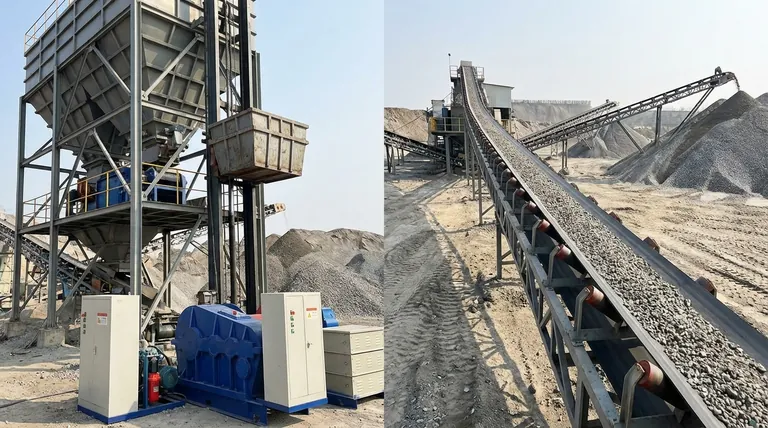
A hopper transportation system typically involves a large container (the hopper or "skip") that is loaded with aggregate at a low point. It is then hoisted vertically or along a steep incline to discharge the material into a silo or mixer at a higher elevation.
Key Advantage: Small Footprint
Because the primary movement is vertical, a hopper system consumes minimal ground area. This makes it an ideal solution for compact plant layouts, urban construction sites, or situations where an existing facility is being upgraded with limited space.
Key Advantage: Simple Structure
The mechanical design of a skip hoist is relatively straightforward. This simplicity often translates to a lower initial investment, easier installation, and more accessible maintenance compared to a sprawling belt system.
Analyzing Belt Transport Systems
The Core Mechanism
A belt transport system, or conveyor, uses a continuous loop of durable material to move aggregate horizontally or at a slight incline. It provides a constant, uninterrupted flow of material from a stockpile directly to the production point.
Key Advantage: High Efficiency
The continuous flow of a belt conveyor is inherently more efficient for high-volume operations than the cyclical, batch-based process of a hopper. This results in greater throughput and a more consistent feed for the plant.
Key Advantage: Longer Transportation Distance
Belt conveyors are the definitive solution for covering significant distances. They can easily transport materials hundreds of feet or more across a large site, something that is impractical for a hopper system.
Key Advantage: Lower Fault Rates
Modern belt systems are mature, highly reliable technologies. With fewer complex lifting components compared to a hoist, they tend to have higher operational uptime and a lower rate of mechanical failure when properly maintained.
Understanding the Trade-offs
The Limits of Hopper Systems
The primary drawback of a hopper is its batch-based nature, which limits its maximum throughput. It is less efficient for large-scale, continuous operations and is not designed for significant horizontal material transport.
The Demands of Belt Systems
While highly efficient, a belt conveyor demands a considerable physical footprint. Its installation can be more complex and costly, requiring structural supports along its entire length, and it may not be feasible for facilities with severe space constraints.
Making the Right Choice for Your Operation
Choosing the correct system requires a clear understanding of your production goals and physical site limitations.
- If your primary focus is a compact, cost-effective setup for a small to medium-sized plant: A hopper system offers the best solution due to its minimal footprint and structural simplicity.
- If your primary focus is high-volume, continuous production across a large site: A belt transport system is the superior choice for its unmatched efficiency, reliability, and long-distance capability.
By aligning your delivery method with your operational scale and site constraints, you ensure a reliable foundation for your entire production process.
Summary Table:
| Feature | Hopper System | Belt Transport System |
|---|---|---|
| Primary Movement | Vertical / Inclined Lift | Horizontal / Slight Incline |
| Best For | Space-constrained, small/medium plants | High-volume, large-scale operations |
| Key Advantage | Small footprint, simple structure | High efficiency, long-distance transport |
| Throughput | Batch-based (lower) | Continuous flow (higher) |
Optimize your aggregate delivery with GARLWAY.
Choosing the right system is critical for your plant's efficiency and profitability. As a specialist in construction machinery, GARLWAY provides robust and reliable solutions, including custom aggregate handling equipment tailored to your site's specific scale and layout.
We help construction companies and contractors globally maximize their productivity. Let our experts analyze your needs and recommend the optimal solution—whether it's a compact hopper system or a high-capacity belt conveyor.
Contact GARLWAY today for a professional consultation and quote.
Visual Guide

Related Products
- HZS35 Small Cement Concrete Mixing Batch Plant
- Auto Concrete Cement Mixer Machine New
- HZS180 Ready Mix Concrete Plant for Foundations with Sand and Cement
- HZS75 Concrete Batching Plant Cement Mixer Price Concrete Mixer Bunnings Mixing Plant
- Small Electric Winch 120V and 240V for Compact Applications
People Also Ask
- Why buy concrete batch plant parts only from the manufacturer? Protect Your Investment and Maximize Uptime
- Why is proper maintenance important for a concrete batch mix plant? Maximize Uptime & Profitability
- What is the advantage of a mobile concrete batching plant? Achieve On-Site Production & Total Control
- What are the advantages and disadvantages of concrete batching plants? Maximize Quality & Efficiency
- What are the two methods of material charging in a concrete mixing station? Single vs. Multiple Charging Explained