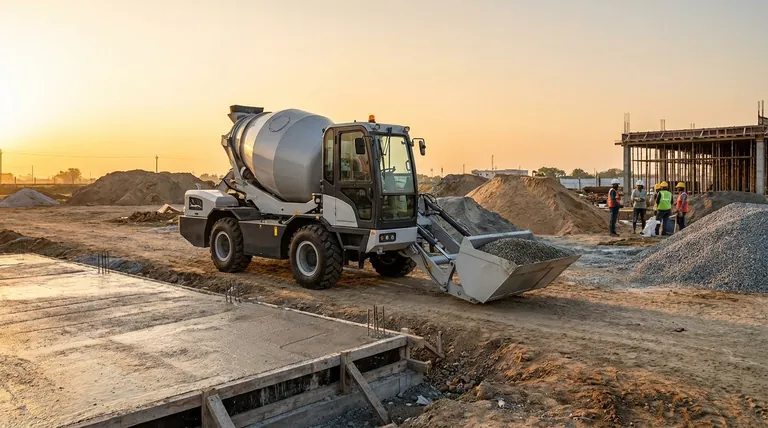
The primary cost benefit of a self-loading mixer truck is its ability to drastically reduce operational expenses by consolidating the entire concrete production process. By integrating material loading, mixing, transportation, and discharge into a single vehicle operated by one person, it effectively eliminates the need for a separate batching plant and its associated labor, transport, and material waste costs.
A self-loading mixer is not just a truck; it is a mobile, on-demand concrete plant. Its core financial advantage comes from transforming the logistics of concrete production from a multi-step, multi-person process into a streamlined, single-operator task performed directly at the job site.
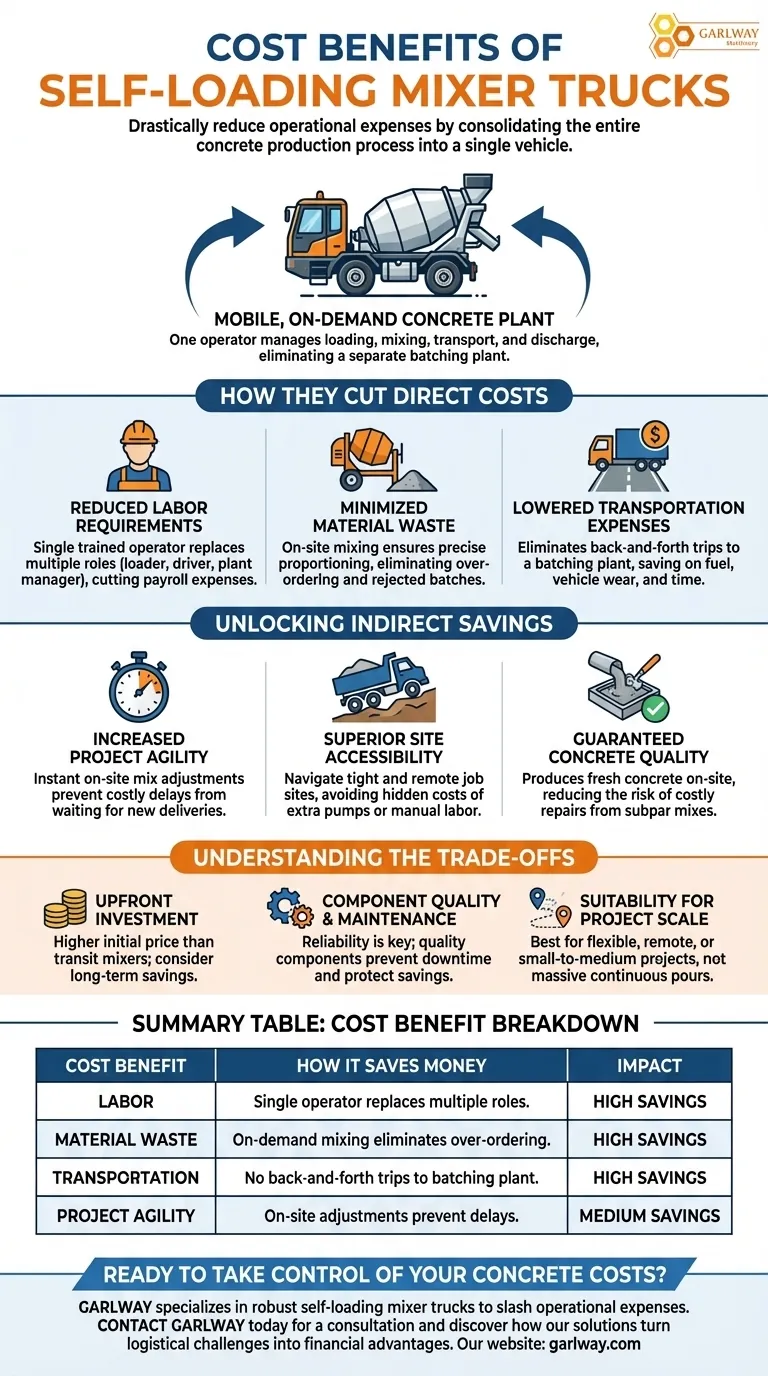
How Self-Loading Mixers Cut Direct Costs
The most immediate financial impacts are seen in the reduction of tangible, line-item expenses common in any construction project involving concrete.
Reduced Labor Requirements
A traditional concrete operation requires a team: loader operators at the batching plant, plant managers, and multiple truck drivers. A self-loading mixer centralizes these roles into a single trained operator who manages the entire process from loading aggregates to pouring the final product. This consolidation significantly cuts down on payroll expenses.
Minimized Material Waste
With on-site production, you mix only what you need, when you need it. The automated controls and precise proportioning systems ensure mix consistency and eliminate the costly problem of over-ordering from a batching plant. This also prevents waste from rejected batches that have been in transit too long.
Lowered Transportation Expenses
This equipment eliminates the constant back-and-forth trips between a central batching plant and the job site. This leads to substantial savings in fuel, vehicle wear-and-tear, and driver time. For remote or hard-to-reach locations, these savings become even more pronounced.
Unlocking Indirect Savings Through Efficiency
Beyond direct cost cutting, these machines introduce operational efficiencies that prevent budget overruns and protect project timelines.
Increased Project Agility
The ability to produce fresh concrete on-demand provides immense flexibility. If project requirements change, the operator can adjust mix ratios on-site instantly. This prevents the costly delays associated with waiting for new deliveries from an off-site supplier.
Superior Site Accessibility
Designed with a narrow body, short wheelbase, and small turning radius, self-loading mixers can navigate job sites inaccessible to larger vehicles. This avoids the hidden costs of using extra equipment like concrete pumps or manual labor to transport concrete across a difficult site.
Guaranteed Concrete Quality
Producing concrete on-site ensures maximum freshness and quality. This reduces the risk of costly repairs or rework caused by using a subpar mix that has degraded during long transit times.
Understanding the Trade-offs
While the long-term savings are significant, it's critical to approach this as an investment and understand the associated considerations.
The Upfront Investment
The initial purchase price of a self-loading mixer is higher than that of a standard transit mixer. The cost-benefit analysis must factor in this initial capital expenditure against the projected operational savings over the equipment's lifespan.
Component Quality and Maintenance
Long-term savings are contingent on the machine's reliability. The quality of key components—such as the hydraulic motor, reducer, chassis, and tank—directly impacts performance and longevity. While robustly designed for minimal maintenance, opting for lower-quality components can lead to downtime and negate savings.
Suitability for Project Scale
These mixers excel on projects requiring flexibility, such as those in remote areas, tight urban spaces, or jobs with multiple small, distinct pours. For massive, continuous pours, a dedicated high-volume batching plant may remain the more cost-effective solution.
Making the Right Choice for Your Goal
To determine if this equipment is the right fit, evaluate it against your most common operational challenges.
- If your primary focus is remote or varied job sites: The self-loader's key benefit is its ability to produce high-quality concrete anywhere, independent of supplier logistics.
- If your primary focus is reducing waste and labor on small-to-medium projects: The single-operator model and precise on-demand mixing will deliver the most significant and immediate cost reductions.
- If your primary focus is maximizing efficiency in constrained spaces: The all-in-one functionality and compact design streamline operations where traditional methods are impractical and expensive.
Ultimately, a self-loading mixer truck offers a powerful way to take control of your concrete supply chain and convert logistical challenges into financial advantages.
Summary Table:
| Cost Benefit | How It Saves Money |
|---|---|
| Labor | Single operator replaces multiple roles (loader, driver, plant manager). |
| Material Waste | On-demand mixing eliminates over-ordering and rejected batches. |
| Transportation | No back-and-forth trips to a batching plant, saving fuel and time. |
| Project Agility | On-site adjustments prevent delays from waiting for new deliveries. |
Ready to take control of your concrete costs?
GARLWAY specializes in construction machinery, offering robust self-loading mixer trucks designed for construction companies and contractors globally. Our machines help you slash operational expenses and increase on-site efficiency.
Contact GARLWAY today for a consultation and discover how our solutions can turn your logistical challenges into financial advantages.
Visual Guide
Related Products
- Skid Steer Self Loading Concrete Mixers for Construction
- Belle Mixer Drum Self Loading Mortar Mixers JS3000
- Portable Cement Mixer with Lift Concrete Machine
- Portable Concrete Mixer Machine Equipment for Mixing Concrete
- Portable Ready Mix Concrete Mixer Equipment
People Also Ask
- How does the control system improve production efficiency in a self loading concrete mixer? Automate Mixing for Speed & Quality
- What is the purpose of keeping the drum rotating during transportation in a self loading concrete mixer? Ensure Quality & Consistency
- How does the weighing process work in a self loading concrete mixer? Achieve Precise, On-Site Concrete Batching
- What components are involved in the loading process of a self loading concrete mixer? A Guide to the Key Systems
- How should materials be loaded into a self-loading concrete mixer? Master the Step-by-Step Process