
A chain hoist is a compact and versatile lifting device used to precisely lift and lower moderate loads in a wide range of industrial and commercial settings. It combines an electric motor with a specialized gearbox and chain mechanism, offering significant mechanical advantage in a portable package.
The core value of a chain hoist lies in its balance of power, precision, and portability. It sacrifices the massive lifting capacity of larger systems for the flexibility to be deployed almost anywhere, from high-altitude installations to ground-level workshops.
Deconstructing the Chain Hoist: The Core Components
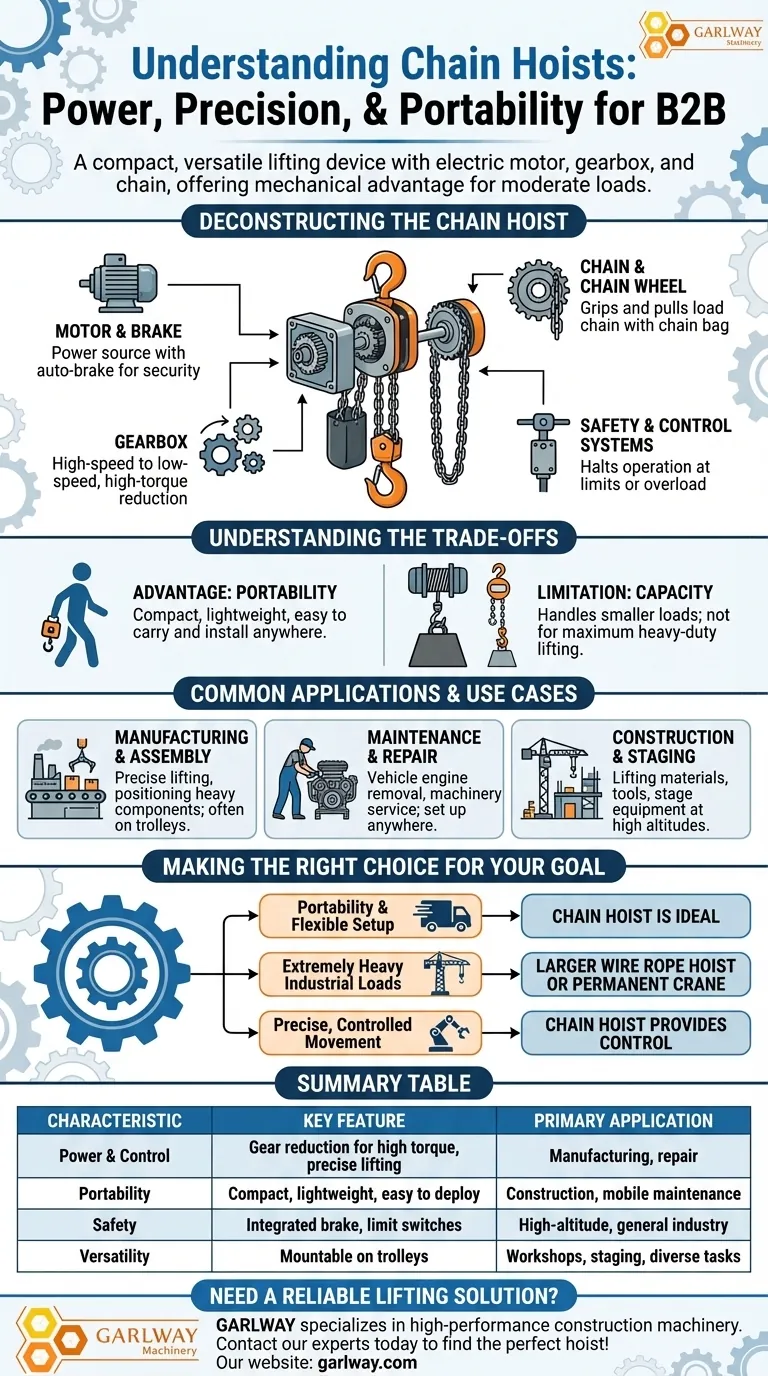
To understand how a chain hoist operates, it's essential to recognize its key mechanical parts. These components work in concert to translate electrical energy into powerful and controlled lifting force.
The Motor and Brake
The electric motor is the primary power source, providing the initial rotational force. It is paired with an integrated brake device that automatically engages when power is cut, ensuring the load is held securely in place and preventing accidental drops.
The Gearbox
The gearbox is the heart of the hoist's power. It contains a series of gears that reduce the motor's high speed into low-speed, high-torque rotation. This gear reduction is what multiplies the force, allowing a small motor to lift loads many times its own weight.
The Chain and Chain Wheel
A specialized chain wheel (or sprocket) is connected to the gearbox. As it turns, it grips and pulls the load chain, which is what directly lifts or lowers the attached hook and its cargo. A chain bag is typically included to safely collect the slack end of the chain during operation.
Safety and Control Systems
Modern chain hoists are equipped with critical safety features. A limit switch is a crucial component that automatically halts operation if the load tries to go too high or too low, or if it exceeds the hoist's rated capacity, preventing mechanical failure and ensuring operator safety.
Understanding the Trade-offs
While incredibly useful, a chain hoist is not the solution for every lifting task. Understanding its primary trade-off is key to using it effectively.
The Advantage of Portability
The most significant advantage of a chain hoist is its relatively small size and low weight. This makes it easy to carry, install, and relocate, which is ideal for construction sites, maintenance tasks, or workshops where lifting needs are not fixed to a single location.
The Limitation of Capacity
The trade-off for this portability is lifting capacity. Compared to larger systems like wire rope hoists or overhead cranes, a chain hoist generally handles smaller loads. Its design is optimized for convenience and versatility, not for maximum heavy-duty lifting.
Common Applications and Use Cases
The unique characteristics of a chain hoist make it suitable for a diverse set of applications across many industries.
Manufacturing and Assembly
In factories and on assembly lines, chain hoists are used to lift and position heavy components with precision. They can be mounted on trolleys to move parts along a beam, streamlining the production process.
Maintenance and Repair
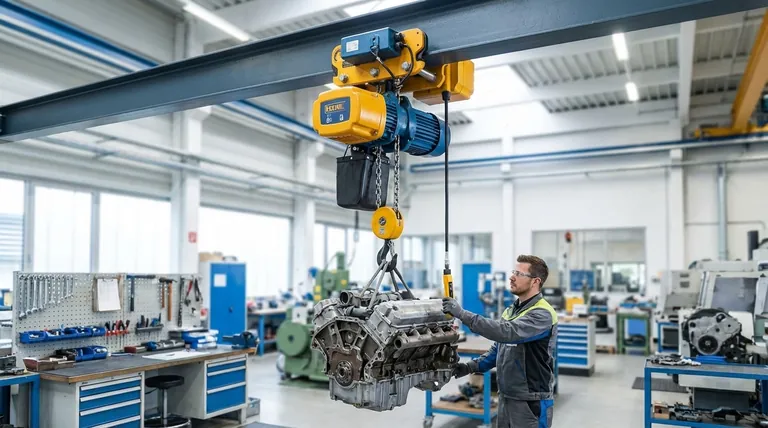
Mechanics and technicians rely on chain hoists for tasks like removing engines from vehicles or lifting heavy machinery for service. Their portability allows them to be set up wherever the work needs to be done.
Construction and Staging
On construction sites or in entertainment rigging, chain hoists lift building materials, tools, and stage equipment into place. Their ability to operate at high altitudes makes them indispensable for these environments.
Making the Right Choice for Your Goal
Selecting the correct lifting equipment depends entirely on the demands of the job.
- If your primary focus is portability and flexible setup for moderate loads: A chain hoist is the ideal tool for the job.
- If your primary focus is lifting extremely heavy industrial materials in a fixed location: You should evaluate a larger wire rope hoist or a permanent crane system.
- If your primary focus is precise, controlled movement for assembly or repair: The gear system in a chain hoist provides the slow, steady control you require.
Ultimately, choosing a chain hoist is a decision for precision, control, and operational versatility where massive capacity is not the overriding concern.
Summary Table:
| Characteristic | Key Feature | Primary Application |
|---|---|---|
| Power & Control | Gear reduction for high torque, precise lifting | Manufacturing assembly, equipment repair |
| Portability | Compact, lightweight, easy to deploy | Construction sites, mobile maintenance |
| Safety | Integrated brake, limit switches for secure operation | High-altitude installations, general industry |
| Versatility | Can be mounted on trolleys for horizontal movement | Workshops, staging, diverse lifting tasks |
Need a reliable lifting solution for your project?
GARLWAY specializes in high-performance construction machinery, including durable and efficient chain hoists. Whether you're a construction company, a contractor, or managing a manufacturing facility, our equipment is engineered for precision, safety, and portability to enhance your operational efficiency.
Let us help you lift your productivity. Contact our experts today to find the perfect hoist for your specific needs!
Visual Guide
Related Products
- Electric Hoist Winch Boat Anchor Windlass for Marine Applications
- Hydraulic Winding Engine Harbor Freight Winch
- Electric and Hydraulic Winch for Heavy Duty Applications
People Also Ask
- How does an electric anchor winch work? Power, Safety, and Reliable Operation Explained
- What are the advantages of installing an electric anchor winch on a boat? Boost Safety & Ease for Boaters
- What are the operational differences between electric hoists and winches? A Guide to Safe Lifting vs. Pulling
- What are the main benefits of a boat anchor winch? Boost Safety & Efficiency for Your Vessel
- How does a boat anchor winch work? A Guide to Reliable Anchor Handling


