
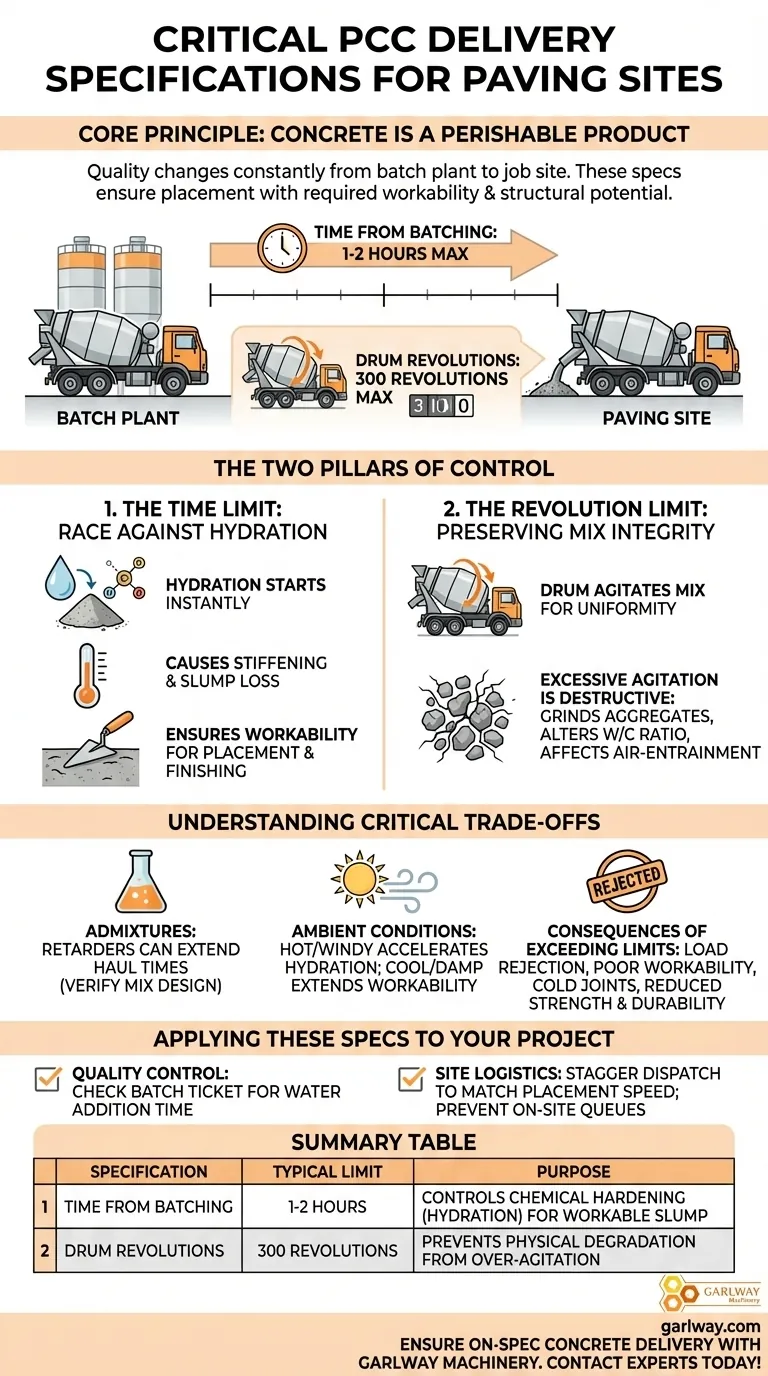
The two most critical specifications for delivering Portland Cement Concrete (PCC) to a paving site are time and the number of drum revolutions. Standard specifications typically limit delivery to a maximum of 1-2 hours and 300 drum revolutions from the moment water is introduced to the mix until final discharge.
The core principle behind these rules is that concrete is a perishable product. Its quality is in a constant state of change from the batch plant to the job site, and these specifications are designed to ensure the concrete is placed while it still has the required workability and structural potential.
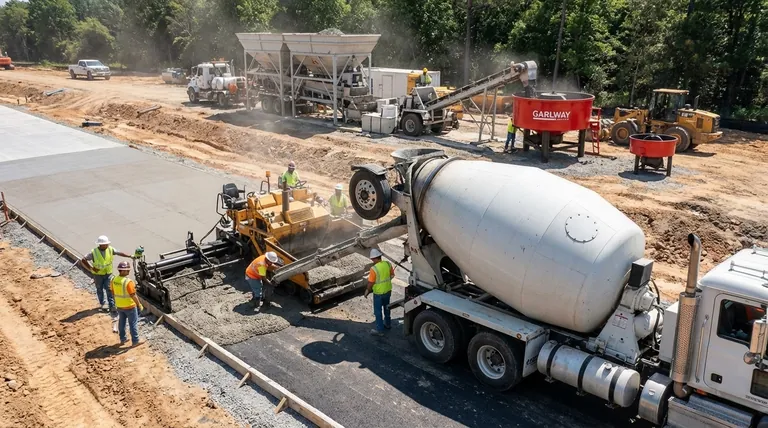
The Two Pillars of Concrete Delivery Control
To understand why these limits are so important, you must view them as controls over two different but related processes: chemical hardening and physical degradation.
The Time Limit: A Race Against Hydration
From the instant water is added to cement powder, a chemical reaction called hydration begins. This is the process that gives concrete its strength, but it also causes the mix to progressively stiffen.
The 1-2 hour time limit is a conservative window to ensure the concrete is discharged, placed, and finished before it becomes too stiff to work with. Exceeding this limit leads to a loss of workability, measured as slump.
The Revolution Limit: Preserving Mix Integrity
The concrete drum's purpose is to agitate the mix, keeping the heavy aggregates suspended and ensuring uniformity. However, excessive agitation is destructive.
The 300-revolution maximum is a safeguard against over-mixing. Too much mixing can grind down aggregates, alter the water-cement ratio, and potentially affect the air-entrainment system designed for durability. It turns a helpful process into a harmful one.
Understanding the Critical Trade-offs
While the time and revolution limits are excellent rules of thumb, they exist within a larger context of site conditions and mix design. Ignoring this context is a common source of error.
Impact of Admixtures
Modern concrete mixes often include chemical admixtures. Retarding admixtures, for example, are specifically designed to slow the hydration process, which can allow for longer haul times. Always verify if the mix design allows for extensions to the standard time limits.
The Role of Ambient Conditions
Weather is a major factor. On a hot, windy day, hydration and evaporation accelerate dramatically, making the 1-2 hour window even more critical. Conversely, on a cool, damp day, the mix will remain workable for longer.
Consequences of Exceeding Limits
When a truck arrives outside these specifications, the load is often rejected for good reason. Using such concrete risks poor workability, difficulty in finishing, and the creation of "cold joints" if it's placed against a layer that has already begun to set. Ultimately, it can lead to a reduction in the final compressive strength and long-term durability of the pavement.
Applying These Specs to Your Project
Your goal is to manage logistics so that every truck arrives within specification, ensuring a high-quality, uniform pavement.
- If your primary focus is quality control: Always check the batch ticket upon the truck's arrival. It contains the critical time when water was first added to the mix.
- If your primary focus is site logistics: Stagger truck dispatch from the plant to match your crew's placement speed. This prevents a queue of trucks from waiting on-site, where they are forced to turn their drums and race against the clock.
Following these delivery specifications is the first and most crucial step in guaranteeing the integrity and lifespan of your concrete pavement.
Summary Table:
| Specification | Typical Limit | Purpose |
|---|---|---|
| Time from Batching | 1-2 Hours | Controls chemical hardening (hydration) to ensure workable slump. |
| Drum Revolutions | 300 Revolutions | Prevents physical degradation of the mix from over-agitation. |
Ensure your next paving project starts with on-spec concrete delivery. GARLWAY specializes in providing robust and reliable construction machinery, including concrete mixers and batching plants, designed to help construction companies and contractors maintain precise control over mix quality and delivery logistics. Let our equipment be the reliable foundation for your high-quality pavement. Contact our experts today to discuss your project needs!
Visual Guide
Related Products
- Portable Cement Mixer with Lift Concrete Machine
- Portable Ready Mix Concrete Mixer Equipment
- Portable Electric Small Cement Mixer Concrete Machine
People Also Ask
- What are the size and portability options for portable cement mixers? Find Your Perfect Match for Any Job
- Why is it necessary to use a portable concrete mixer? Gain Total Control & Efficiency
- How much concrete can you pour with a portable mixer? Find the Perfect Fit for Your Project
- What is a portable cement mixer? Achieve Consistent, On-Demand Concrete Mixing
- What are the power sources for portable cement mixers? Choose the Right Power for Your Job Site


