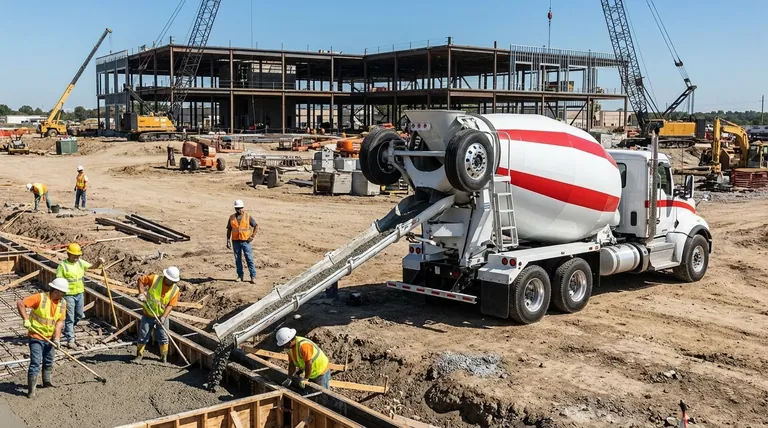
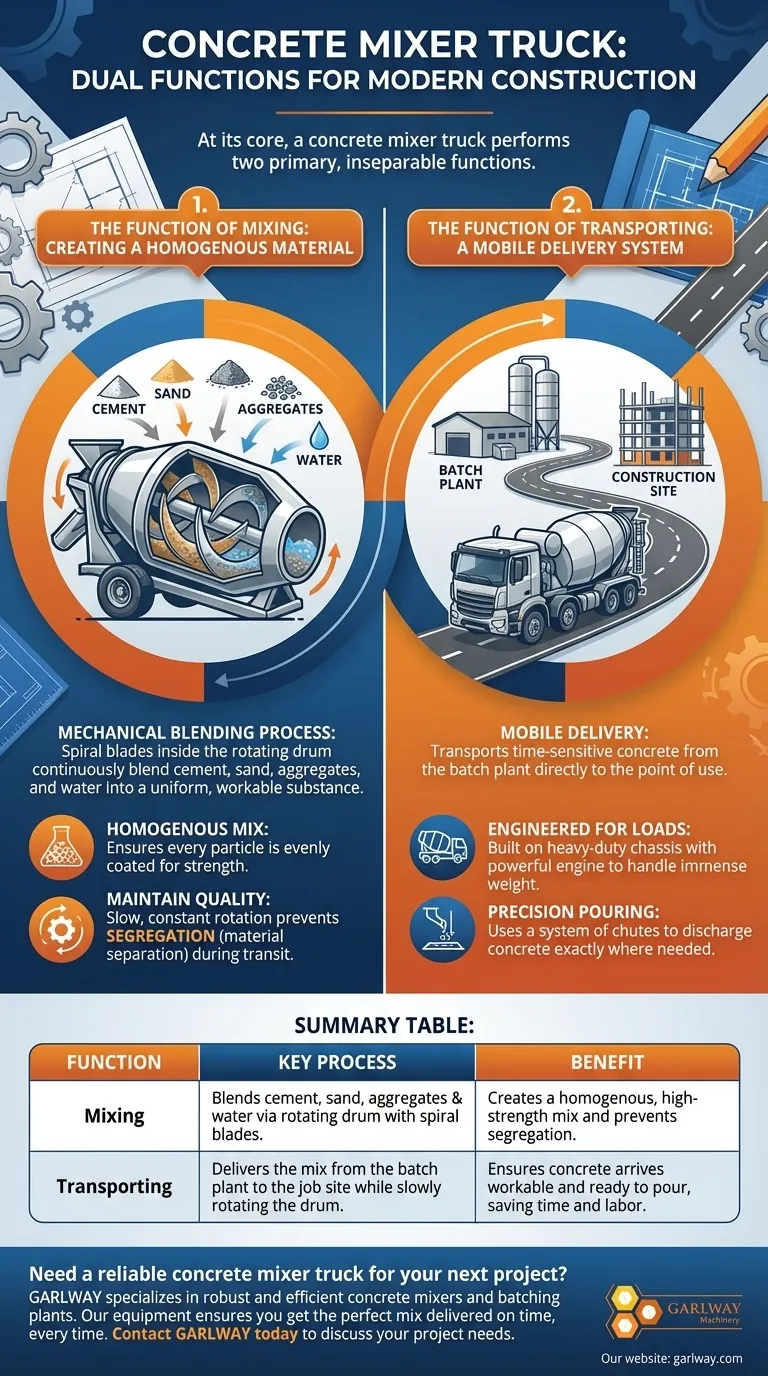
At its core, a concrete mixer truck performs two primary, inseparable functions. It is designed to first mix raw materials—cement, sand, aggregates, and water—into homogenous concrete, and second, to transport that freshly mixed concrete to a construction site while keeping it in a viable, unhardened state.
The critical insight is that a concrete mixer truck is not merely a vehicle for transportation; it is an active, mobile mixing plant. Its dual functions ensure that the concrete arrives at the job site with the precise consistency and quality required, preventing premature setting and material separation during transit.
The Function of Mixing: Creating a Homogenous Material
The first core function is to mechanically blend disparate ingredients into a uniform, workable substance. This process is far more complex than simply stirring materials in a container.
The Key Ingredients
A mixer truck combines cement, which acts as the binding agent, with aggregates like sand and gravel. Water is then added to trigger the chemical reaction (hydration) that allows the concrete to harden and gain strength.
The Mechanical Blending Process
Inside the large, rotating drum are spiral blades or turbines. As the drum turns, these blades continuously lift and fold the materials over one another. This action ensures every particle of sand and gravel is evenly coated with cement paste, creating a homogenous mixture.
Maintaining Quality During Transit
The mixing doesn't stop once the ingredients are combined. The slow, constant rotation of the drum during transport is critical. It prevents the heavier aggregates from settling to the bottom (a process called segregation) and stops the concrete from beginning to harden before it can be poured.
The Function of Transportation: A Mobile Delivery System
The second core function is to deliver this time-sensitive product directly to the point of use. The truck itself is engineered specifically for this purpose.
From Batch Plant to Job Site
Mixer trucks are the final link in the ready-mix concrete supply chain. They are filled with either dry ingredients and water at a central batching plant or arrive pre-loaded with concrete that was mixed at the plant.
Engineered for Heavy Loads
The vehicle is built on a heavy-duty truck chassis with multiple axles to distribute the immense weight of the concrete. A powerful engine, often exceeding 400 horsepower, is required to move the load and power the hydraulic system that rotates the drum.
Precision Pouring
Upon arrival, the truck uses a system of chutes to discharge the concrete precisely where it's needed. The driver can control the speed of the drum's rotation to manage the flow rate of the pour, giving construction crews control over the placement.
Understanding the Trade-offs: Why Combining Functions is Essential
Separating the mixing and transportation functions would fundamentally compromise the quality of the concrete. The dual-purpose design of the mixer truck solves critical logistical and material science problems.
The Problem with Simple Hauling
If you were to mix concrete and then transport it in a standard dump truck, the vibration and lack of agitation would cause the materials to segregate. The heavy gravel would sink, and the water would rise, resulting in a weak, inconsistent, and unusable product upon arrival.
On-Site Mixing vs. Ready-Mix Delivery
While small batches can be mixed on-site, it is inefficient for larger projects. A concrete mixer truck delivers large, quality-controlled batches exactly when needed, eliminating the need for bulky mixing equipment and material storage on the construction site itself. This improves project speed and logistical efficiency.
The Mixer Truck's Role in Project Success
Choosing ready-mix concrete delivered by a mixer truck is a decision based on the specific needs of your project.
- If your primary focus is material quality and strength: The continuous agitation provided by the truck is the single most important factor in guaranteeing a homogenous, high-performance concrete mix.
- If your primary focus is project efficiency and speed: The truck's ability to deliver large, ready-to-pour batches directly to the site minimizes on-site labor, reduces equipment clutter, and accelerates the construction timeline.
Ultimately, the concrete mixer truck's dual-function design is the key to modern construction, delivering a consistent, reliable, and perfectly timed product.
Summary Table:
| Function | Key Process | Benefit |
|---|---|---|
| Mixing | Blends cement, sand, aggregates & water via rotating drum with spiral blades. | Creates a homogenous, high-strength mix and prevents segregation. |
| Transporting | Delivers the mix from the batch plant to the job site while slowly rotating the drum. | Ensures concrete arrives workable and ready to pour, saving time and labor. |
Need a reliable concrete mixer truck for your next project?
GARLWAY specializes in construction machinery, offering robust and efficient concrete mixers and batching plants for construction companies and contractors globally. Our equipment ensures you get the perfect mix delivered on time, every time.
Contact GARLWAY today to discuss your project needs and discover how we can help you achieve superior results.
Visual Guide
Related Products
- Ready Mixer Machine for Construction Ready Mix Machinery
- JW1000 Mobile Cement Mixer Concrete Mixer Truck and Batching Plant
- Mini Cement Mortar Mixer Truck for Construction
- Harbor Freight JS1500 On Site Concrete Mixing Volumetric Cement Mixer
- HZS90 Large Multiquip Concrete Mixers for Construction
People Also Ask
- What are the purposes of low-speed agitation in truck mixers? Preserve Concrete Quality During Transit
- How is ready-mixed concrete transported from a commercial concrete batching plant? Ensuring Quality & Timely Delivery
- What are the main ingredients mixed in a concrete mixer truck? Master the Formula for Strong Concrete
- In what ways does a mobile concrete mixer improve quality control and consistency? Achieve Superior On-Site Concrete Quality
- What types of construction projects typically use concrete mixer trucks? From Highways to Home Foundations