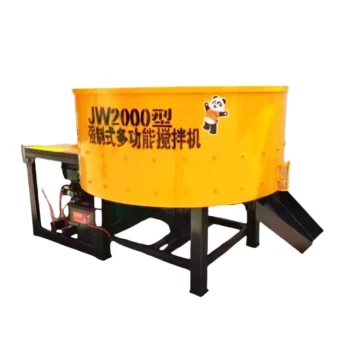
The fundamental advantage of a concrete mixer is its ability to produce a completely homogeneous mixture. This uniform blending of cement, water, sand, and aggregates is the basis for creating concrete that is consistent, strong, and durable, directly translating to higher quality and greater reliability in any construction project.
The core issue isn't speed, it's control. Manual mixing inevitably creates inconsistent pockets of material, leading to unpredictable weak points. A mechanical mixer eliminates this guesswork, ensuring every part of the batch meets its specified strength and durability.
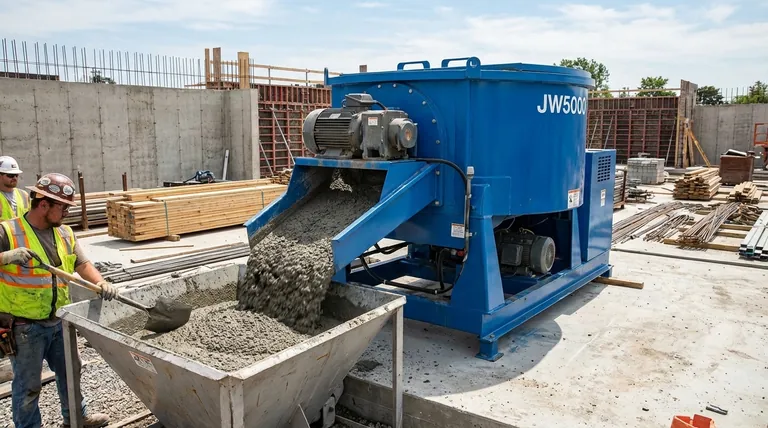
The Foundation of Quality: Uniformity and Consistency
The quality of finished concrete is determined long before it's poured. It begins with the thoroughness of the mix, where a mechanical mixer provides advantages that are impossible to replicate by hand.
Achieving a Homogeneous Mixture
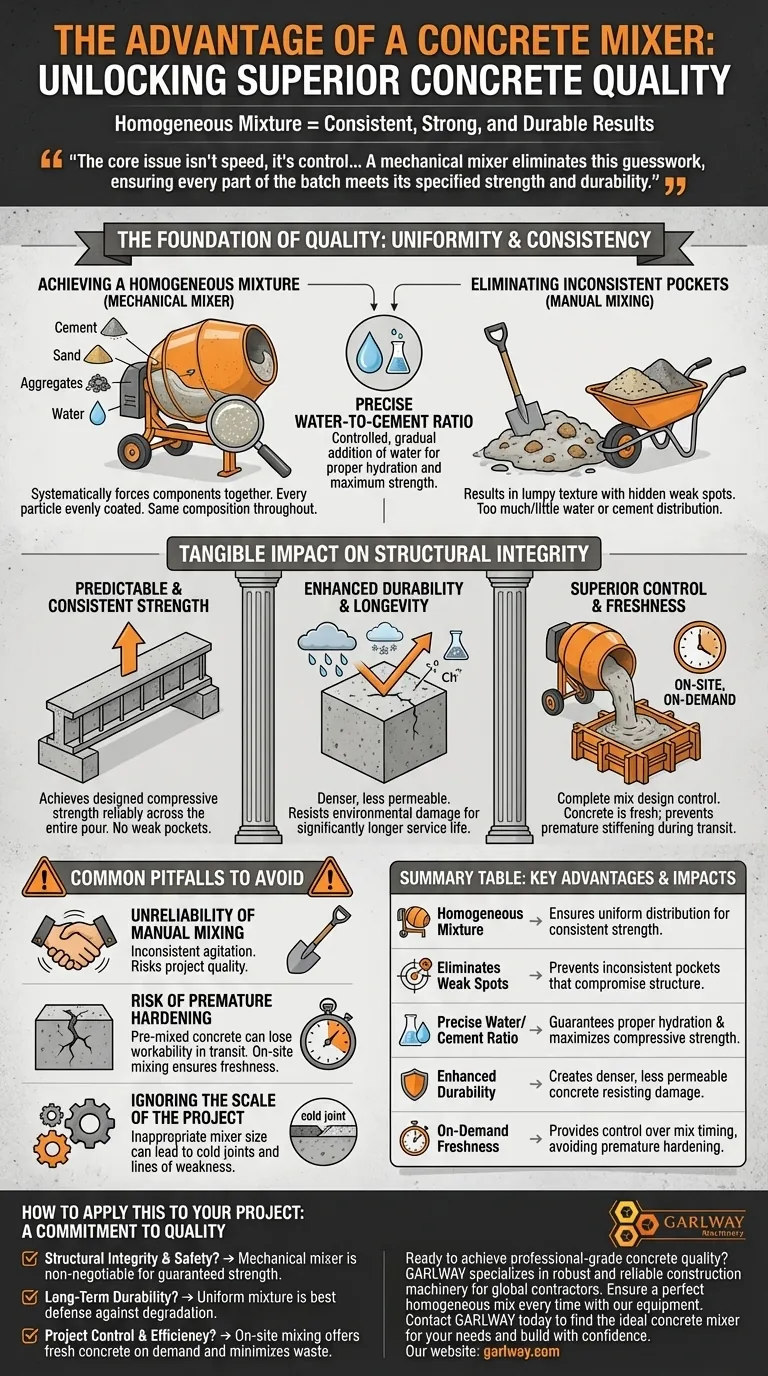
A concrete mixer forces the components together systematically, ensuring every particle of sand and aggregate is evenly coated with cement paste. This creates a homogeneous mixture, meaning it has the same composition and properties throughout.
Eliminating Inconsistent Pockets
Manual mixing often results in a lumpy, inconsistent texture. These areas can have too much water, too little cement, or poorly distributed aggregates, creating hidden weak spots within the final structure.
Guaranteeing a Precise Water-to-Cement Ratio
The strength of concrete is critically dependent on the water-to-cement ratio. A mixer allows for the controlled, gradual addition of water, ensuring it is fully and evenly incorporated, which is essential for proper hydration and strength development.
The Tangible Impact on Structural Integrity
A uniform mix isn't just an abstract concept; it has direct, measurable effects on the performance and lifespan of the concrete structure.
Predictable and Consistent Strength
Because the components are distributed evenly, the resulting concrete achieves its designed compressive strength reliably across the entire pour. There are no pockets of weakness that could compromise the overall structural integrity.
Enhanced Durability and Longevity
Well-mixed concrete is denser and less permeable. This uniformity helps it resist water penetration, chemical attacks, and the effects of freeze-thaw cycles, leading to a significantly longer service life.
Superior Control and Freshness
Using a mixer on-site, especially a mobile or portable one, gives you complete control over the mix design. It ensures the concrete is fresh and hasn't begun to prematurely stiffen, a common risk with pre-mixed concrete that has traveled a long distance.
Common Pitfalls to Avoid
While a mixer is a superior tool, its benefits are only realized when used correctly. Understanding the contrast with manual methods highlights the critical risks you are avoiding.
The Unreliability of Manual Mixing
For any structural application, manual mixing is unreliable. The physical effort required makes it nearly impossible to achieve the consistent, forceful agitation needed to create a truly homogeneous mixture, putting the project's quality at risk.
The Risk of Premature Hardening
One of the key quality advantages of on-site mixing is avoiding premature stiffening. Pre-mixed concrete that sits too long in transit or on-site can lose workability and strength, but a mixer allows you to produce fresh batches exactly when needed.
Ignoring the Scale of the Project
Using a small, portable mixer for a large slab pour can be just as problematic as manual mixing. It can lead to "cold joints" between batches, creating lines of weakness. The type and size of the mixer must be appropriate for the job.
How to Apply This to Your Project
Choosing to use a mechanical mixer is the first step in ensuring a professional-grade outcome. The decision is a commitment to quality over convenience.
- If your primary focus is structural integrity and safety: A mechanical mixer is non-negotiable, as it is the only way to guarantee the consistent, predictable strength required.
- If your primary focus is long-term durability: The dense, uniform mixture from a mixer is your best defense against premature degradation from weather and environmental factors.
- If your primary focus is project control and material efficiency: On-site mixing provides fresh concrete on demand, allows for precise adjustments, and minimizes the waste associated with over-ordering pre-mixed batches.
Ultimately, using a concrete mixer is the defining line between amateur results and professional, long-lasting construction.
Summary Table:
| Advantage | Impact on Concrete Quality |
|---|---|
| Homogeneous Mixture | Ensures uniform distribution of materials for consistent strength. |
| Eliminates Weak Spots | Prevents inconsistent pockets that compromise structural integrity. |
| Precise Water-to-Cement Ratio | Guarantees proper hydration and maximizes compressive strength. |
| Enhanced Durability | Creates a denser, less permeable concrete that resists environmental damage. |
| On-Demand Freshness | Provides control over mix timing, avoiding premature hardening. |
Ready to achieve professional-grade concrete quality on your next project?
GARLWAY specializes in providing robust and reliable construction machinery, including a range of concrete mixers designed for construction companies and contractors globally. Our equipment ensures you produce a perfectly homogeneous mix every time, guaranteeing the structural integrity, durability, and cost-efficiency your projects demand.
Contact GARLWAY today to find the ideal concrete mixer for your specific needs and build with confidence.
Visual Guide
Related Products
- Portable Concrete Mixer Machine Equipment for Mixing Concrete
- Construction Products Concrete Plant Machine Mixing Concrete Mixer
- Portable Electric Concrete Mixer Machine for Cement Mixing
- Concrete Cement Mixer Machine Drum Mixer for Construction
- HZS25 Best Cement Mixer for Quick Mix Concrete at Bunnings
People Also Ask
- Why is it necessary to use a portable concrete mixer? Gain Total Control & Efficiency
- How much concrete can you pour with a portable mixer? Find the Perfect Fit for Your Project
- What types of projects are portable concrete mixers suitable for? Ideal for DIY & Small-Scale Construction
- How much does a portable concrete mixer hold? A Guide to Choosing the Right Capacity
- What types of portable concrete mixers exist? Find the Perfect Mixer for Your Project