
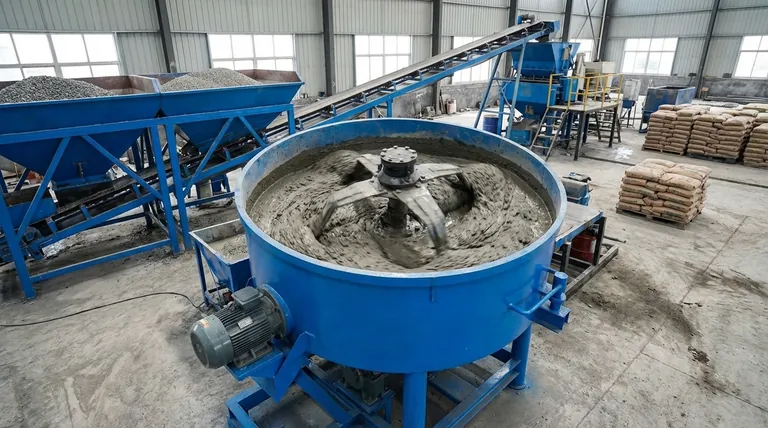
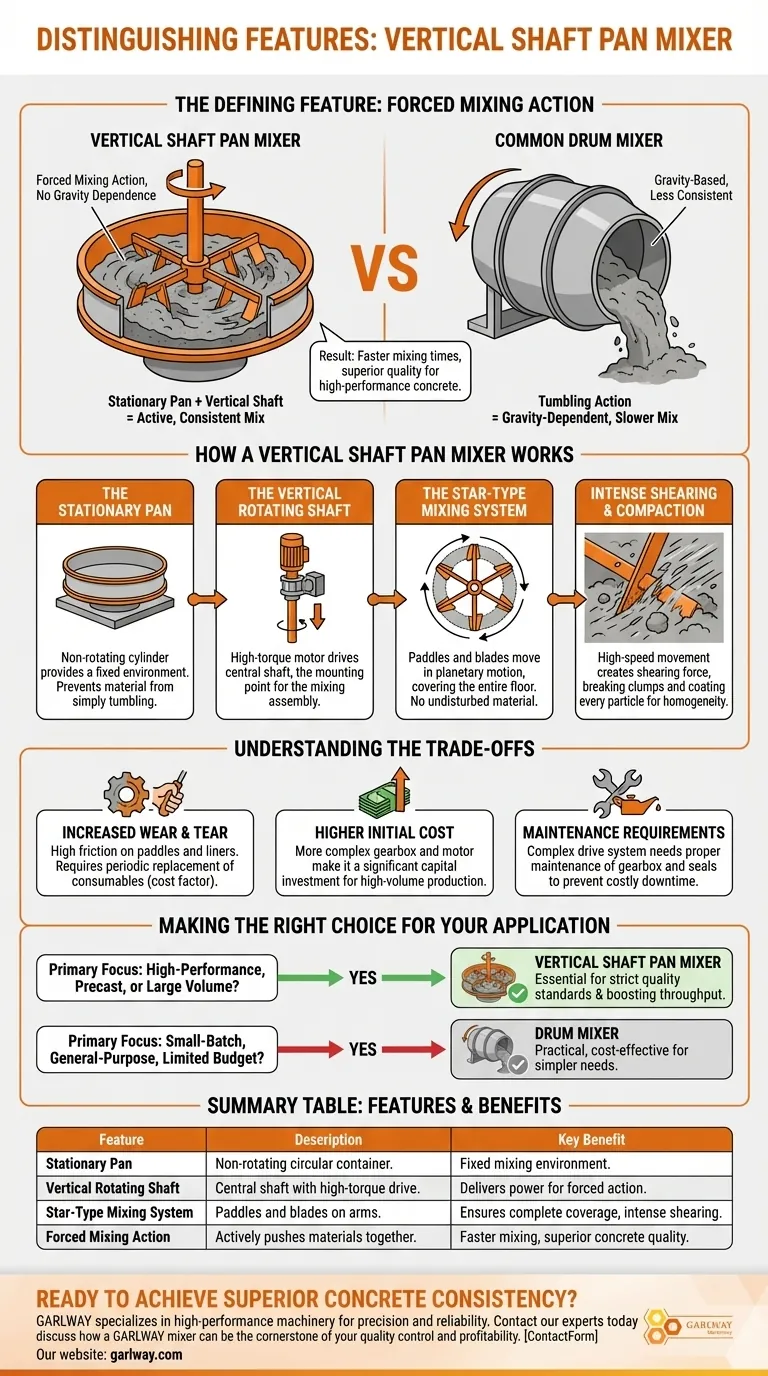
The defining feature of a vertical shaft pan mixer is its stationary, circular pan combined with a centrally mounted, vertical rotating shaft. This shaft drives a "star-shaped" system of paddles and blades that move through the material, creating a powerful, forced mixing action that ensures a highly consistent and homogeneous mixture.
The crucial difference from a common drum mixer is that a vertical pan mixer doesn't rely on gravity. Instead, it actively forces materials to interact, resulting in faster mixing times and superior quality, especially for high-performance or specialized concrete.
How a Vertical Shaft Pan Mixer Works
To understand its advantages, we must first examine its core mechanics. The design is a direct solution to the limitations of simpler, gravity-based mixers.
The Stationary Pan
The foundation of the mixer is the non-rotating, circular pan or cylinder. All raw materials—aggregates, cement, water, and admixtures—are loaded into this static container.
This design ensures the mixing tools have a fixed environment to work within, preventing material from simply tumbling and relying on chance for distribution.
The Vertical Rotating Shaft
Power is delivered through a high-torque electric motor and gearbox connected to a vertical shaft. This shaft extends down into the center of the pan and serves as the mounting point for the entire mixing assembly.
The Star-Type Mixing System
Attached to the shaft is a set of arms, often called a "mixing star." Paddles, blades, and scrapers are mounted on these arms.
As the shaft rotates, these tools travel in a planetary or counter-current motion, covering the entire pan floor. This guarantees that no material is left undisturbed. The "follow-up paddle" mentioned in technical descriptions is part of this system, designed to ensure complete coverage.
Intense Shearing and Compaction
The high-speed movement of the paddles through the stationary material creates an intense shearing force. This action breaks down any clumps of cement and forces water and fine particles to coat every piece of aggregate, achieving a level of homogeneity difficult to match with other systems.
Understanding the Trade-offs
While highly effective, this design comes with specific considerations that are critical for making an informed decision.
Increased Wear and Tear
The forced-mixing action creates significant friction. The mixing paddles and the pan liners are subjected to constant, high-pressure abrasion, especially with coarse aggregates.
This means these components are considered consumables and will require periodic replacement, adding to the operational cost.
Higher Initial Cost
The complexity of the gearbox, motor, and mixing star assembly makes vertical shaft pan mixers more expensive to purchase than simple tilting drum mixers. They are a significant capital investment intended for high-volume or high-specification production.
Maintenance Requirements
The drive system is more complex than that of a simple drum mixer. Proper maintenance of the gearbox, seals, and bearings is critical to ensure reliability and longevity. Neglecting this can lead to costly downtime.
Making the Right Choice for Your Application
Selecting the correct mixer depends entirely on the required quality and volume of your output.
- If your primary focus is high-performance or precast concrete: The superior homogeneity and speed of a vertical shaft pan mixer are essential for meeting strict quality standards.
- If your primary focus is producing large volumes of standard-grade concrete: This mixer's efficiency and short cycle times can significantly boost plant throughput and profitability.
- If your primary focus is small-batch, general-purpose mixing with a limited budget: A simpler and less expensive drum mixer is often the more practical and cost-effective solution.
Ultimately, choosing a vertical shaft pan mixer is an investment in consistency, speed, and quality control for demanding applications.
Summary Table:
| Feature | Description | Key Benefit |
|---|---|---|
| Stationary Pan | Non-rotating circular container for materials. | Provides a fixed environment for consistent mixing. |
| Vertical Rotating Shaft | Central shaft driven by a high-torque motor and gearbox. | Delivers the power for a forced, non-gravity-dependent mixing action. |
| Star-Type Mixing System | Paddles and blades attached to the shaft. | Ensures complete material coverage and intense shearing for a homogeneous mix. |
| Forced Mixing Action | Actively pushes materials together instead of relying on tumbling. | Results in faster mixing times and superior concrete quality, ideal for precast and high-performance mixes. |
Ready to achieve superior concrete consistency and boost your plant's efficiency?
GARLWAY specializes in high-performance construction machinery, including robust vertical shaft pan mixers designed for construction companies and contractors who demand precision and reliability. Our mixers deliver the fast cycle times and homogeneous results essential for precast and high-specification projects.
Contact our experts today to discuss how a GARLWAY mixer can be the cornerstone of your quality control and profitability.
Visual Guide
Related Products
- Shaft Mixer Machine for Cement and Regular Concrete Mixing
- JS500 Electric Cement Concrete Mixer for Sale
- Portable Cement Mixer with Lift Concrete Machine
- Construction Products Concrete Plant Machine Mixing Concrete Mixer
- Ready Mixer Machine for Construction Ready Mix Machinery
People Also Ask
- How do cement mixers enhance safety on construction sites? Reduce Strain, Hazards, and Accidents
- What are the key benefits of using a cement mixer on a construction site? Boost Efficiency, Quality & Safety
- What are the efficiency advantages of cement mixers? Boost Project Speed, Quality, and ROI
- How does cleaning a cement mixer after use benefit its performance? Maximize Lifespan and Mix Quality
- Can a cement mixer be used for mixing mortar? Understanding the Risks and Best Practices





