
The two primary methods for ready-mix concrete delivery are the traditional barrel truck (or in-transit mixer) and the modern volumetric concrete mixer. A barrel truck delivers concrete that was already mixed at a central plant, arriving in a wet, plastic state. In contrast, a volumetric mixer functions as a mobile batch plant, carrying dry ingredients and water in separate compartments to be mixed fresh on-site.
The fundamental choice is not just about the truck, but about your project's needs. You are choosing between the large-batch consistency of a central plant (barrel truck) and the on-demand flexibility and freshness of a mobile plant (volumetric mixer).
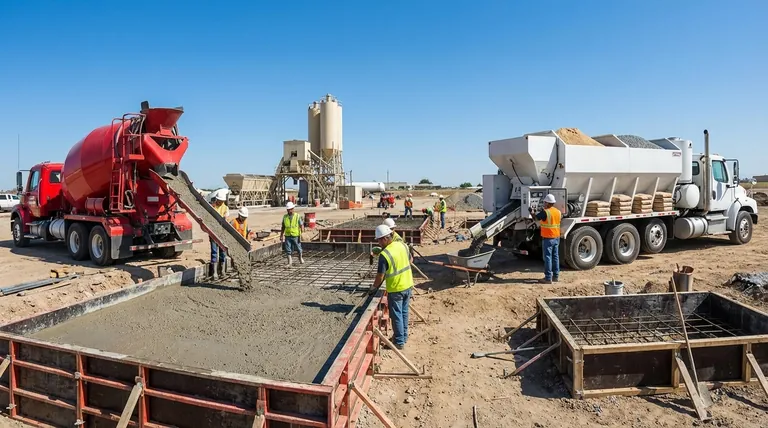
The Barrel Truck: The Traditional Workhorse
The barrel truck, also known as an in-transit mixer, is the most common image associated with concrete delivery. The large rotating drum is designed to agitate pre-mixed concrete to prevent it from setting during transport.
How It Works
The raw materials—cement, sand, stone, and water—are precisely measured and mixed at a central batching plant. This wet concrete is loaded into the truck's drum, which then rotates continuously on the way to the job site.
Key Advantage: Centralized Quality Control
Because the concrete is produced in a controlled plant environment, it can offer high levels of consistency and can be certified to meet stringent engineering specifications. This makes it ideal for large-scale projects like foundations and commercial slabs.
Critical Limitation: The "Hot Load"
The moment water is added at the plant, the hydration process begins, and the concrete starts to cure. This creates a time limit, typically around 90 minutes or 300 drum revolutions, to discharge the load before it becomes unusable. Delays on-site can lead to wasted material and significant costs.
The Volumetric Mixer: The On-Demand Solution
A volumetric mixer is essentially a complete batch plant mounted on a truck chassis. It provides a fundamentally different approach to concrete delivery.
How It Works
The truck carries unmixed materials—sand, stone, cement powder, and water—in separate compartments. Upon arrival, the operator uses calibrated controls to mix these components on-site, producing fresh concrete as needed.
Key Advantage: Freshness and Flexibility
Since the concrete is mixed seconds before it is poured, it is always at maximum strength and workability. The mix design can be adjusted on the fly, and the operator can start and stop the pour at any time, which is perfect for multiple small jobs or projects with uncertain volume requirements.
Key Advantage: No Waste, Precise Costing
You only mix the exact amount of concrete required for the job. This "pay for what you use" model eliminates the waste and cost associated with ordering too much from a barrel truck, which often has minimum load charges.
Understanding the Core Trade-offs
Choosing the right delivery method requires balancing the needs of your specific project. Neither option is universally superior; they are simply suited for different tasks.
Time vs. Flexibility
Barrel trucks are built for speed and volume on well-planned, continuous pours. Volumetric mixers offer unmatched flexibility, making them ideal for projects with delays, multiple pour locations, or uncertain quantities.
Cost Structure
Barrel trucks may have a lower cost per cubic yard on very large orders, but they often include charges for short loads (not meeting the minimum order) and extra on-site time. Volumetric mixers can be more cost-effective for small to medium-sized jobs by eliminating waste and short-load fees.
Project Location
For remote sites far from a batch plant, a volumetric mixer is often the only viable option. It bypasses the time constraint of a "hot load," ensuring fresh concrete can be produced anywhere.
Making the Right Choice for Your Project
Your decision should be guided by the unique demands of your job site and project goals.
- If your primary focus is a single, large, continuous pour: The certified consistency and high-volume output of a barrel truck from a central plant is often the most efficient choice.
- If your primary focus is flexibility, multiple small pours, or remote access: The on-demand freshness and adaptability of a volumetric mixer are superior.
- If your primary focus is minimizing waste and controlling costs on a smaller project: The "pay for what you use" model of a volumetric mixer provides significant financial and logistical advantages.
Ultimately, understanding these two delivery methods empowers you to match the right tool to the specific requirements of your job.
Summary Table:
| Delivery Method | How It Works | Key Advantage | Best For |
|---|---|---|---|
| Barrel Truck (In-Transit Mixer) | Mixed at central plant, delivered wet | Centralized quality control & consistency | Large, continuous pours (e.g., foundations, slabs) |
| Volumetric Mixer | Mixed on-site from separate compartments | Freshness, flexibility, no waste | Small to medium jobs, remote sites, multiple pours |
Still unsure which concrete delivery method is right for your project?
At GARLWAY, we specialize in construction machinery and understand the unique demands of contractors and construction companies. Whether you need the high-volume efficiency of a barrel truck or the on-demand flexibility of a volumetric mixer, we provide reliable solutions tailored to your job site.
Let our experts help you maximize efficiency and minimize costs. Contact GARLWAY today for a consultation and discover the perfect concrete delivery solution for your needs!
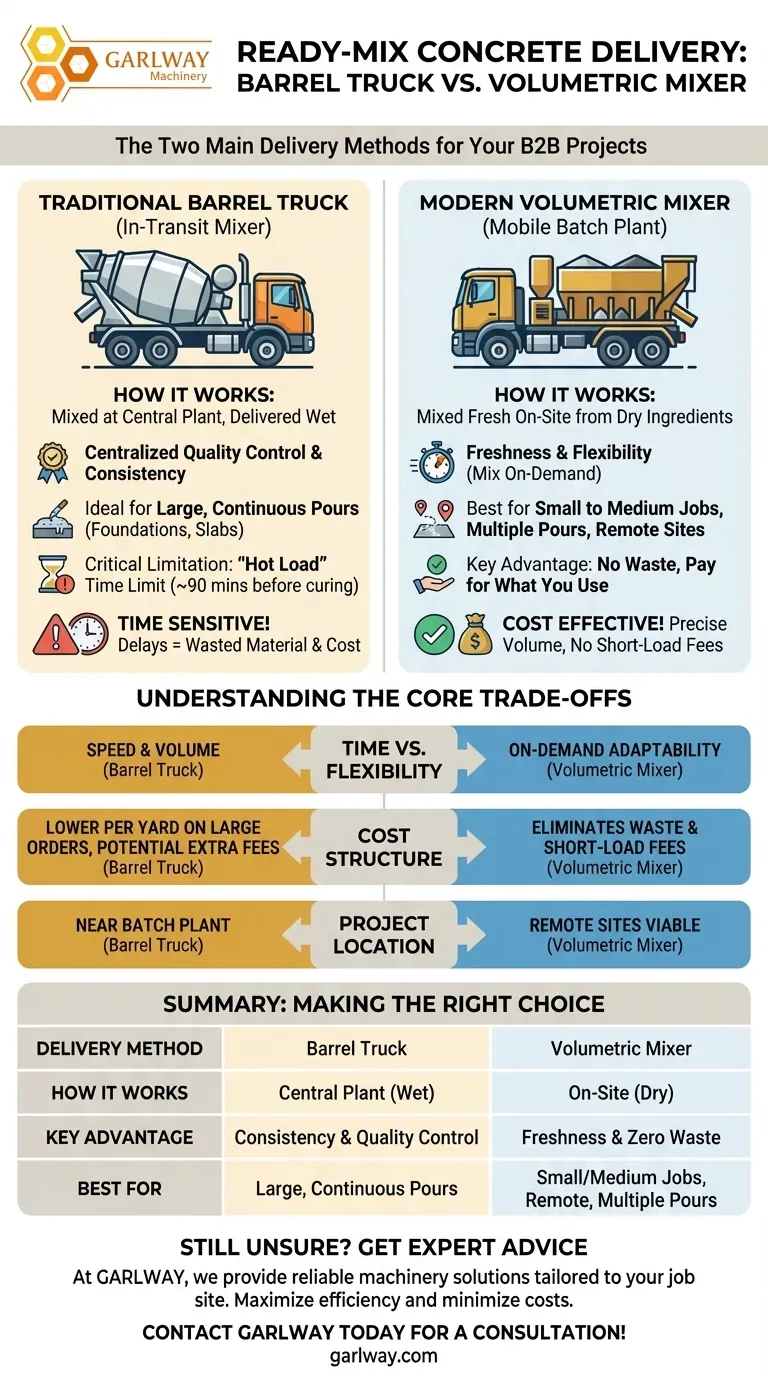
Visual Guide
Related Products
- Ready Mixer Machine for Construction Ready Mix Machinery
- HZS180 Ready Mix Concrete Plant for Foundations with Sand and Cement
- Portable Ready Mix Concrete Mixer Equipment
- HZS120 Ready Mix Concrete Batching Plant Commercial Mud Cement Mixer
- Skid Steer Self Loading Concrete Mixers for Construction
People Also Ask
- What are the purposes of low-speed agitation in truck mixers? Preserve Concrete Quality During Transit
- How is ready-mixed concrete transported from a commercial concrete batching plant? Ensuring Quality & Timely Delivery
- What are the main ingredients mixed in a concrete mixer truck? Master the Formula for Strong Concrete
- In what ways does a mobile concrete mixer improve quality control and consistency? Achieve Superior On-Site Concrete Quality
- What types of construction projects typically use concrete mixer trucks? From Highways to Home Foundations





