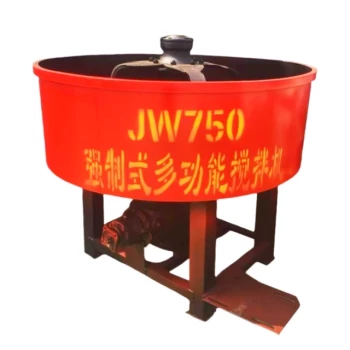
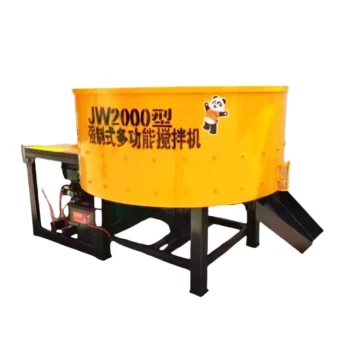
To answer your question directly, the two main categories of concrete mixers discussed are volumetric mixers and traditional drum mixers (also known as rear or front discharge mixers). These represent two fundamentally different approaches to producing and delivering concrete.
The most critical distinction is not just the mixer's shape, but its core operating principle: whether it prepares a single, large batch in advance (batch mixing) or produces fresh concrete continuously on-site as needed (volumetric mixing).
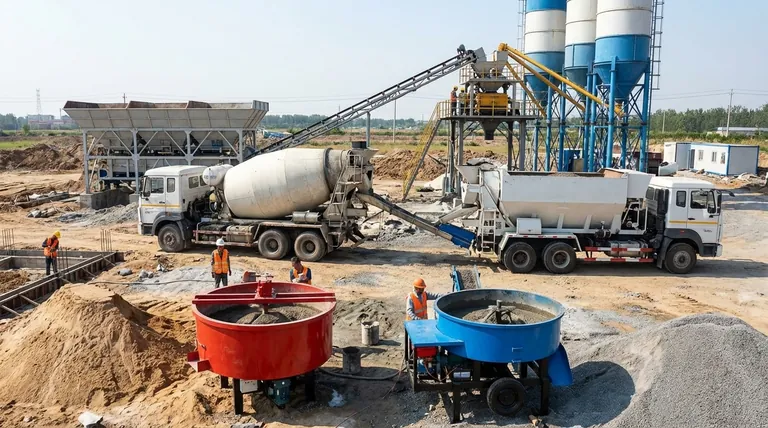
The Fundamental Divide: How Concrete is Mixed
Understanding the operational method is the key to differentiating concrete mixers. All types fall into one of two primary working principles.
Batch Mixers (The Traditional Approach)
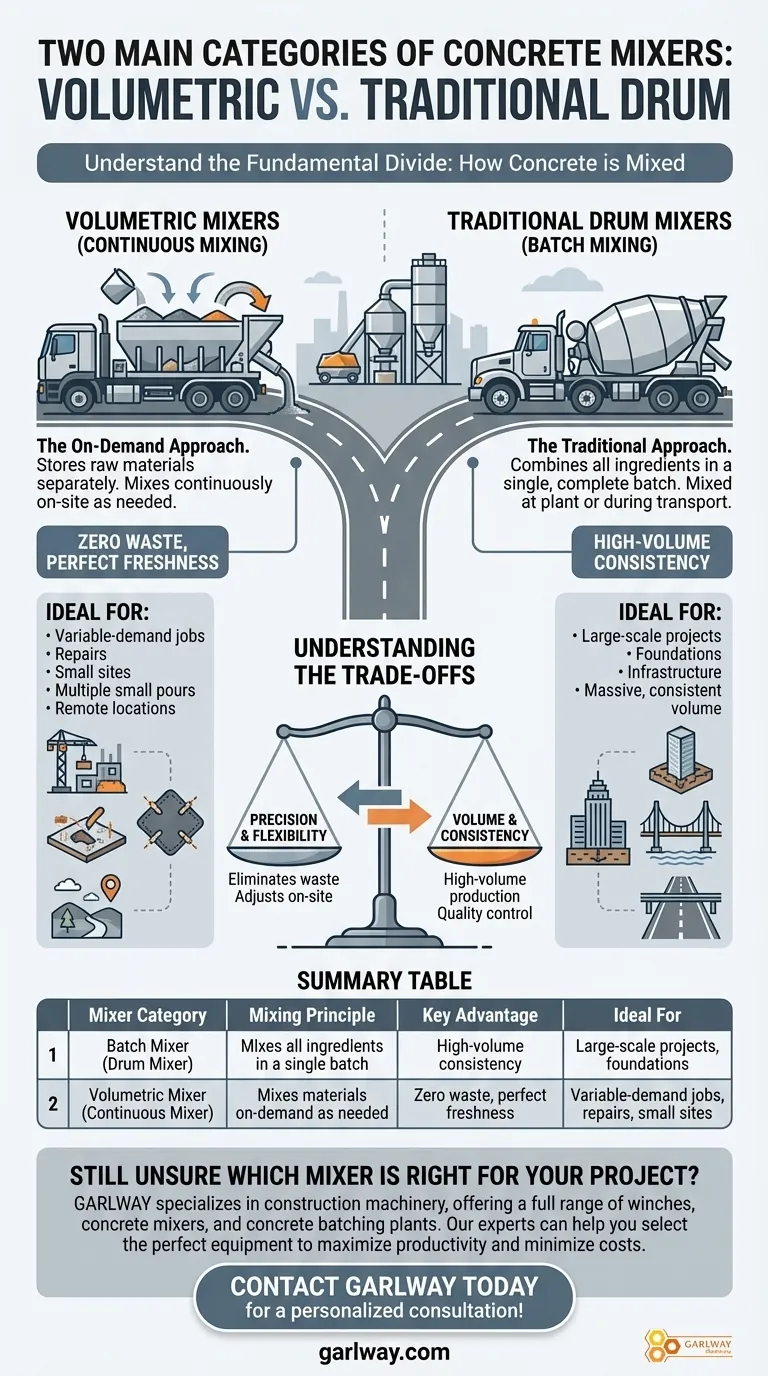
A batch mixer combines all the necessary ingredients—cement, sand, aggregate, and water—in fixed quantities to create a single, complete batch of concrete.
This entire batch is mixed at once, either at a central plant or in a rotating drum on a truck during transport. This is the most common method for large-scale production.
Traditional drum mixers on trucks are the most visible example of a mobile batch mixing system.
Continuous Mixers (The On-Demand Approach)
A continuous mixer stores raw materials in separate compartments and mixes them continuously as the concrete is being discharged.
This process allows for the on-demand production of fresh concrete right at the job site. The operator can start and stop the mixing process at any time.
Volumetric mixers are the definitive example of a continuous mixer, acting as mobile batch plants that measure materials by volume.
The Second Layer: Where the Mixing Happens
Beyond the mixing method, the location of the mixer adds another layer of classification that defines its role in a project.
Stationary Mixers (The Central Hub)
These are large, fixed-in-place mixers, often the core component of a concrete batching plant.
They are designed for high-volume, highly consistent production. The mixed concrete is then discharged into truck mixers for transport to various job sites.
Mobile Mixers (Flexibility in the Field)
This category includes any mixer mounted on a vehicle. It’s crucial to recognize that this includes both operational types.
A traditional truck mixer is a mobile batch mixer. A volumetric mixer is a mobile continuous mixer. The choice between them depends entirely on the project's needs for volume, freshness, and flexibility.
Understanding the Trade-offs
Neither system is universally superior; they are engineered for different tasks. The choice involves clear trade-offs.
Consistency vs. Freshness
Plant-batched concrete, produced in a stationary mixer, offers exceptional consistency and quality control. However, the clock is ticking from the moment it's mixed, risking issues if there are travel or on-site delays.
Volumetric mixers eliminate this risk entirely. The concrete is always perfectly fresh, as it's mixed seconds before being poured.
Volume vs. Precision
Batching plants are unmatched for producing massive volumes of concrete required for large foundations or infrastructure.
Volumetric mixers excel in precision. They eliminate waste by producing the exact amount needed, making them ideal for jobs with uncertain quantities, repair work, or multiple small pours.
Upfront Planning vs. On-Site Flexibility
Using traditional drum mixers requires precise calculation and ordering ahead of time. Over-ordering leads to costly waste, and under-ordering leads to delays.
Volumetric mixers offer unparalleled flexibility. Since materials are mixed on-site, you can adjust the volume and even the mix design on the fly, paying only for what you use.
Making the Right Choice for Your Project
Selecting the right mixer is a matter of aligning the technology with your primary objective.
- If your primary focus is massive, consistent volume for a large project: A stationary batch plant supplying traditional drum trucks is the most efficient solution.
- If your primary focus is eliminating waste and ensuring freshness for variable-demand jobs: A volumetric (continuous) mixer provides unmatched precision and on-site flexibility.
- If your primary focus is working on multiple small, remote, or repair sites in one day: The on-demand nature of a volumetric mixer is the clear choice.
Ultimately, understanding the core difference between batch and continuous mixing empowers you to select the right tool for the job.
Summary Table:
| Mixer Category | Mixing Principle | Key Advantage | Ideal For |
|---|---|---|---|
| Batch Mixer (Drum Mixer) | Mixes all ingredients in a single batch | High-volume consistency | Large-scale projects, foundations |
| Volumetric Mixer (Continuous Mixer) | Mixes materials on-demand as needed | Zero waste, perfect freshness | Variable-demand jobs, repairs, small sites |
Still unsure which concrete mixer is right for your project?
GARLWAY specializes in construction machinery, offering a full range of winches, concrete mixers, and concrete batching plants for construction companies and contractors globally. Whether you need the high-volume efficiency of a batch plant or the on-site flexibility of a volumetric mixer, our experts can help you select the perfect equipment to maximize productivity and minimize costs.
Contact GARLWAY today for a personalized consultation and let us build a solution tailored to your needs!
Visual Guide
Related Products
- Portable Concrete Mixer Machine Equipment for Mixing Concrete
- Construction Products Concrete Plant Machine Mixing Concrete Mixer
- Portable Electric Concrete Mixer Machine for Cement Mixing
- JZC400 Mobile Small Concrete Mixer Cement Mixer Machine
- Hydraulic Concrete Mixer Machine Cement Mixing Equipment for Mixture Concrete
People Also Ask
- Why is it necessary to use a portable concrete mixer? Gain Total Control & Efficiency
- How much concrete can you pour with a portable mixer? Find the Perfect Fit for Your Project
- What types of projects are portable concrete mixers suitable for? Ideal for DIY & Small-Scale Construction
- How much does a portable concrete mixer hold? A Guide to Choosing the Right Capacity
- What types of portable concrete mixers exist? Find the Perfect Mixer for Your Project