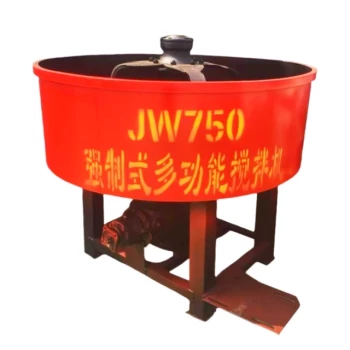
At its core, a road-specific Roller-Compacted Concrete (RCC) mixing plant is defined by its massive output and continuous operation. Key specifications include a production capacity of 800 tons per hour and the use of a high-efficiency twin-shaft continuous mixer to achieve this volume.
This equipment is not just a concrete mixer; it is a high-volume material production system engineered to meet the relentless pace of large-scale paving operations, where a consistent, uninterrupted flow of material is critical for project success.
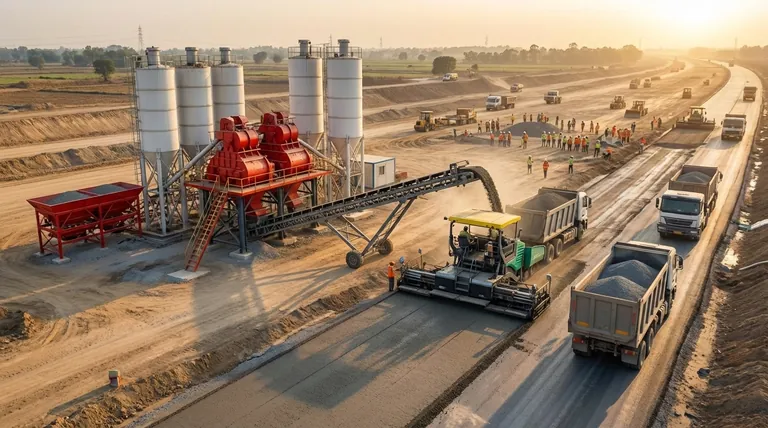
Deconstructing the Core Specifications
To understand the value of this plant, we must look beyond the numbers and analyze what these specifications mean in a practical, operational context.
The 800 Tons/Hour Production Capacity
This figure signifies an exceptionally high production rate. It is designed to continuously feed large paving machines without causing costly delays.
This level of output is essential for major infrastructure projects, such as highways, airport runways, and dams, where speed and efficiency directly impact budget and timelines.
The Twin-Shaft Continuous Mixer
The heart of the plant is its twin-shaft continuous mixer. Unlike a batch mixer that produces concrete in discrete loads, a continuous mixer works non-stop.
Raw materials are fed in one end, and a steady, homogenous stream of RCC or stabilized material flows out the other. This design is the key to achieving both high volume and consistent quality, which is critical for the structural integrity of a road surface.
The "Road-Specific" Advantage
The design choices in this plant are deliberate, tailored specifically for the unique demands of modern road construction.
Continuous Output for Paving Operations
Paving equipment works most effectively when it moves continuously. Any stop or delay can create a "cold joint" in the pavement, which is a potential weak point.
This plant's ability to provide an uninterrupted supply of material ensures the paver can maintain a constant speed, resulting in a smoother, stronger, and more durable surface.
Material Versatility for Road Layers
Modern roadbeds are complex structures built in layers. This plant's value is amplified by its ability to produce more than just the final RCC surface course.
It can be configured to produce other essential road-building materials, such as cement-stabilized soil and cement-stabilized gravel, for the sub-base and base layers. This makes it a single, versatile solution for the entire pavement structure.
Understanding the Trade-offs
While powerful, this plant's specialized design comes with important considerations. It is a specific tool for a specific job.
Focus on Volume, Not Batch Flexibility
This is an industrial-scale production line, not a jobbing plant. It is optimized to produce a massive quantity of a single, consistent mix design.
It is less suited for projects requiring many small, different batches of concrete, a task better handled by traditional batching plants.
Significant Logistical Footprint
A plant capable of producing 800 tons per hour is a substantial piece of equipment. It requires significant site preparation, a large footprint, and a well-organized logistical chain to keep it supplied with aggregates, cement, and water.
Its efficiency is directly tied to the ability to continuously feed its raw material bins. Any interruption in the supply chain will halt the entire paving operation.
Making the Right Choice for Your Project
Selecting the right mixing plant depends entirely on the scale and nature of your construction goals.
- If your primary focus is large-scale highway or runway construction: This plant's high-volume, continuous output is perfectly matched to the demands of large paving equipment.
- If your project involves building the entire road structure from the ground up: Its versatility in producing both stabilized base materials and RCC makes it an incredibly efficient central asset.
- If your work consists of smaller, varied projects like residential streets or repair work: A more mobile and flexible batching plant would be a more practical and cost-effective choice.
Ultimately, choosing the right equipment means aligning its core capabilities with the operational flow and scale of your project.
Summary Table:
| Specification | Key Feature | Operational Impact |
|---|---|---|
| Production Capacity | 800 tons per hour | Supports continuous, high-volume paving operations for highways and runways. |
| Mixer Type | Twin-shaft continuous mixer | Ensures a non-stop, homogenous flow of RCC or stabilized materials. |
| Material Versatility | Produces RCC, cement-stabilized soil, and gravel | A single solution for constructing the entire roadbed structure. |
Ready to power your next large-scale paving project?
GARLWAY specializes in providing robust construction machinery, including high-capacity concrete batching plants for construction companies and contractors globally. Our road-specific RCC mixing plants are engineered to deliver the uninterrupted output and material consistency your project demands, ensuring you meet tight deadlines and budget goals.
Contact our experts today to discuss how a GARLWAY mixing plant can be the cornerstone of your project's success.
Visual Guide

Related Products
- HZS35 Small Cement Concrete Mixing Batch Plant
- Construction Products Concrete Plant Machine Mixing Concrete Mixer
- HZS120 Ready Mix Concrete Batching Plant Commercial Mud Cement Mixer
- HZS180 Ready Mix Concrete Plant for Foundations with Sand and Cement
- HZS75 Concrete Batching Plant Cement Mixer Price Concrete Mixer Bunnings Mixing Plant
People Also Ask
- Why buy concrete batch plant parts only from the manufacturer? Protect Your Investment and Maximize Uptime
- Why is proper maintenance important for a concrete batch mix plant? Maximize Uptime & Profitability
- What is the advantage of a mobile concrete batching plant? Achieve On-Site Production & Total Control
- What are the advantages and disadvantages of concrete batching plants? Maximize Quality & Efficiency
- What are the two methods of material charging in a concrete mixing station? Single vs. Multiple Charging Explained