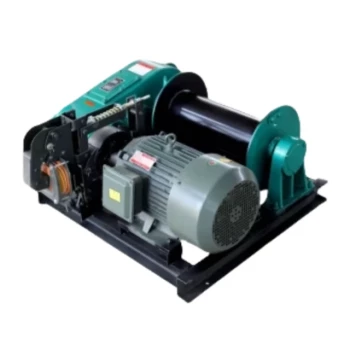
At its core, a high-speed winch is a specialized tool for two primary domains: industrial material handling and vehicle recovery. In an industrial context—such as construction, mining, or railways—it excels at the rapid vertical lifting and horizontal dragging of materials. For vehicle recovery and utility work, it is used for pulling stuck vehicles from obstacles like mud or snow and moving heavy objects.
The term "high-speed" is relative; the true value of these winches lies in their ability to balance pulling power with operational velocity. Your choice of winch should always be dictated by whether your specific task prioritizes the speed of the pull or the sheer force required to move the load.
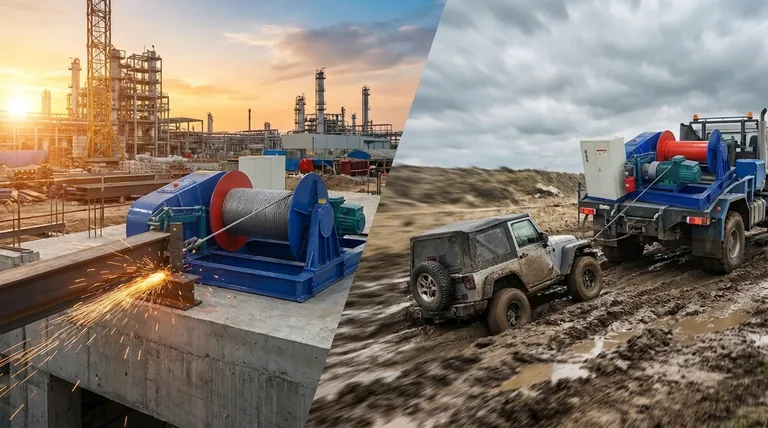
The Two Primary Fields of Use
A high-speed winch is not a one-size-fits-all solution. Its design is optimized for applications where time is a critical factor, and the loads, while heavy, are within the winch's specific operational capacity.
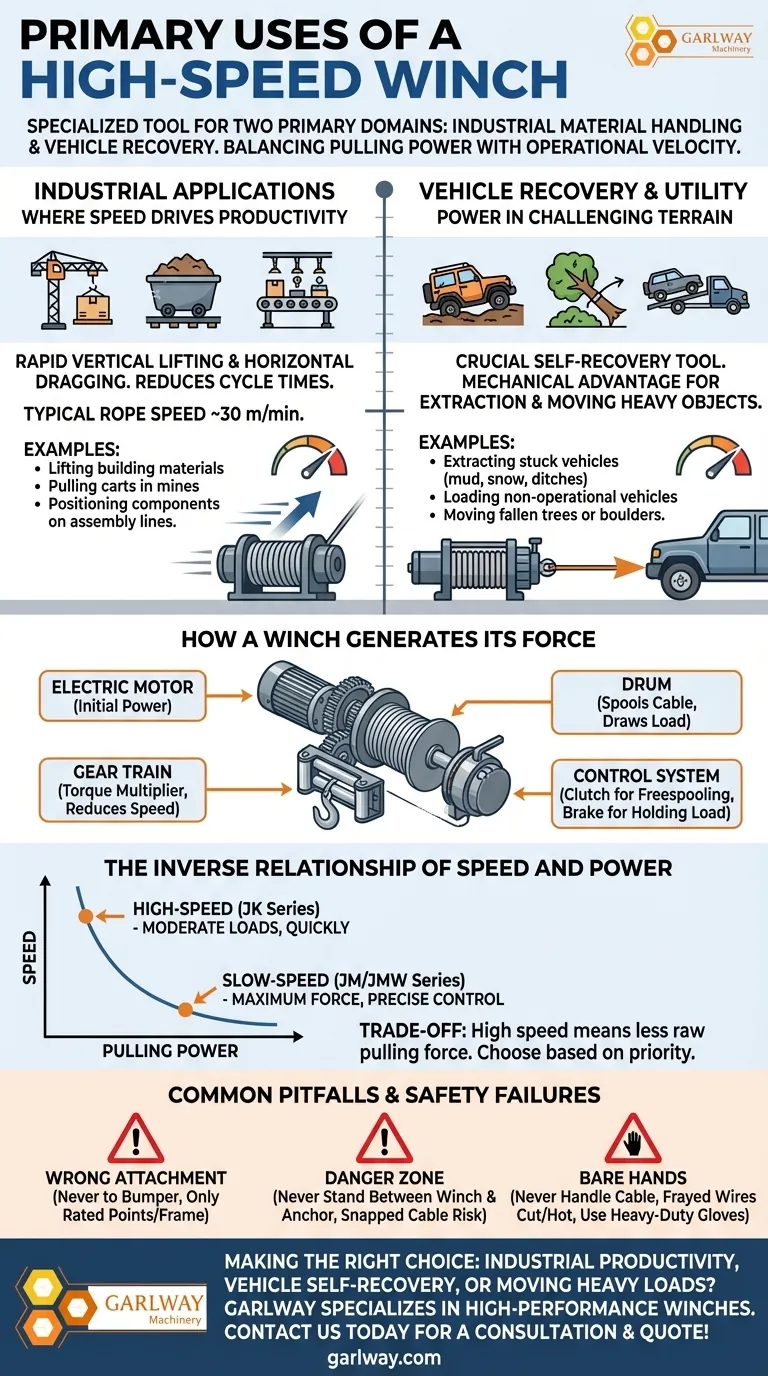
Industrial Applications: Where Speed Drives Productivity
In settings like construction sites, factories, and hydroelectric projects, efficiency is paramount. A high-speed winch, with a typical rope speed around 30 meters per minute, significantly reduces cycle times for lifting and moving goods.
This makes it ideal for repetitive tasks like lifting building materials to upper floors, pulling carts along a track in a mine, or positioning components on an assembly line.
Vehicle Recovery & Utility: Power in Challenging Terrain
For off-road enthusiasts and utility workers, a winch is a crucial self-recovery tool. It provides the mechanical advantage needed to extract a vehicle from mud, sand, snow, or a ditch.
Beyond recovering your own or another's vehicle, these winches are also used for tasks like loading a non-operational vehicle onto a trailer or carefully moving heavy obstacles like fallen trees or boulders from a path.
How a Winch Generates Its Force
Understanding the core components of a winch helps clarify how it performs its work. Each part plays a critical role in converting motor power into a controlled, powerful pull.
The Motor and Gear Train
The electric motor provides the initial power. This power is then fed into a gear train, which acts as a torque multiplier. The gear reduction process increases pulling force at the cost of rotational speed.
The Drum and Cable
The drum is the spool that the steel cable or synthetic rope winds onto. As the drum turns, it pulls the cable in, drawing the load closer.
The Control System
The clutch allows the operator to disengage the drum from the gear train, enabling the cable to be pulled out freely by hand (a process called "freespooling"). The brake system automatically engages to hold the load securely when the motor is not pulling.
Understanding the Trade-offs
Choosing a winch isn't just about finding the fastest or strongest model. It's about understanding the inherent engineering compromises, especially between speed and power, and always prioritizing safety.
The Inverse Relationship of Speed and Power
For a given motor, there is a direct trade-off between speed and pulling power. A winch geared for high speed will typically have less raw pulling force than a slow-speed winch with the same motor.
High-speed models (often designated as JK series) are designed for moving moderate loads quickly. Slow-speed models (like the JM or JMW series) are built for deliberate, heavy pulls where control and maximum force are more important than velocity.
Common Pitfalls and Safety Failures
The speed and power of a winch make it inherently dangerous if misused. Always adhere to strict safety protocols.
Never attach the winch hook to a non-structural point like a bumper. Always connect it to a rated recovery point or the vehicle's frame. Additionally, avoid standing between the winch and its anchor point, as a snapped cable can cause severe injury.
Finally, never handle the winch cable with bare hands. Frayed steel wires can cause deep cuts, and the cable can become hot during operation. Always use heavy-duty gloves.
Making the Right Choice for Your Goal
Your decision should be guided by the primary task you need to accomplish. Different goals demand different winch capabilities.
- If your primary focus is industrial productivity: You need a high-speed winch designed for rapid, repetitive lifting and pulling to maximize operational efficiency.
- If your primary focus is vehicle self-recovery: A winch with a high line speed can be beneficial, but you must ensure its load capacity is at least 1.5 times your vehicle's gross weight.
- If your primary focus is moving extremely heavy or delicate loads: Prioritize a slow-speed winch that offers maximum pulling power and precise control over raw speed.
Ultimately, understanding the balance between speed and power is the key to selecting the right winch and executing your task safely and effectively.
Summary Table:
| Application | Primary Use | Key Characteristic |
|---|---|---|
| Industrial | Rapid lifting & dragging of materials | High rope speed (~30 m/min) for efficiency |
| Vehicle Recovery | Pulling stuck vehicles from mud/snow | Self-recovery tool for challenging terrain |
| Utility Work | Moving heavy obstacles (e.g., fallen trees) | Provides mechanical advantage for heavy loads |
Need a reliable winch for your construction or recovery needs?
GARLWAY specializes in high-performance construction machinery, including robust winches designed for demanding industrial and vehicle recovery applications. Our experts can help you select the right model to balance speed and power for your specific project, ensuring safety and maximum productivity.
Contact GARLWAY today for a personalized consultation and quote!
Visual Guide
Related Products
- Quick Windlass Portable Winch for Truck and Boat Best Boat Winch
- Electric and Hydraulic Winch for Heavy Duty Applications
- Heavy Duty Electric Boat Winch Windlass Anchor
- Electric 120V Boat Winch by Badlands
- 12000 lb Heavy Duty Electric Boat Winch
People Also Ask
- What features were incorporated into the upgraded portable winch system? Boost Your Recovery Power & Safety
- What are some uses mentioned for portable winches beyond vehicle recovery? Essential Versatility for Property & Work
- How could the twisting issue with a portable winch be mitigated? Achieve Safe, Centered Pulls with Proper Rigging
- What are the primary uses of a portable winch for a truck? Boost Your Truck's Capability and Self-Reliance
- What is the single rope traction force of the quick winch without a pulley block? 0.5 to 40 Tons Explained