
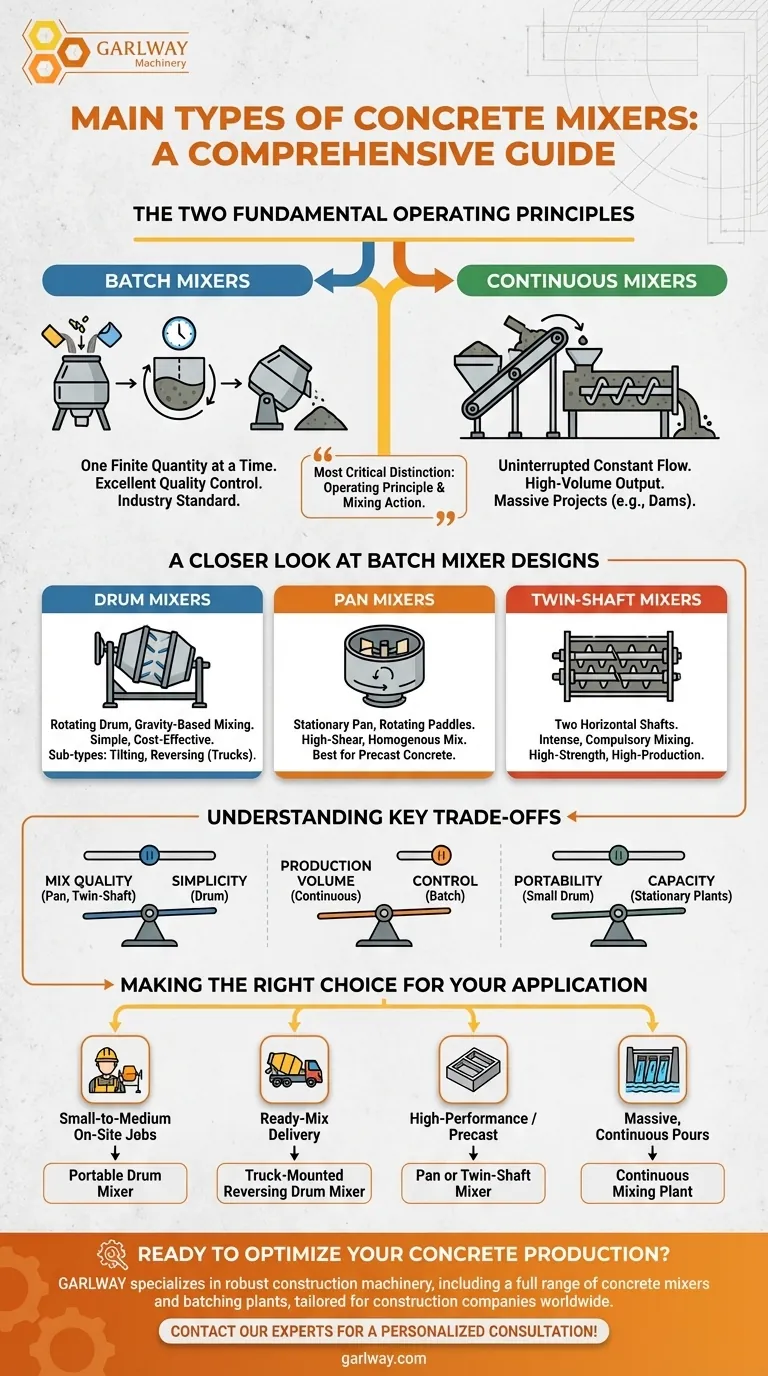
At its core, the vast array of concrete mixers can be organized into two fundamental operational types: Batch Mixers, which produce concrete one specific volume at a time, and Continuous Mixers, which produce a constant flow. Within these categories, the primary designs include drum mixers, pan mixers, and twin-shaft mixers, each suited for different applications and scales.
The most critical distinction is not just the mixer's shape, but its operating principle—batch versus continuous—and its mixing action. Your project's required quality, volume, and logistical constraints will determine which combination is the correct tool for the job.
The Two Fundamental Operating Principles
Every concrete mixer falls into one of two primary categories based on how it processes materials. Understanding this distinction is the first step in selecting the right equipment.
Batch Mixers: The Industry Standard
Batch mixers are the most common type. They are designed to mix a single, finite quantity of concrete, with all ingredients loaded in a specific sequence before mixing begins.
Once the mixing cycle is complete, the entire batch is discharged. This method offers excellent control over the consistency and quality of each individual load.
Continuous Mixers: For High-Volume Output
Continuous mixers operate without interruption. Raw materials are continuously fed into the machine, mixed, and then discharged in a constant stream.
This type is ideal for massive construction projects like dams, large foundations, or pavement production where a very large and uninterrupted supply of concrete is necessary.
A Closer Look at Batch Mixer Designs
Most mixers you will encounter are batch mixers. Their internal design dictates the mixing action, which directly impacts the quality, speed, and type of concrete they can produce effectively.
Drum Mixers
This is the most recognizable type of mixer, featuring a rotating drum with fixed fins or paddles on the inside. The rotation lifts and tumbles the materials to combine them.
Sub-types include tilting drum mixers, which tilt down to discharge, and non-tilting or reversing drum mixers, which reverse their rotation to push the concrete out. Concrete transit trucks are a common example of reversing drum mixers.
Pan Mixers
Pan mixers use a stationary cylindrical pan while paddles, or "stars," rotate inside on a vertical axis. This creates a high-shear, forced-mixing action, scraping the sides and floor of the pan.
This design is highly effective for producing homogenous, high-quality mixes and is frequently used in precast concrete plants where consistency is paramount.
Twin-Shaft Mixers
As the name implies, these mixers use two horizontal shafts with attached paddles that rotate in opposite directions within a stationary trough.
This creates an intense, compulsory mixing action that is extremely fast and thorough. Twin-shaft mixers are known for producing very uniform, high-strength concrete and are a standard in high-production ready-mix and precast plants, particularly in Europe.
Understanding the Key Trade-offs
No single mixer is universally superior. The right choice always involves balancing performance, cost, and logistics.
Mix Quality vs. Simplicity
Drum mixers are simple and cost-effective but rely on gravity, which can sometimes lead to less uniform mixtures. Pan and twin-shaft mixers provide a forced, high-shear action that guarantees a more consistent and homogenous product, but at a higher cost and complexity.
Production Volume vs. Control
Continuous mixers offer unmatched output volume for large-scale projects. However, batch mixers provide superior control over the mix design and quality of each specific load, making them more versatile for most construction scenarios.
Portability vs. Capacity
Small, portable drum mixers are perfect for on-site, small-batch work. Larger systems, like stationary pan mixers or batching plants built around twin-shaft mixers, offer massive capacity but are fixed installations. Truck mixers offer a unique compromise, delivering large batches directly to the point of use.
Making the Right Choice for Your Application
Your project goals should guide your selection.
- If your primary focus is small-to-medium on-site jobs: A portable drum mixer offers the best balance of cost, convenience, and sufficient quality.
- If your primary focus is delivering ready-mix concrete: A truck-mounted reversing drum mixer is the industry standard for transport and mixing.
- If your primary focus is producing high-performance or precast concrete: A pan or twin-shaft mixer is necessary to achieve the required consistency and strength.
- If your primary focus is massive, continuous pours: A continuous mixing plant is the only efficient solution for the required volume.
Ultimately, matching the mixer's core function to the specific demands of your project ensures efficiency, quality, and cost-effectiveness.
Summary Table:
| Mixer Type | Key Feature | Best For |
|---|---|---|
| Batch Mixer | Mixes one finite quantity at a time | Standard construction, quality control |
| Continuous Mixer | Produces a constant, uninterrupted flow | Large-scale projects (dams, pavements) |
| Drum Mixer | Rotating drum; gravity-based mixing | On-site jobs, ready-mix delivery |
| Pan Mixer | Stationary pan with rotating paddles | High-quality, precast concrete |
| Twin-Shaft Mixer | Two shafts for intense, compulsory mixing | High-strength, high-volume production |
Ready to Optimize Your Concrete Production?
Choosing the right concrete mixer is critical for your project's efficiency, quality, and budget. GARLWAY specializes in providing robust construction machinery, including a full range of concrete mixers and batching plants, tailored for construction companies and contractors worldwide.
We can help you select the perfect equipment—whether it's a portable drum mixer for on-site flexibility or a high-capacity twin-shaft system for a precast plant—to ensure you achieve consistent, high-quality results.
Let's discuss your specific needs and find the ideal solution for your operation.
Contact our experts today for a personalized consultation!
Visual Guide
Related Products
- Portable Concrete Mixer Machine Equipment for Mixing Concrete
- Construction Products Concrete Plant Machine Mixing Concrete Mixer
- Portable Electric Concrete Mixer Machine for Cement Mixing
- JZC400 Mobile Small Concrete Mixer Cement Mixer Machine
- Hydraulic Concrete Mixer Machine Cement Mixing Equipment for Mixture Concrete
People Also Ask
- Why is it necessary to use a portable concrete mixer? Gain Total Control & Efficiency
- How much concrete can you pour with a portable mixer? Find the Perfect Fit for Your Project
- What types of projects are portable concrete mixers suitable for? Ideal for DIY & Small-Scale Construction
- How much does a portable concrete mixer hold? A Guide to Choosing the Right Capacity
- What types of portable concrete mixers exist? Find the Perfect Mixer for Your Project






